Back to Blog
Enterprise AI TCO: When a Successful Rollout Becomes a Budgeting Problem

November 17, 2026
•
AI Strategy


Ask what workplace AI costs and you will usually hear a price per seat. Ask again a year into a successful rollout and the answer can look very different. For the same everyday work, new research puts the monthly cost of a single AI user anywhere between $30 and $205, depending largely on how the vendor charges for usage. That gap is what enterprise AI TCO is really about, and it raises a question most business cases never ask: what happens to the bill when people actually use the tool?
That question sits at the heart of new research published by GigaOm on 1 November 2026, Demystifying the TCO of Enterprise AI. Its central claim is simple, and worth repeating to anyone signing off on an AI budget: the value of workplace AI is best judged by the outcomes it drives, not by the price of a single prompt or a single seat.
Enterprise AI TCO (total cost of ownership) is the full cost of running AI across an organisation over time: licences or access fees, usage-based charges, governance and integration, and the effort needed to make people productive with it. It differs from the sticker price because most of these costs only appear once adoption takes off.
That last point is the uncomfortable one. With traditional software, a licence is a licence: the cost of a seat does not change whether someone opens the application once a month or fifty times a day. Generative and agentic AI broke that assumption. Every prompt, every document summarised and every agentic workflow consumes compute, and vendors have chosen very different ways of passing that cost on to customers.
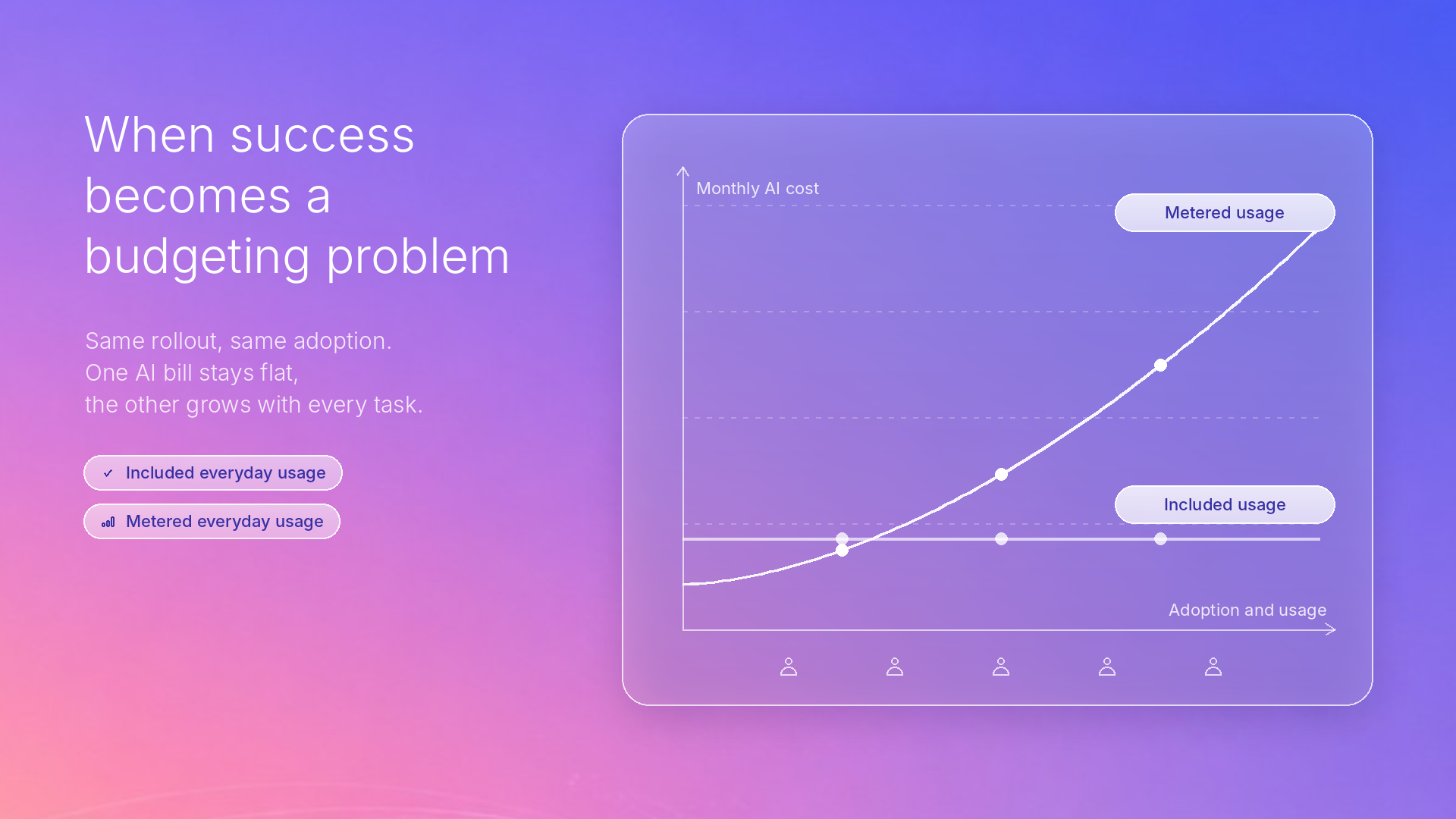
The price per seat is a poor guide to enterprise AI TCO because AI vendors now use fundamentally different pricing models. Broadly, there are two. In the first, a subscription buys access, and all AI usage is charged on top, usually through credits or tokens. In the second, the subscription includes everyday AI usage, and only advanced capabilities, such as long-running agentic workflows, are billed by consumption.
On paper, the first model often looks cheaper. A lower monthly fee is easy to approve. But it shifts the risk to the customer: the more successful the rollout, the more the organisation pays. As the GigaOm report puts it, when everyday usage is metered, "a successful rollout then becomes a budgeting problem".
This is not a theoretical concern. Gartner warned in September 2024 that "500 to 1000 percent errors of AI cost estimates are possible" when organisations do not understand how AI costs scale. In June 2026, the analyst firm went further, predicting that through 2028, at least 50% of GenAI projects will overrun their budgeted costs because of poor architectural choices and a lack of operational know-how.
GigaOm tested three enterprise AI products hands-on in October 2026: Microsoft Copilot, Claude Enterprise and ChatGPT Enterprise. It is worth being transparent about the study's origins, as the report itself is: it was commissioned and paid for by Microsoft, with Microsoft running the testing and GigaOm shaping the research design and validating the method, results and conclusions.
The setup was deliberately practical. All three products worked on the same fictional company, with the same data, across 37 prompts covering chat, Word, Excel, PowerPoint and agentic "cowork" workflows. Each prompt was run up to 10 times in fresh sessions, and every output was checked against a validation list covering correct sources, facts and figures, complete deliverables and instruction following.
The researchers then modelled two typical users. The everyday AI user relies on AI as an assistant: finding information, preparing for meetings, drafting documents and analysing data, roughly 100 tasks a month. The advanced AI user does all of that and also delegates complex, multi-step work to agents, such as an analyst whose agent tracks market signals, assesses the impact on forecasts and produces a briefing for leadership. That profile came to roughly 140 tasks a month, including 20 agentic workflows.
Under the report's assumptions, monthly cost per user ranged from $30 to $299 for the same work, depending on the product and the type of user. The table below summarises the modelled results, based on list or assumed prices in October 2026.
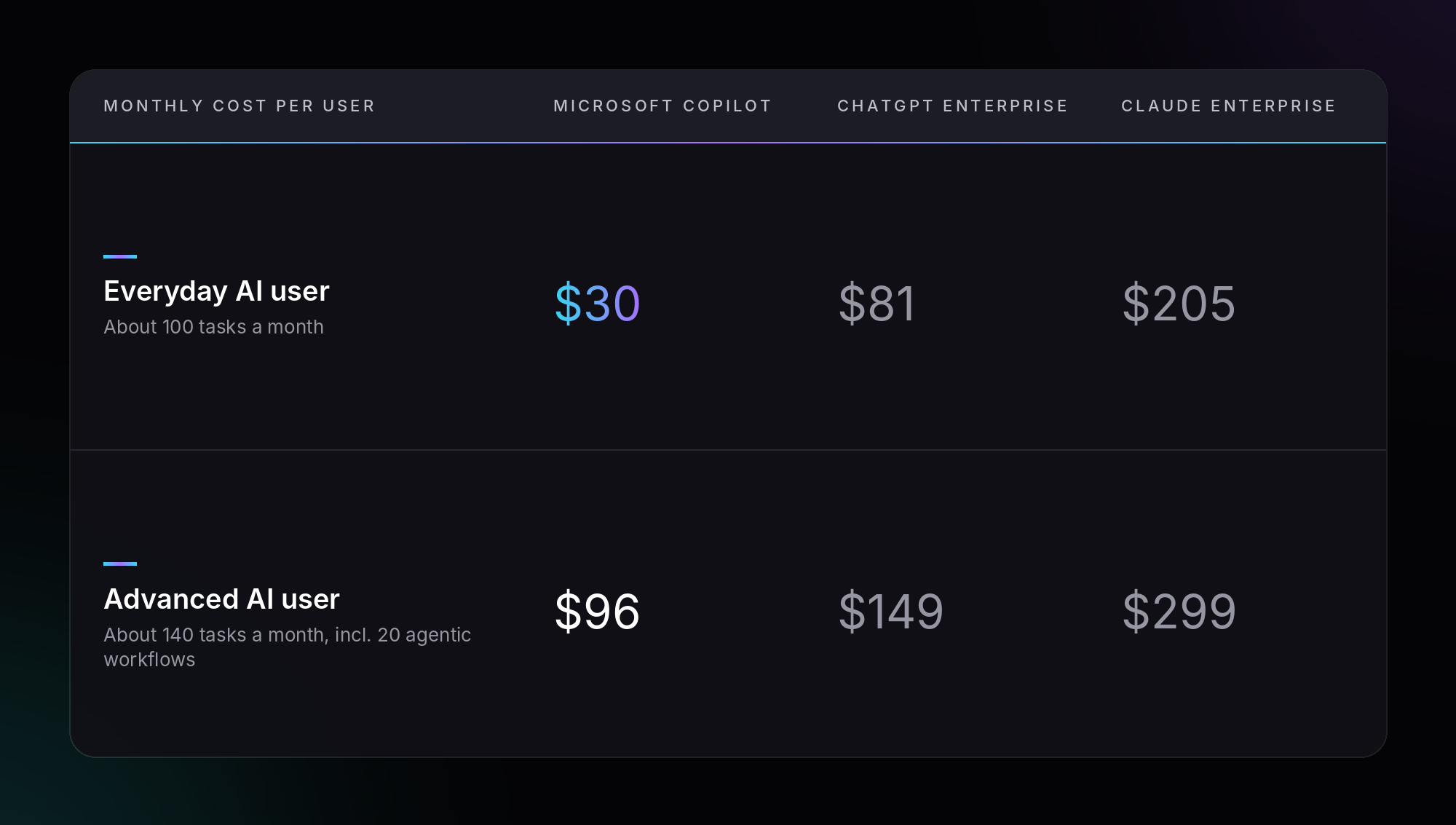
Source: GigaOm, Demystifying the TCO of Enterprise AI, November 2026. Modelled estimates, not invoices; excludes negotiated discounts.
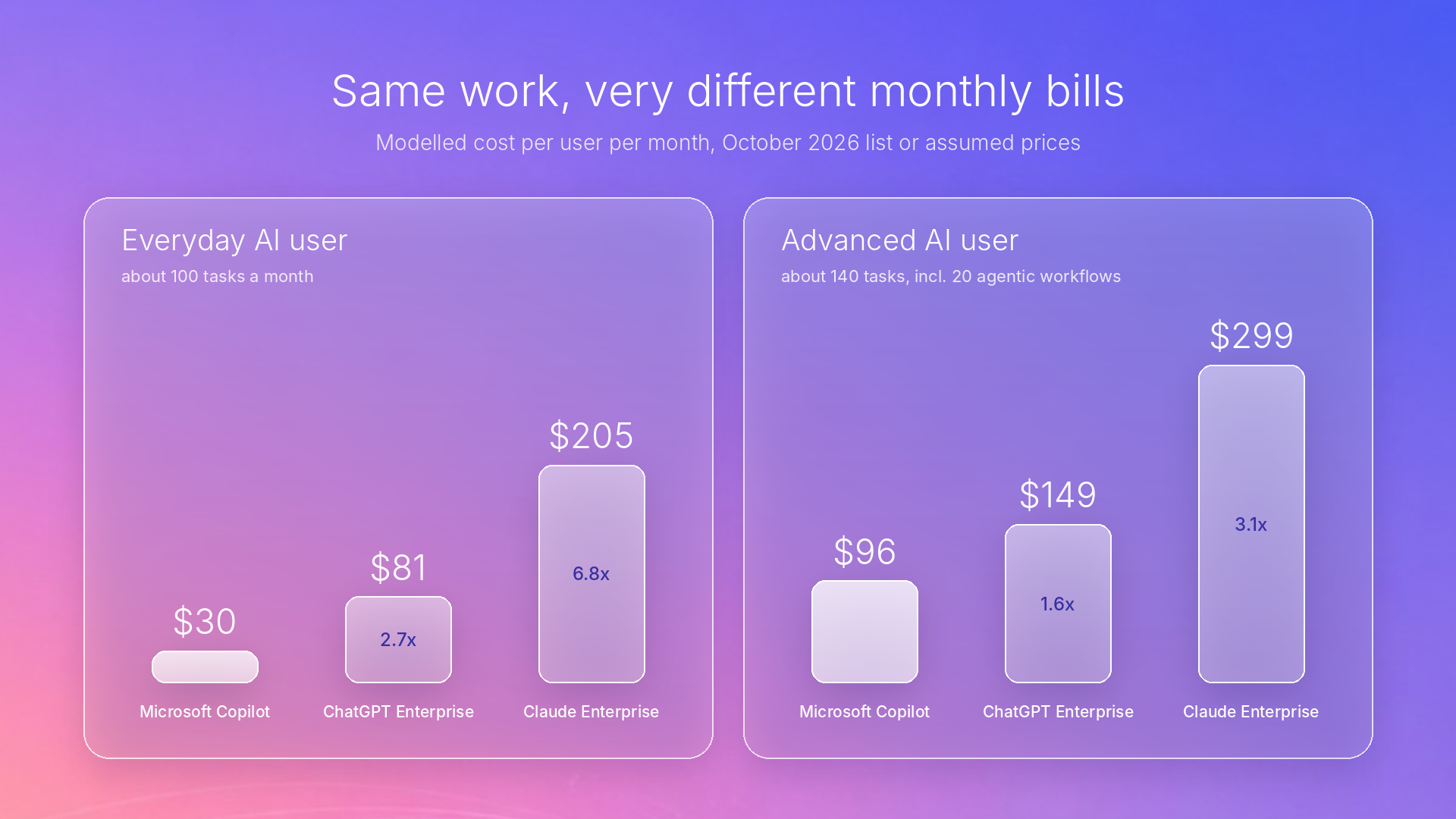
For the everyday user, Copilot's cost stayed at its $30 subscription because chat and Microsoft 365 app usage is included. ChatGPT came to more than 2.5 times that figure and Claude to more than six times. For advanced users, the gap narrowed but held: ChatGPT cost more than 1.5 times as much and Claude more than three times. Crucially, output quality was broadly comparable across the three products on the tested tasks, so the cost difference did not buy better results.
A quick piece of arithmetic shows why this matters at scale. For an organisation with 1,000 everyday AI users, the modelled difference between $30 and $205 a month adds up to more than $2 million a year, before a single agent has been deployed. That is our own illustration, not a figure from the report, and real numbers will depend on negotiated pricing and workloads. But it shows how quickly a per-task cost becomes a board-level line item.
Model selection is one of the least visible drivers of enterprise AI TCO. The report found that in Claude and ChatGPT, every request incurred the rate of the selected premium model, so even quick lookups and short rewrites were billed at premium prices. Users can switch to lighter models, but that requires them to understand which model and effort level gives good enough quality for each task, which is not a reasonable expectation for most employees.
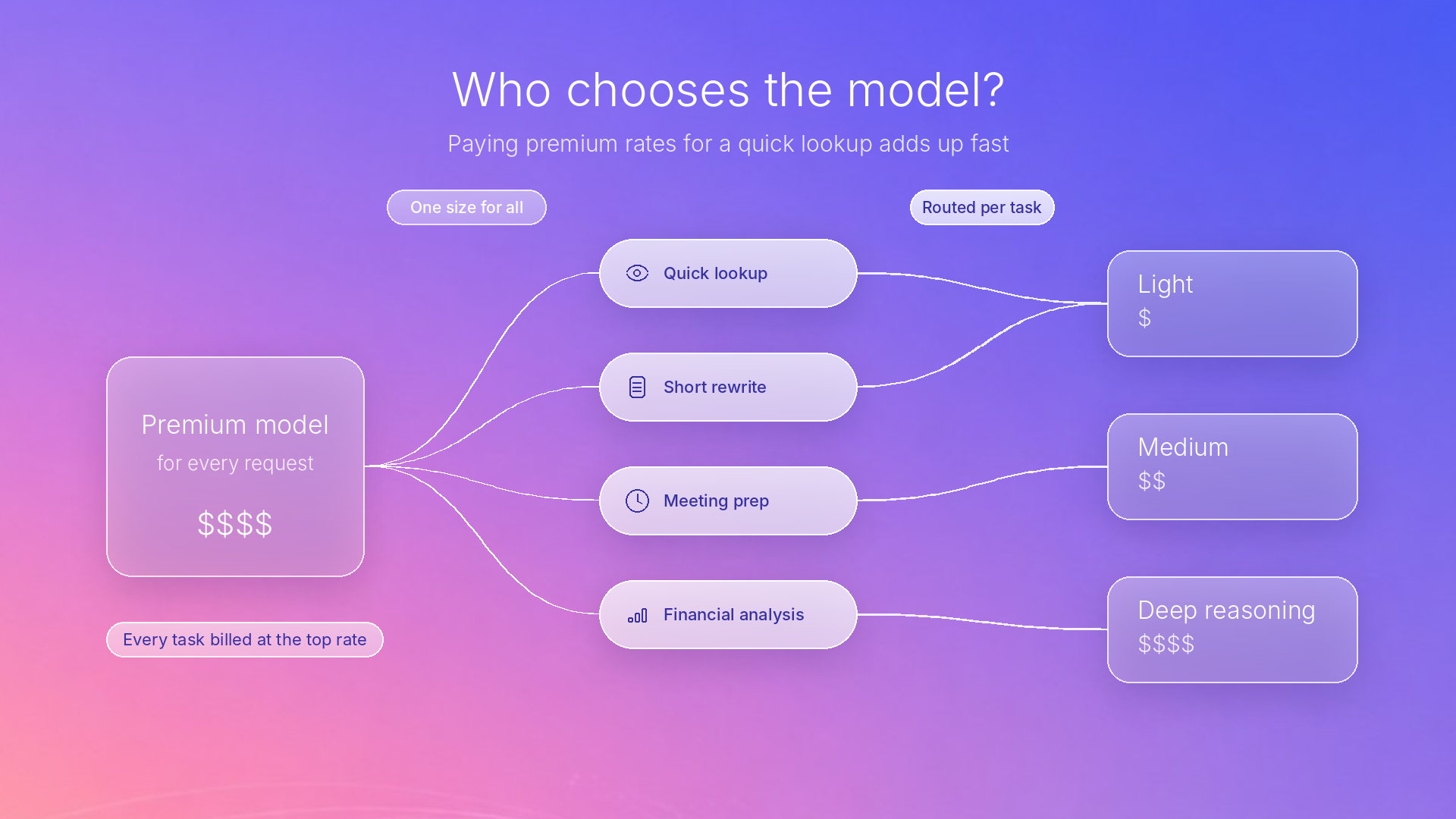
Copilot handles this through Auto mode, which routes each request to a suitable model and effort level, balancing quality, speed and cost. A short rewrite is treated differently from an in-depth financial analysis. We explored the wider shift towards matching intelligence to the task in The End of One-Size-Fits-All AI Spend; this research puts a price on getting it wrong.
A price comparison is only one layer of enterprise AI TCO, and the GigaOm report is candid about what it did not measure. The products differ in how they operate inside an enterprise environment. Copilot runs within Microsoft 365, respecting existing permissions and sensitivity labels, and can be governed by Microsoft Purview data loss prevention policies. Tools that connect to Microsoft 365 through connectors and add-ins retrieve content and process it in their own services, under their own terms. For a regulated European organisation, that difference carries real cost: extra legal review, additional data protection assessments, and governance work that never shows up on a vendor invoice. Our security and governance work with clients regularly starts here.
The other cost that rarely appears in a business case is unused capability. A licence that sits idle has a TCO with no return at all. This is why the value side of the equation deserves as much rigour as the cost side, and why adoption belongs in any honest TCO calculation.
The strongest evidence for AI value comes from organisations that measured time saved and translated it into money. Lumen Technologies estimates that Copilot saves its sellers an average of four hours a week, which the company equates to $50 million a year (Microsoft, July 2024). At Vodafone, an analysis in the legal department found that Microsoft 365 Copilot users save on average four hours per week, per person, after a 300-person trial that led to plans to expand access to 68,000 people (Microsoft, December 2024).
At the level of a whole organisation, a Forrester Total Economic Impact study commissioned by Microsoft in March 2025 modelled a composite company of 25,000 employees and found a 116% return on investment for Microsoft 365 Copilot over three years, with a payback period of 10 months and nine hours saved per user per month. These are vendor-commissioned and self-reported figures, so treat them as signals rather than guarantees. What they share is a focus on outcomes rather than on the cost of individual prompts, which is exactly where the GigaOm report lands.
The most reliable way to calculate enterprise AI TCO is to test the tools on your own work, with your own pricing. GigaOm itself stresses that its findings are directional and recommends that organisations repeat the method in their own environment. In practice, that comes down to four layers of cost and four questions.

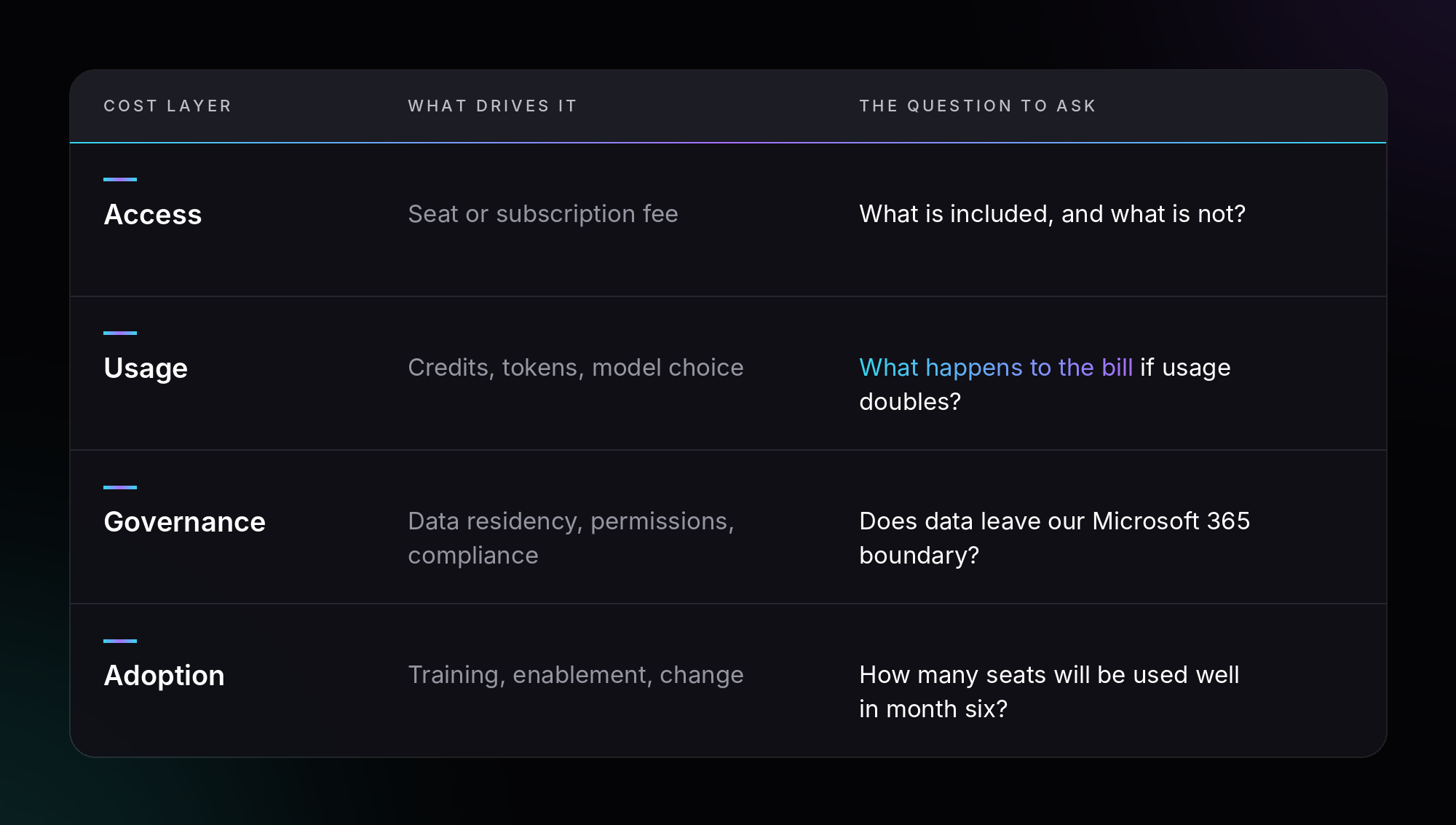
Start with real tasks, not demos. Select the work your people actually do, split into everyday and advanced users, and run each task several times. One-off demos hide variability.
Define quality before you look at price. Agree what a good output looks like, from correct figures to complete deliverables. A cheaper result that needs rework is not cheaper.
Model growth, not just today. Calculate costs at current usage and at two or three times that level. The pricing model that looks cheapest in a pilot can be the most expensive after a successful rollout.
Price in governance and adoption. Add the cost of legal and security review, and the investment needed to get people from occasional use to everyday habit. Programmes such as our Copilot Adoption Accelerator exist precisely because this layer decides whether the rest of the spend pays off.
As AI moves from occasional assistance to the way work gets done, how it is priced can matter as much as what it can do. The organisations that get enterprise AI TCO right will be the ones that stop comparing seat prices and start asking a better question: what does it cost us to complete this piece of work with AI, and how does that cost behave when everyone is using it?
That is also where possibility, governance and adoption meet. The capability is only worth what your people actually do with it, inside guardrails your organisation can defend, at a cost your finance team can predict.
Wondering what your own AI estate really costs, or how it will scale? Talk to our team about building a TCO view based on your own workloads.


Unlock exclusive insights and stay ahead in the digital world. No spam, only useful content.