Back to Blog
Everyone is building an AI second brain. Your organisation still forgets everything.

November 4, 2026
•
Data Management


Think of the most valuable person in your team.
The one who knows why the pricing model works the way it does. Who remembers which supplier let you down in 2023, and how the workaround for the reporting tool came about. Who people message first when something unusual lands on their desk.
Chances are, that person is also building an AI second brain.
Their AI assistant remembers how they like to work. Their notes, meetings and documents are summarised, linked and searchable in seconds. Every month, they get a little faster and a little sharper.
Now imagine they hand in their notice.
Their second brain leaves with them. And your organisation is left with the same problem it has always had, just more visibly: it forgets almost everything it learns.
The idea of a second brain is not new. Productivity writer Tiago Forte popularised it as a personal system for capturing, organising and reusing what you learn, so your head is free to think rather than remember.
For years, that meant discipline: tagging notes, filing documents, keeping folders tidy. Most people gave up after a few weeks.
AI removes most of that effort. An AI second brain captures and organises information for you, and lets you retrieve it simply by asking. Tools such as Copilot Memory allow Microsoft 365 Copilot to remember your preferences and context across conversations, while Work IQ is the intelligence layer that personalises Copilot to you and your organisation.
The result is powerful. Instead of starting from zero every time, your AI starts from what it already knows about you and your work.
But notice who that knowledge belongs to.
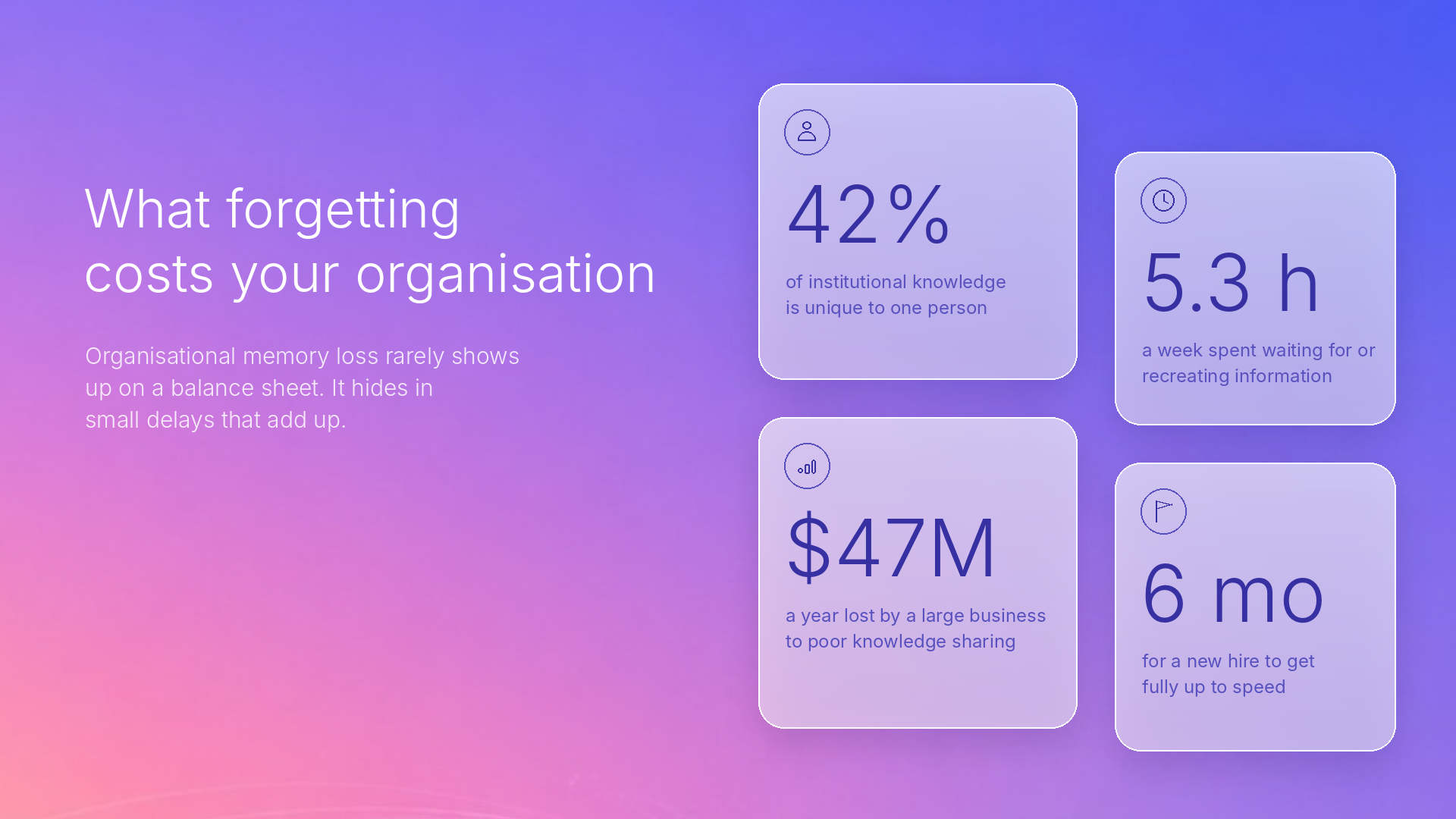
Organisational forgetting rarely shows up on a balance sheet. It hides in small delays: the question nobody can answer, the analysis that gets redone, the new colleague who needs months to find their way.
Add those delays up, and the numbers become hard to ignore.
That research dates from 2018, before generative AI arrived. More recent figures point the same way: a 2021 APQC survey of nearly 1,000 knowledge workers found they still lose 2.8 hours a week simply looking for or requesting the information they need.
Personal AI tools help individuals find their own information faster. They do very little about the knowledge that was never shared in the first place.
Most of the value of AI so far has accrued to individuals. Each person gets better at using it, builds their own habits and accumulates their own context.
The organisation, meanwhile, learns surprisingly little.
Microsoft's 2026 Work Trend Index makes this tension visible. It found that organisational factors such as culture, manager support and talent practices account for 67% of reported AI impact, more than twice as much as individual mindset and behaviour.
Yet even among the most advanced AI users, only 25% say their teams have documented, repeatable workflows at the organisational level. Among everyone else, it is 14%.
In other words, the people who are best at AI are mostly getting better on their own. What they learn rarely becomes something the rest of the organisation can build on.
That is the paradox of the AI second brain. It makes individuals more capable, while leaving the organisation just as forgetful as before. Possibly more so, because so much of the valuable context now sits inside personal AI histories that nobody else can see.
Even the best personal knowledge system misses the knowledge that matters most to an organisation.
The why behind decisions. Documents record what was decided. They rarely record why, which alternatives were rejected, or what would need to change for the decision to be revisited.
The workarounds. Every organisation runs on small fixes that never made it into a process description. The spreadsheet that corrects a system error. The colleague in Finance you call when an invoice gets stuck.
The mistakes. What was tried and failed is often the most valuable lesson of all, and the least likely to be written down.
This is what is usually called tacit knowledge: the experience that lives in people's heads rather than in systems. As engineers at Meta put it, "the most valuable specialist knowledge lives in people's heads and rarely gets captured anywhere durable."
The same technology that powers personal second brains is now being pointed at the organisation itself. And the early results show why this matters.
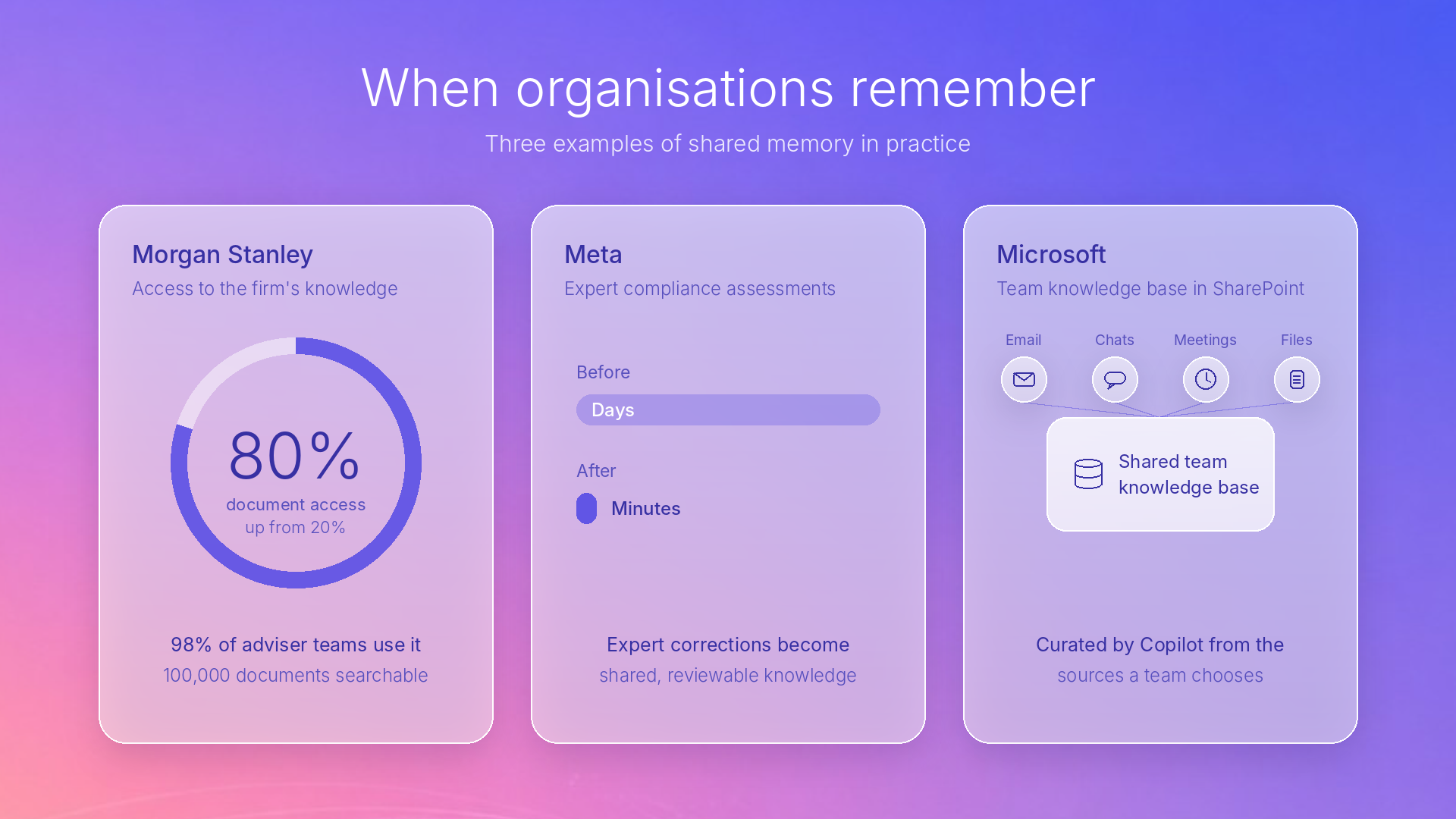
Morgan Stanley: making every adviser as smart as the best one
Morgan Stanley Wealth Management faced a classic memory problem: a vast library of research, guidance and procedures that advisers struggled to navigate. It built an AI assistant on top of that knowledge.
According to the company's case study with OpenAI, access to the firm's documents rose from 20% to 80%, the assistant can now answer questions across a corpus of 100,000 documents, and over 98% of adviser teams use it actively. Follow-ups that used to take days now happen within hours.
Jeff McMillan, who led the programme, summed up the value of organisational memory in one line: "This technology makes you as smart as the smartest person in the organization."
Meta: turning expert judgement into a system that keeps learning
Meta tackled the hardest kind of knowledge: the judgement of specialists. Its engineers built an organisational second brain for compliance reviews, capturing how experts interpret their domain in more than 200 linked knowledge files.
The clever part is how it learns. When an expert corrects the system, that correction becomes a small, reviewable edit to the shared knowledge, rather than a one-off fix. Meta reports that assessments which used to take days now take minutes, and that domain experts rate the output useful almost all the time. In Meta's words, the goal is "a system where expert effort compounds permanently."
Microsoft: shared memory built into everyday tools
What used to require a custom engineering project is now arriving in mainstream workplace tools. In October 2026, Microsoft introduced a team knowledge base curated by Copilot: a library of linked pages in SharePoint that Copilot builds from the emails, meetings, chats and files a team chooses to include. People can read it, and AI can use it as a starting point for its work. It is currently in preview.
Why analysts expect this to scale
In its Top Strategic Technology Trends for 2027, Gartner lists AI context platforms, which give AI the business knowledge it needs to act in line with an organisation's goals, as one of ten defining trends. It predicts that by 2027, organisations that prioritise the meaning and structure of their data could improve the accuracy of agentic AI by up to 80% and reduce costs by up to 60%.
The pattern across all three cases is the same. The value does not come from a smarter model. It comes from an organisation that remembers what its best people know, and makes it available to everyone else.
Building organisational memory is not simply a technical project. It raises questions that most organisations have never had to answer explicitly.
What should be remembered? Not every chat or meeting belongs in a shared memory. Some conversations are exploratory, personal or sensitive, and should stay that way.
Who can see it? A shared knowledge base can make information visible to people who never had access to the original email or file. That is useful, and potentially risky. Access needs to be a conscious decision, not a side effect.
What should be forgotten? Outdated knowledge is worse than no knowledge, because it is trusted. A company brain needs a way to retire information, just as a team needs to update its processes.
Will people trust it? If employees feel that everything they say may be captured and reused, they will share less, not more. Transparency about what is collected and why is a precondition for adoption.
These are questions of responsible AI and culture as much as technology. And they are far easier to answer at the start than after the fact.
The good news is that this does not require a massive knowledge-management programme. Start small and make it part of how work already happens.
Most of these steps are about habits, not tools. That is exactly why they work. Technology can do the capturing and organising; people decide what is worth remembering. Building those habits is at the heart of AI adoption.
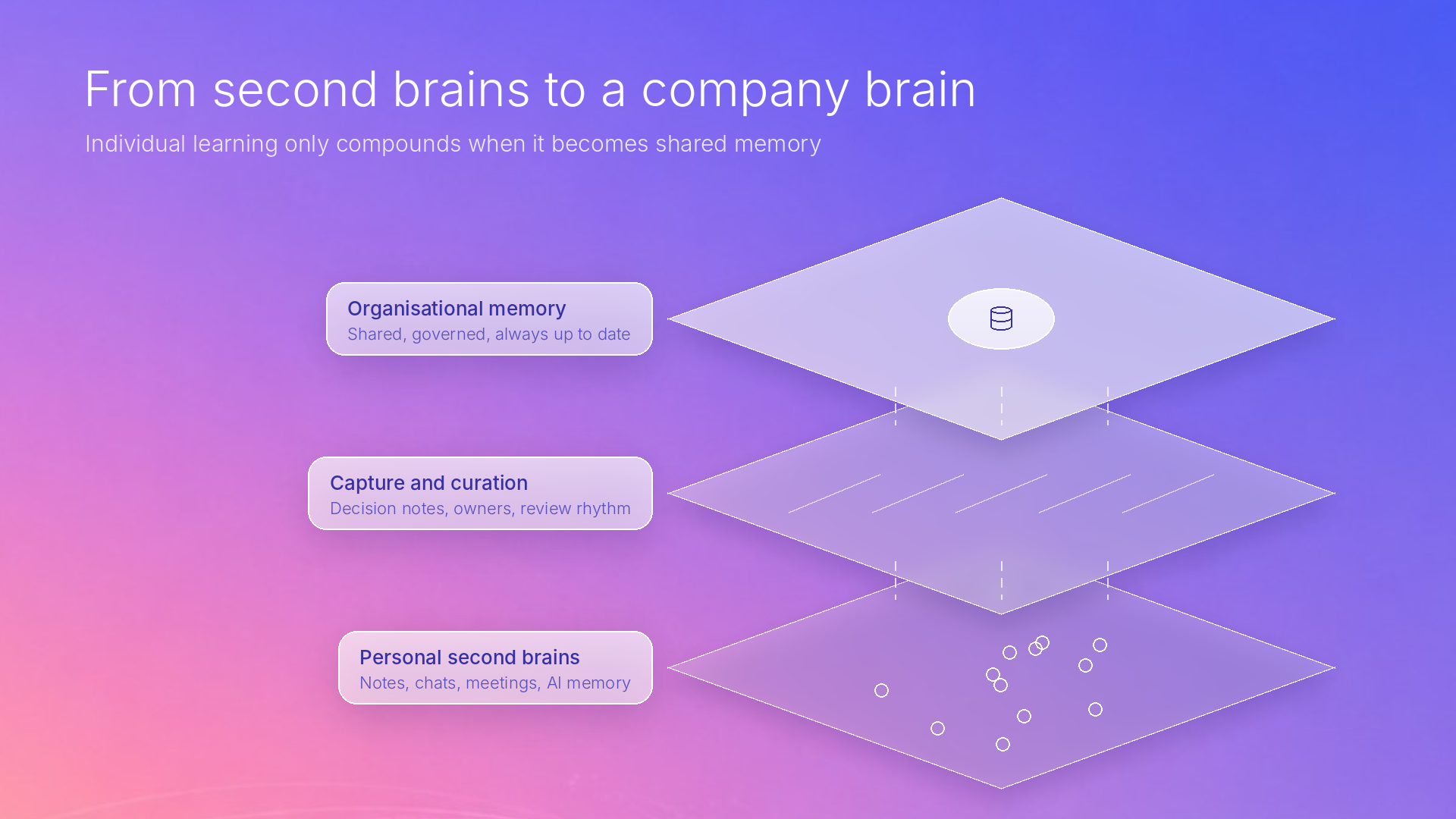
For the past few years, AI conversations have focused on making individuals more productive.
That was the right place to start. But it is not where the lasting advantage lies.
An organisation full of people with brilliant personal second brains is still an organisation that forgets every time someone moves on.
The organisations that pull ahead will be the ones that turn individual learning into shared memory: knowledge that stays when people leave, improves every time it is used, and makes every new colleague smarter from day one.
Everyone is building a second brain.
The real question is whether your organisation is building one too.
Wondering where your organisation's most valuable knowledge is quietly leaking away? Talk to our team and we will help you find the best place to start.


Unlock exclusive insights and stay ahead in the digital world. No spam, only useful content.