Back to Blog
The End of One-Size-Fits-All AI Spend

August 28, 2026
•
AI Strategy


For years, technology budgets were simple. You bought software licences, assigned them to employees, and knew roughly what your monthly bill would be. Whether someone used Excel for eight hours a day or opened it once a week made little difference. The economics were predictable.
AI started in much the same way. The first wave of enterprise AI adoption revolved around per-user licensing. Buy a Microsoft 365 Copilot licence, provide access to employees, and let them work. Simple. But something important has changed. Microsoft's introduction of multiple AI models within Copilot Cowork signals a broader shift in enterprise AI. Users are no longer consuming a single intelligence. They're choosing between different levels of intelligence, reasoning depth, speed and cost characteristics depending on the task in front of them. And that changes everything.
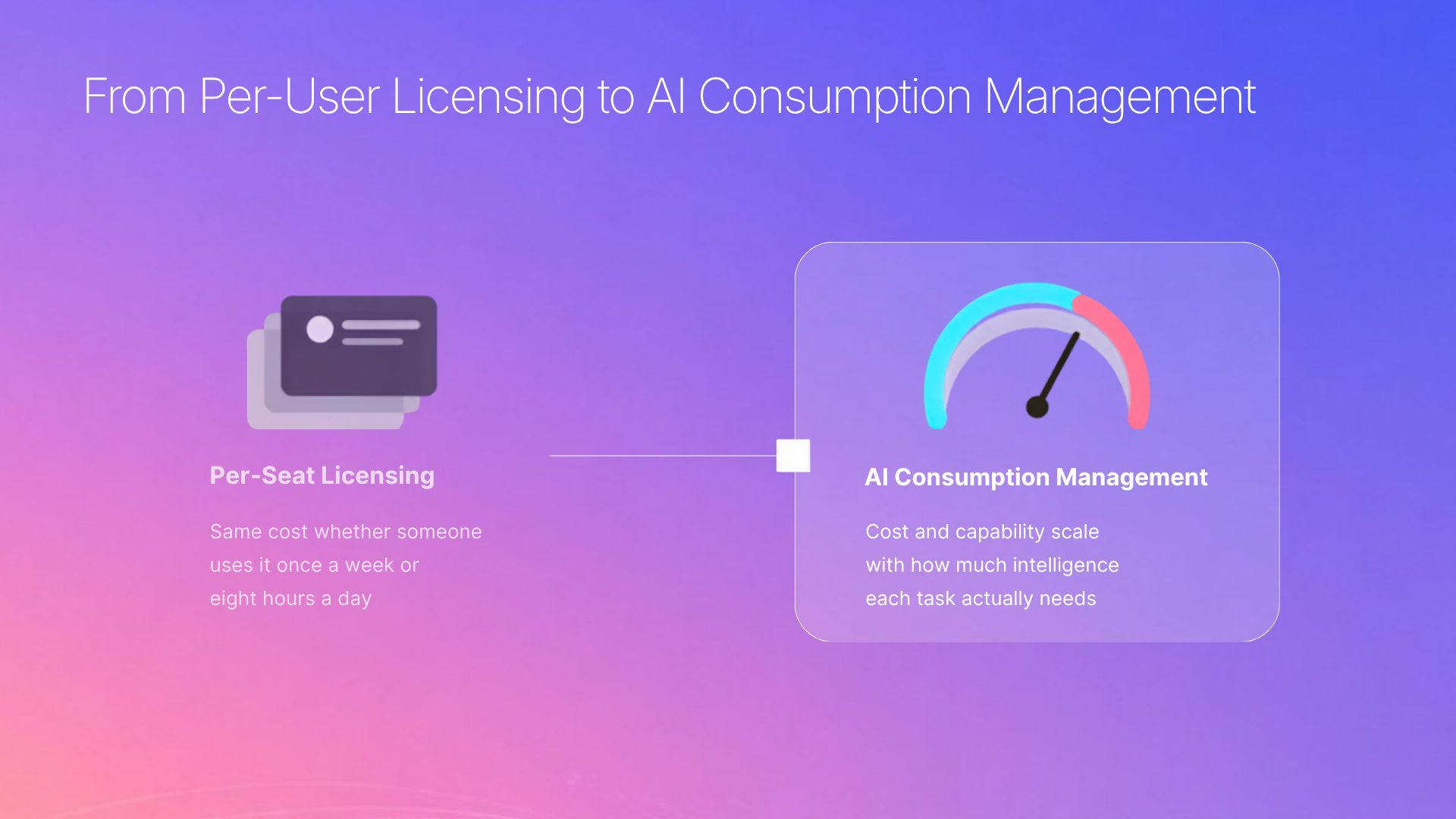
Most organisations are still focused on AI access. How many licences have we purchased? How many employees are using Copilot? What's our adoption rate? Those are useful questions, but increasingly they're not the most important ones. The more strategic question is: Are people using the right level of intelligence for the work they're trying to do?
Think about the difference between asking Copilot to turn an hour-long Teams meeting into five bullet points, rewrite a customer follow-up email, create a draft project update for stakeholders, or analyse three years of financial data and identify risks in a potential acquisition. All of these tasks benefit from AI. But they don't all require the same level of intelligence. A weekly status report is a very different challenge from evaluating a merger. Summarising a conversation is very different from building a board-level business case. Yet many organisations still treat AI as if every task should receive the same amount of computational power and reasoning.
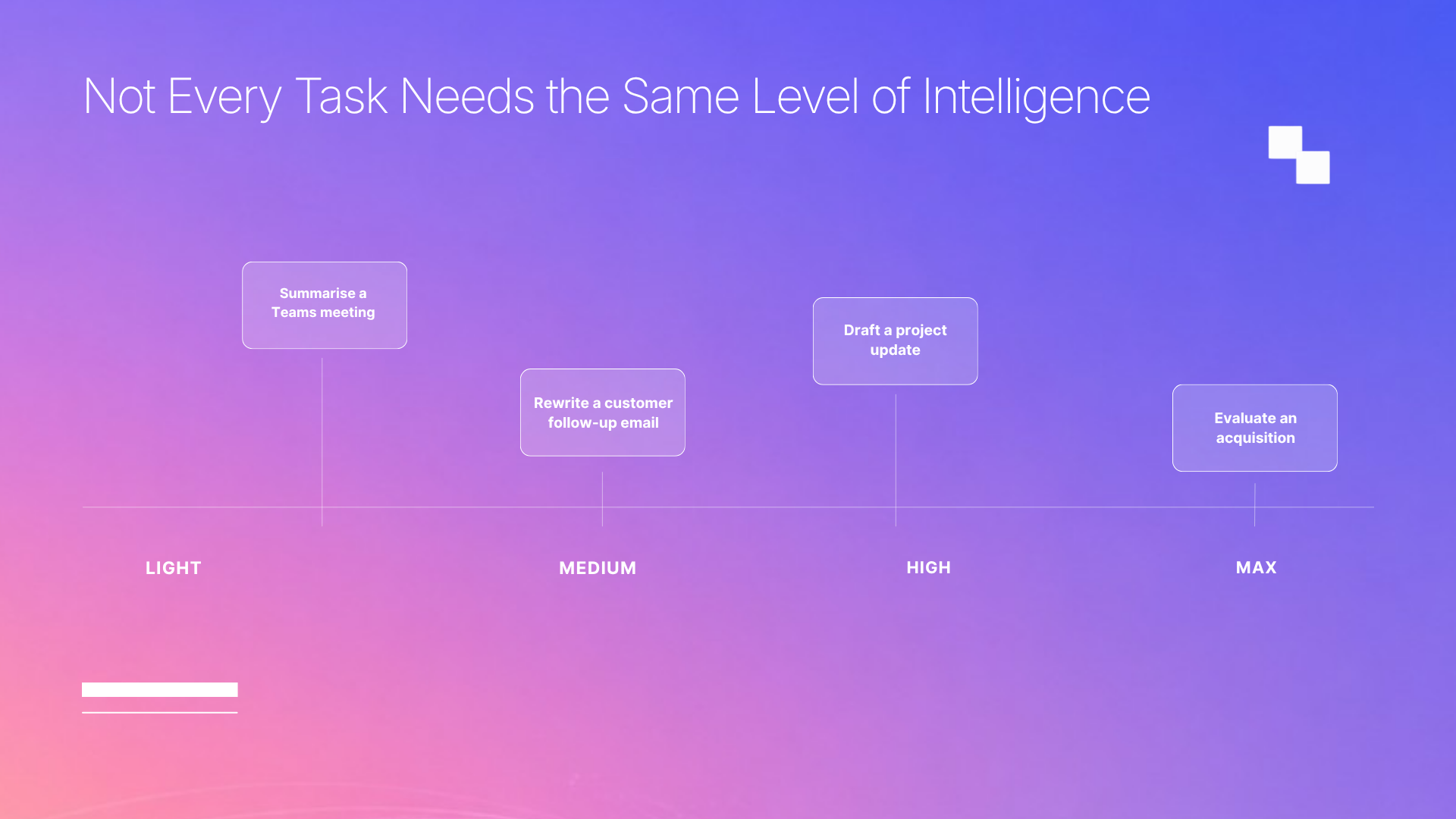
The reality is that not all AI work is equal. And for the first time, Microsoft's model selection capabilities are making this visible to everyday users. Copilot Cowork can automatically select the most appropriate model for a task, while organisations can also enable specialised models designed for everything from rapid drafting to complex reasoning. This is AI consumption management becoming democratised. Not something reserved for data scientists or cloud architects. Something every knowledge worker can participate in.
At first glance, Microsoft's default Auto model selection looks like a convenience feature. In reality, it's much more than that. The enterprise challenge with AI has never been giving people access to intelligence. It's helping them use the appropriate intelligence without introducing unnecessary cost, complexity or risk. Auto effectively abstracts that decision away from the user. Instead of expecting employees to understand the nuances between reasoning models, frontier models and specialised AI engines, the platform selects the most suitable option for the task.
Consider how we already consume technology today. When you open a website, you don't choose which data centre serves the page. When you stream a film, you don't decide which server delivers the content. When you make a Teams call, you don't select the network route that carries your voice. The platform makes those decisions for you.
Microsoft's Auto model selection works in a similar way. If you're asking Copilot to rewrite a document, it may use one level of intelligence. If you're asking it to reason through a complex business challenge, it may choose another. The employee focuses on the outcome, not the underlying technology. In many ways, Auto represents the beginning of intelligent cost optimisation at the productivity layer. The best governance isn't telling people what they can't do. It's enabling them to do the right thing by default.
There's another reason this matters. Most organisations are still operating under an assumption that more intelligence automatically creates more value. That isn't always true. As Jared Spataro argues, much of day-to-day knowledge work reaches a point of saturation. Beyond a certain threshold, additional model capability doesn't create meaningfully better outcomes. It simply consumes more resources.
Imagine asking a Formula 1 team to deliver your groceries. They could absolutely do it. But it would be an expensive way to complete a simple task. That's the risk organisations face with AI. If every request is routed to the most advanced model available, you're paying for capability that often isn't needed. A weekly project status report doesn't suddenly become strategic thinking because it was generated by the most sophisticated reasoning model on the market. A customer email doesn't become more valuable simply because more computational power was applied to it. At some point, additional intelligence produces diminishing returns. Or put another way: Using the most powerful AI model for every task is like sending a management consultant to change a lightbulb. The work gets done. The economics don't make sense.
This is what we mean by intelligence inflation: applying expensive AI capability to work that simply doesn't require it. The organisations that understand this earliest will be the ones that generate the greatest value from their AI investments.
This is where governance starts to evolve. Traditional governance focused on access and security. Who can use the tool? What data can they see? What policies apply? Those questions still matter. But now organisations must also think about optimisation. Which models should be available? When should advanced models be enabled? How do we balance innovation with consumption control?
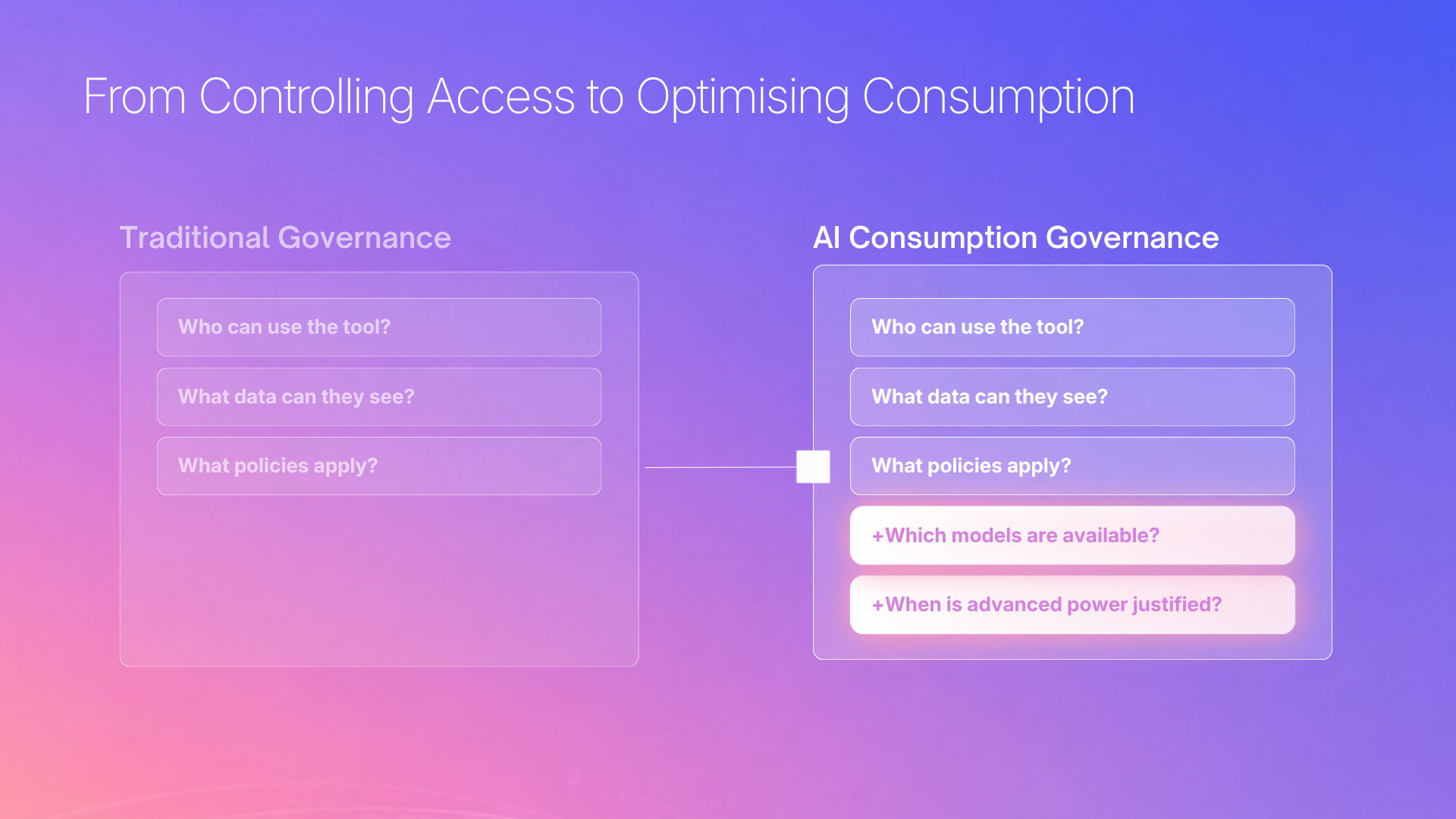
Microsoft has already built many of these controls into the platform. Administrators can determine which model families are available and decide whether specialised or preview models should be enabled through organisation-wide Cowork governance settings. The technology is there. The challenge is operational. Most organisations don't yet have a framework for deciding how AI consumption should be governed, measured and optimised. That's where a new governance conversation begins. Not around restriction, around intentionality.
This is exactly where many AI programmes begin to stall. The technology works. Employees are engaged. Adoption is increasing. Yet leaders struggle to answer a deceptively simple question: Are we generating value efficiently?
We increasingly see successful AI adoption as a balance between possibility, governance and adoption. The emergence of model choice inside Microsoft 365 Copilot brings a fourth dimension into sharper focus: consumption management. We often compare this to the way organisations manage cloud infrastructure. Not every application needs the most powerful server available. Not every business system requires the highest performance environment. The goal is simply to match resources to requirements. AI is heading in the same direction.
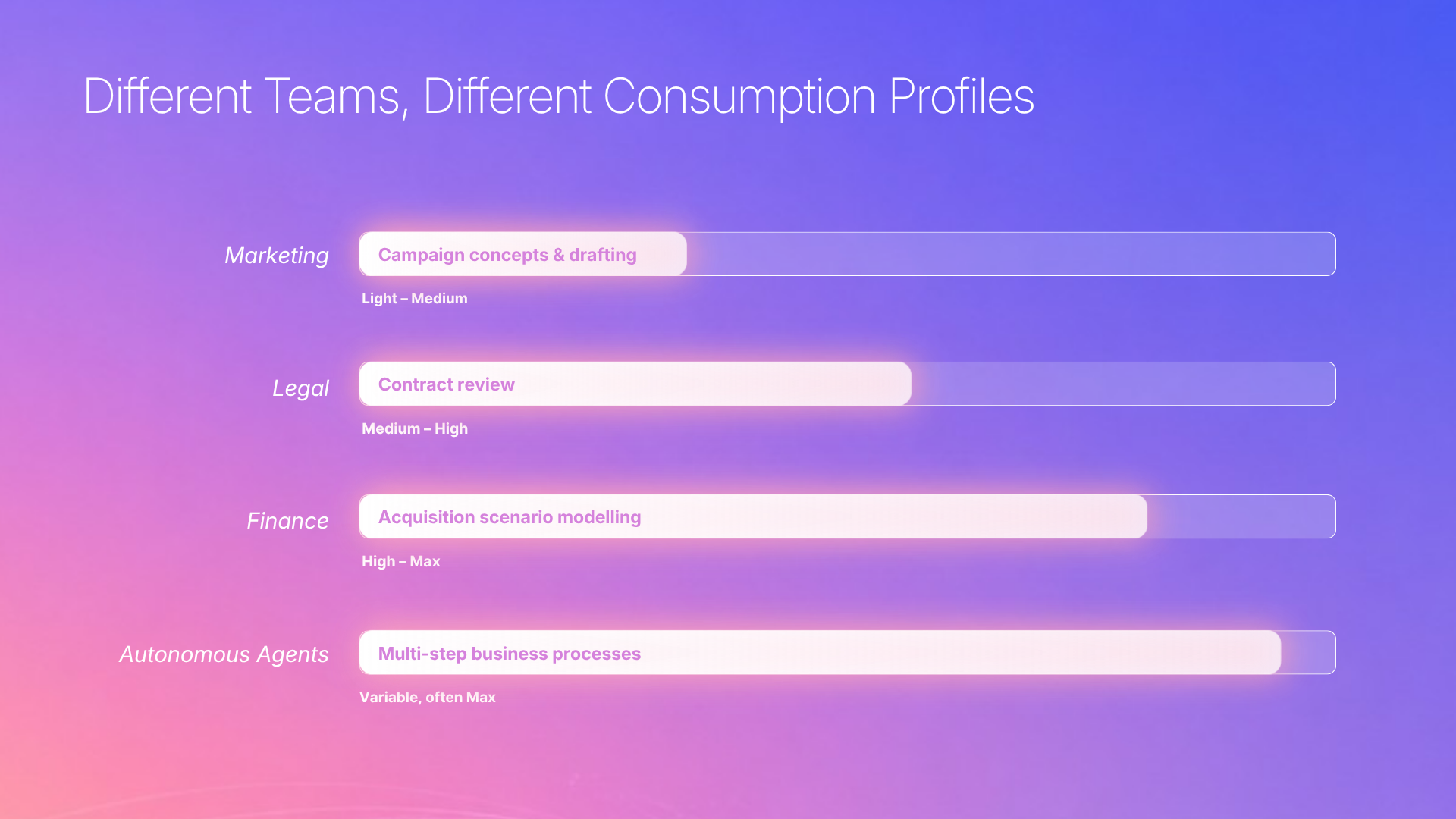
A marketing team generating campaign concepts may need one level of capability. A legal team reviewing contracts may need another. A finance team modelling acquisition scenarios may need something more advanced again. And an autonomous business process running multiple AI agents may introduce an entirely different consumption profile. The organisations seeing the greatest return won't necessarily be the ones using the most AI. They'll be the ones using the right AI for the right job.
For years, technology governance was largely about controlling access. Today, access is becoming the easy part. The harder challenge is ensuring intelligence is applied appropriately, economically and responsibly. That's why the arrival of multiple AI models inside Copilot Cowork matters far beyond the technology itself. It's a glimpse of what enterprise AI will look like over the next decade: not a single model powering every task, but an ecosystem of intelligence levels matched to different types of work.
The winners won't be the organisations with access to the most intelligence. They'll be the organisations that know when not to use it.
If you're rethinking how your organisation approaches AI consumption management, get in touch with Digital Bricks to talk through what a right-sized governance model could look like for your teams.


Unlock exclusive insights and stay ahead in the digital world. No spam, only useful content.