Back to Blog
Why Every Enterprise Will Soon Need an AI Connectivity Strategy

September 8, 2026
•
AI Strategy


Last year, enterprises were obsessed with AI models. Next year, they'll be obsessed with AI connectivity.
For the past two years, organisations have spent enormous amounts of time comparing AI models. Is GPT better than Claude? Is Gemini catching up? Should we use Copilot? Should we build our own model? These questions dominate boardroom discussions, AI strategies, and technology roadmaps.
But as we argued in our earlier article, The Bigger Truth About Enterprise AI Adoption: It's Not About the Model, many organisations are focusing on the wrong part of the conversation.
The reality is that AI models are becoming increasingly capable across the board. Differences still exist, but the gap between them is shrinking rapidly. As AI capabilities become more accessible, organisations will discover that competitive advantage comes from somewhere else entirely.
The winners of the next phase of AI adoption won't be the companies with the smartest model. They'll be the companies that can connect AI to the information, systems, and processes that already run their business.
That's because no matter how intelligent an AI becomes, it can only be as useful as the information it can access.
Imagine hiring the smartest employee on the planet. They can learn instantly, analyse information in seconds, solve complex problems, and communicate brilliantly. On paper, they're perfect.
Now imagine you give them no access to anything. They can't open SharePoint. They can't access customer records. They can't view sales reports. They can't check inventory levels or browse contracts. Every time they need information, they're forced to guess.
Suddenly, that brilliant employee becomes far less valuable.
The problem isn't intelligence. The problem is access.
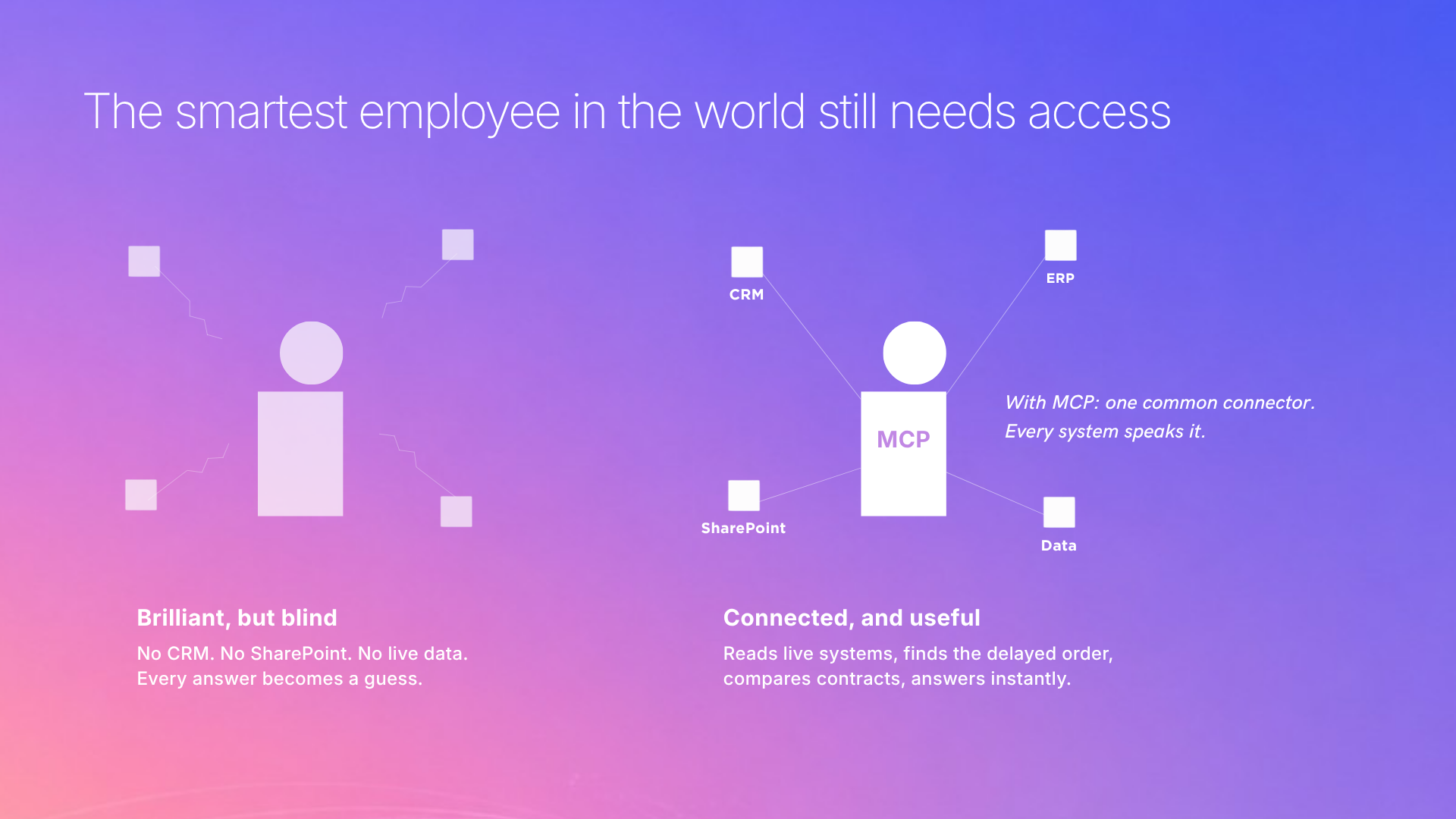
This is exactly the challenge many organisations face with AI today. The technology is impressive, but it often operates without the context needed to create meaningful business value. An AI assistant might help an employee write an email or summarise a document, but can it identify a delayed customer order? Can it compare supplier contracts? Can it retrieve information buried inside thousands of project documents? Can it answer employee questions using the latest company knowledge?
Without connections to enterprise systems, the answer is often no.
The challenge facing organisations is no longer whether AI is capable. The challenge is ensuring AI has secure access to the information it needs to become useful.
Most organisations already have a rich digital ecosystem. Customer data sits inside a CRM. Financial data lives in an ERP system. Documents are stored in SharePoint. Collaboration happens through Teams. Operational data is spread across databases, applications, and specialised business systems.
Over the years, companies have invested millions in building these platforms. Together they contain the knowledge that powers daily decisions and business operations.
The challenge is that these systems were never designed for an AI-first world.
As organisations move from experimentation to enterprise adoption, they're discovering that implementing AI is often the easy part. Connecting AI to the right systems, while maintaining security, governance, and control, is where the real complexity begins.
A useful analogy is road infrastructure. Imagine building the fastest cars ever created, only to realise there are no roads connecting cities. The cars may be technically impressive, but they cannot deliver value because they have nowhere to go.
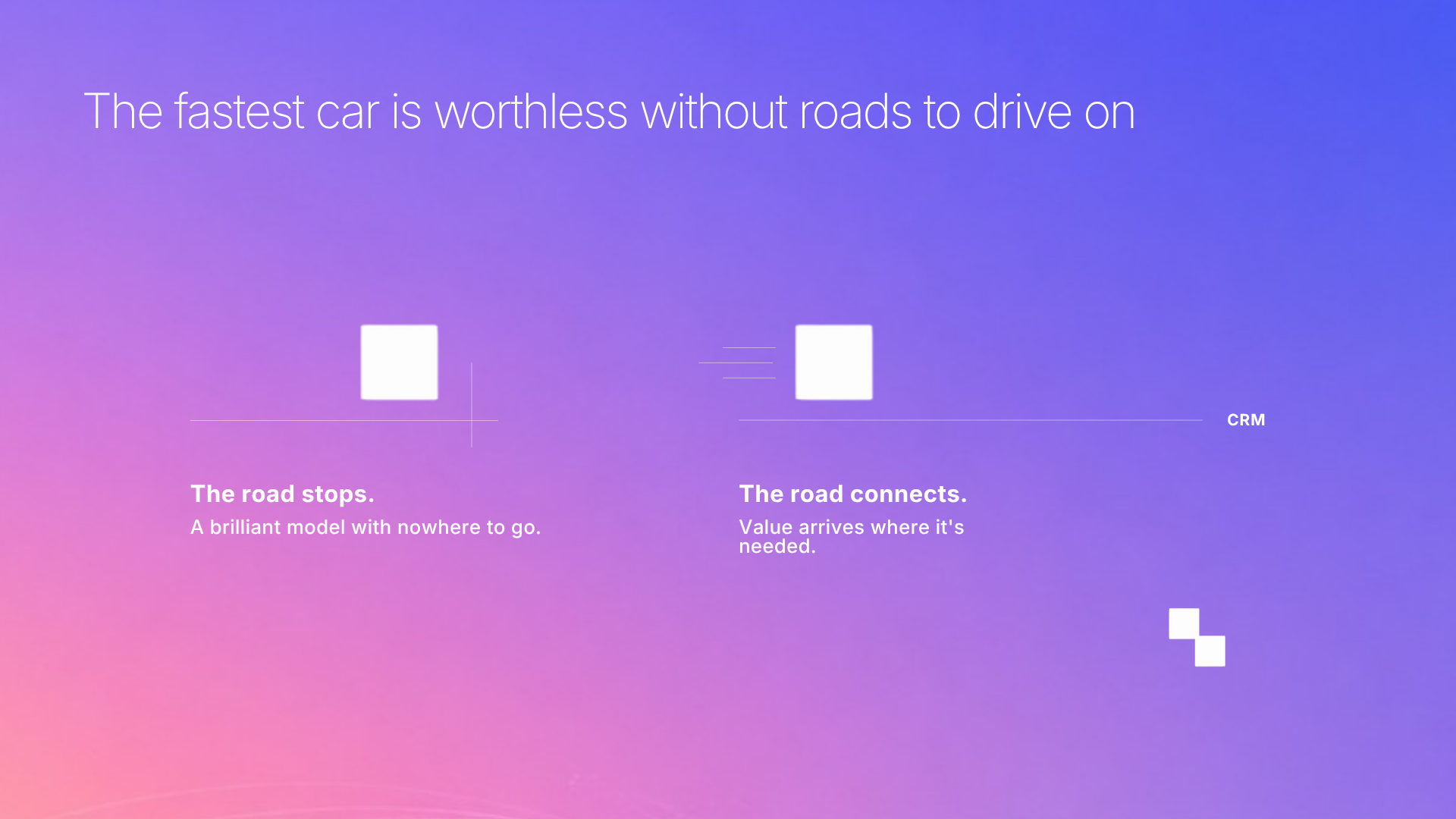
AI faces a similar challenge. The models are becoming extremely capable, but without the infrastructure that allows them to move between systems, retrieve information, and interact with business processes, much of their potential remains unrealised.
This is why AI connectivity is becoming a strategic priority. The organisations building these connections today are laying the foundation for how work will be done tomorrow.
Many companies already have an AI strategy. Far fewer have an AI connectivity strategy.
An AI strategy typically focuses on use cases. Where can we automate work? Which departments should use AI? How can we improve productivity? Which tools should we deploy?
These are all important questions, but they don't address a more fundamental issue: how will AI safely interact with the business?
As organisations introduce more AI solutions, complexity grows quickly. Marketing adopts one platform, finance adopts another, customer service introduces its own assistant, and operations experiments with something else. Each initiative may create value individually, but together they can create a fragmented landscape of disconnected integrations, inconsistent governance, and growing security concerns.
This is why enterprise leaders need to think beyond AI adoption and start thinking about AI architecture. They need a clear strategy for how AI connects to systems, how permissions are managed, how data flows across the organisation, and how future AI solutions can be introduced without creating another layer of complexity.
The companies that solve this challenge will be able to scale AI across the business. Those that don't may find themselves stuck in an endless cycle of proofs of concept.
As organisations grapple with the connectivity challenge, a new concept is rapidly gaining attention: Model Context Protocol (MCP).
While the technical mechanics can be complex, the underlying idea is surprisingly simple.
Imagine every application inside your organisation speaks a different language. Your CRM speaks one language, your ERP another, SharePoint another, and your databases something different again. Now imagine every AI assistant also has its own way of communicating.
Connecting everything together becomes difficult very quickly.
Historically, organisations solved this problem by building custom integrations between systems. This works, but it doesn't scale well. The more applications and AI tools you introduce, the more complex the integration landscape becomes.
MCP aims to solve this by creating a more standardised way for AI systems and business applications to communicate with each other.
Think of it like USB-C. Before USB became a universal standard, every device needed a different cable. Printers, cameras, storage devices, and phones all had their own connectors. USB simplified that complexity by creating a common language for hardware.
MCP has the potential to do something similar for AI. Instead of building unique integrations everywhere, organisations could adopt a common approach that allows AI tools to discover information, access systems, and perform actions in a consistent and secure manner.
Whether MCP ultimately becomes the dominant standard remains to be seen. But one thing is already clear: as AI adoption grows, the need for standardised connectivity will only become more important.
History teaches us that transformational technologies rarely create value on their own. Infrastructure creates value.
The internet changed the world because computers could connect. Cloud computing transformed businesses because systems could connect. Smartphones became indispensable because people, applications, and information could connect seamlessly.
AI is following the same pattern.
The next phase of enterprise AI will not be defined by who has access to the latest model. Most organisations will eventually have access to similar AI capabilities. The real differentiator will be how effectively those capabilities are connected to business knowledge, systems, people, and processes.
The organisations that can securely connect AI to their CRM, ERP, SharePoint environment, databases, and operational systems will unlock entirely new ways of working. They'll make decisions faster, eliminate inefficiencies, and empower employees with information when and where it's needed.
Those that fail to build these connections may find themselves owning powerful AI technology that remains disconnected from the business it was meant to transform.
In many ways, AI connectivity is becoming the next generation of enterprise infrastructure. It may not be the most visible part of the AI conversation, but it could become the most important.
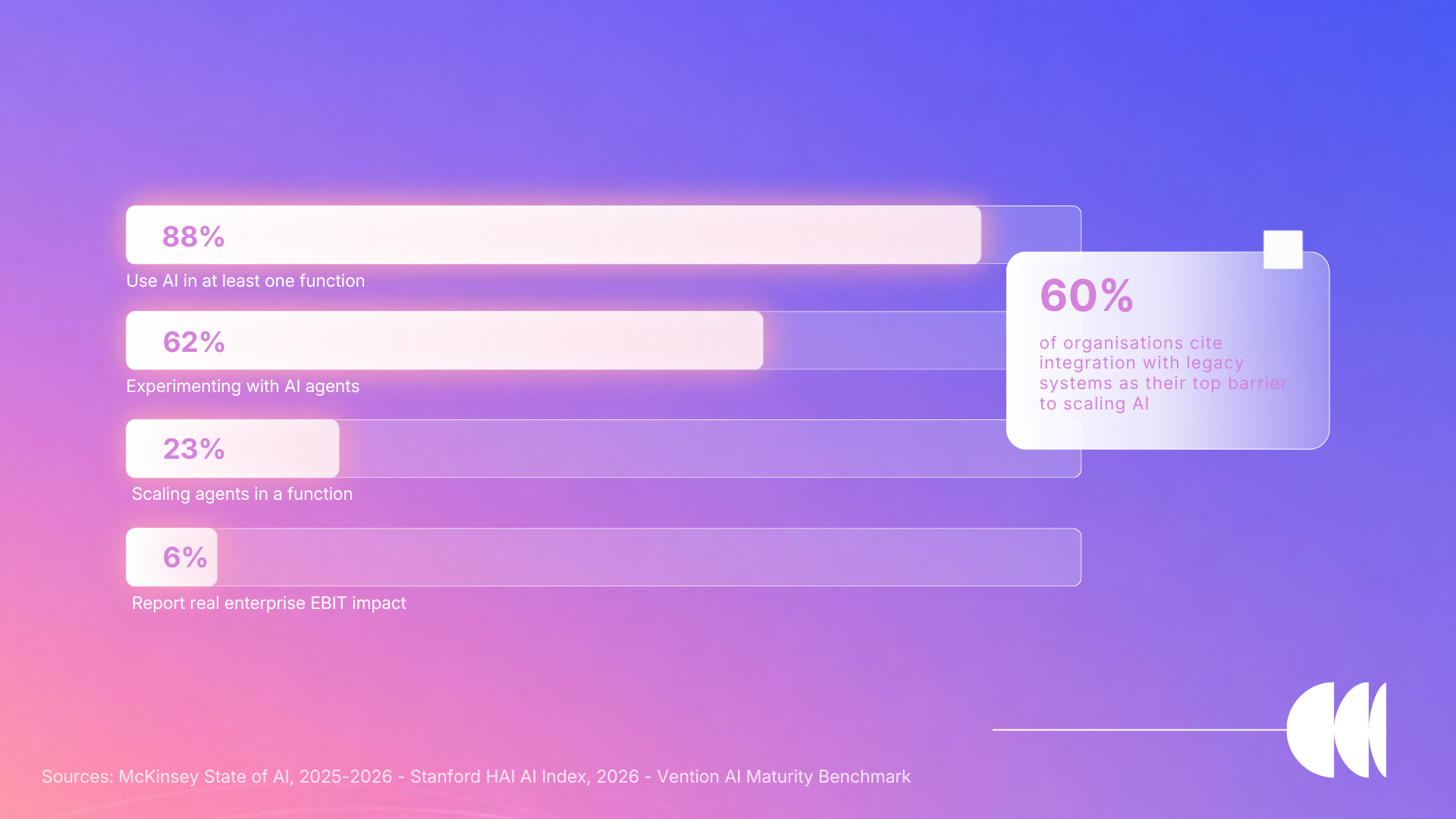
As AI adoption matures, the conversation is shifting from experimentation to integration. Organisations are realising that lasting value doesn't come from deploying another AI tool. It comes from creating the foundations that allow AI to securely access knowledge, systems, and business processes at scale.
At Digital Bricks, we help organisations move beyond isolated AI initiatives and build the foundations for sustainable adoption. From Microsoft Copilot and enterprise AI governance to AI-ready architectures and emerging standards such as MCP, we help turn AI ambition into measurable business outcomes.
The future won't belong to the companies with the most AI. It will belong to the companies that connect AI to the knowledge and processes that drive their business.
Want to understand what connected AI could mean for your organisation? Let's start the conversation.


Unlock exclusive insights and stay ahead in the digital world. No spam, only useful content.