Back to Blog
Your AI strategy has a new problem: who is managing all your AI agents?

October 27, 2026
•
AI Strategy


Imagine walking into your next leadership meeting and asking one seemingly simple question:
How many AI agents are currently operating inside our organisation?
Marketing has built a few. Finance is experimenting with one. HR has an onboarding agent. Someone in Sales created a personal agent to prepare account briefings. IT is testing more advanced automation. And somewhere in Microsoft 365, another employee has just discovered how easy it has become to build one themselves.
Now try the harder questions.
Who owns each agent? What data can it access? Which systems can it change? Is anyone measuring whether it still delivers value? And who has the authority to switch it off?
Welcome to the next phase of enterprise AI: AI agent management.
For the past two years, the big question has been what AI agents can do. In 2026, that conversation is shifting. As agents move from experiments into everyday workflows, organisations have to work out something far less glamorous, but much more important:
How do you manage a workforce that increasingly includes AI agents?
We spent years asking what agents could do

Generative AI initially entered most organisations through assistants and copilots. You asked a question, AI produced an answer. You asked it to draft an email, summarise a meeting or analyse a document, and it helped.
AI agents change that relationship.
An agent can be given a goal, access information and tools, reason about what to do next and take actions within defined boundaries. That distinction matters because it moves AI beyond generating information and into executing work.
Consider a finance process.
An assistant might tell an employee which invoices are overdue.
An agent could identify those invoices, retrieve associated account information, draft follow-up messages, update the CRM and escalate exceptions to the relevant account manager.
The first produces information. The second participates in work.
And this is no longer a niche scenario. Gartner predicts that 40% of enterprise applications will feature task-specific AI agents by the end of 2026, up from less than 5% in 2025.
As that becomes normal, another problem appears.
Imagine an HR agent that assists with employee onboarding.
Initially, it might simply answer questions using company policies.
Then you connect it to SharePoint.
Then the HR system.
Then an automated workflow.
Soon, that same agent might be able to find employee records, generate documents, trigger approvals or initiate parts of an onboarding process.
Each additional capability increases its usefulness. It also increases the consequences of getting something wrong.
This matters because agents are no longer merely answering questions. They can be given access to external tools, business data and actions. That is why the security community, including the OWASP Top 10 for LLM Applications, now pays close attention to risks such as prompt injection, excessive permissions and unintended agent actions.
The governance question therefore changes.
It is no longer simply:
Who is allowed to use AI?
It becomes:
What is this particular AI agent allowed to do?
And increasingly:
Who is accountable for it?
AI agent sprawl occurs when an organisation creates or adopts AI agents across teams, platforms and business processes faster than it can consistently track, evaluate and govern them.
The conditions for it are already emerging.
Agent-building capabilities are increasingly accessible through enterprise platforms. Microsoft, for example, has been expanding agent creation and orchestration capabilities across Microsoft 365 and Copilot Studio. The important organisational consequence is that building AI functionality is no longer exclusively the domain of specialist development teams.
This is citizen development meeting autonomous AI.
That is exciting. It can also become messy remarkably quickly.
One department might create an agent that solves almost exactly the same problem as an existing agent elsewhere. An employee could create a useful agent, leave the company six months later, and leave nobody clearly responsible for maintaining it. An agent might retain access to information it no longer needs. Another might continue consuming resources despite barely being used.
None of these problems requires a malicious actor or a spectacular AI failure.
They are ordinary management problems.
And that is precisely why they matter.
Once agents become operational components of a business, organisations need to start treating them accordingly.
At minimum, every production agent should have answers to five basic questions.
Who owns it?
There should be a named business owner who remains accountable for what the agent is designed to achieve.
Technical ownership isn't enough. If an agent supports a procurement workflow, somebody responsible for that process should also be responsible for determining whether the agent still performs a useful and appropriate role.
What can it access?
Its data sources, connectors, APIs and business applications should be understood and controlled.
This is where established cybersecurity principles become relevant to AI. Least privilege, for example, means giving a user or system only the permissions required to perform its task.
The same logic applies to agents.
An invoice agent that needs read access to supplier information does not automatically need permission to modify supplier bank details.
That distinction becomes increasingly important as agents gain more tools.
What can it actually do?
Retrieving information is different from editing a customer record.
Drafting a response is different from sending it.
Recommending a refund is different from issuing one.
The level of autonomy should therefore be a deliberate design decision, rather than something that quietly grows each time another connector or capability is added.
How do we know it is working?
Every production agent needs an objective.
Faster case resolution? Less manual processing? Higher first-contact resolution? Fewer hours spent searching for information? Lower error rates?
Without a baseline and a measurable outcome, organisations risk accumulating agents without knowing whether those agents are actually creating business value.
When does a human step in?
Human oversight matters most when the potential impact of an action increases.
An agent summarising an internal document presents a very different risk profile from an agent making employment recommendations or initiating transactions.
The objective is not to put a human approval step in front of everything. That can eliminate much of the value of automation. The goal is to decide where human judgement materially changes the risk.
This is where AI agent management starts to look less like an AI project and more like an operating model.
There is a temptation to answer new AI risks with more policy.
Write another document. Add another committee. Introduce another approval.
But operational AI requires operational governance.
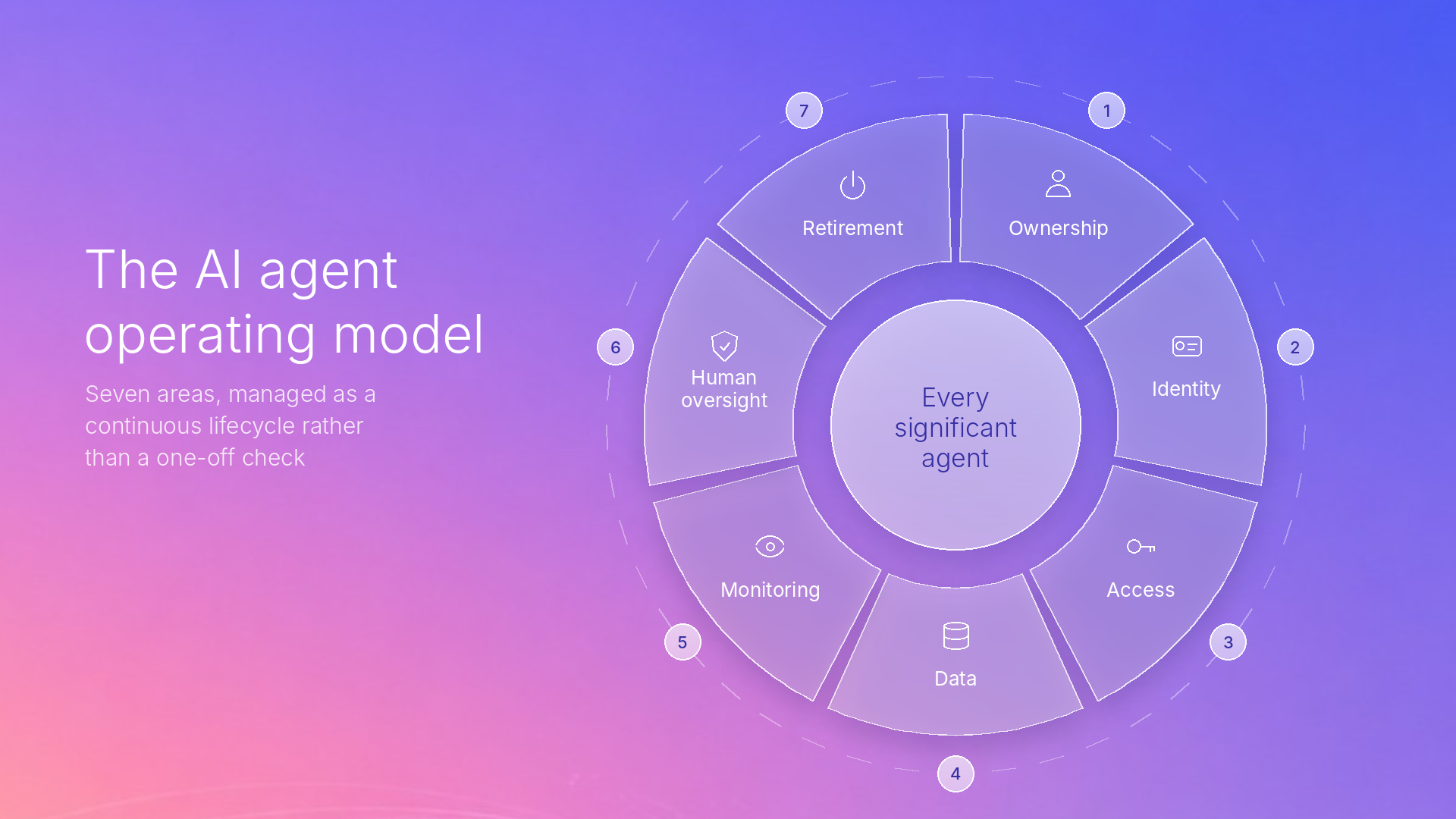
A useful starting point is to manage every significant agent across seven areas:
1. Ownership: a named business owner who is accountable for the outcome.
2. Identity: every agent is recognisable as a distinct entity, not hidden behind a personal account. Microsoft's Entra Agent ID is one example of agents getting their own managed identities.
3. Access: permissions granted on the principle of least privilege, and reviewed.
4. Data: clarity on which information the agent uses, and where it ends up.
5. Monitoring: visibility into what the agent does, and whether it delivers value.
6. Human oversight: defined moments where a person reviews, approves or intervenes.
7. Retirement: a clear trigger for when an agent is updated, replaced or switched off.
Together, they answer a much more useful question than "Do we have an AI policy?"
They answer:
Can we responsibly operate the AI systems we are actually building?
This way of thinking is consistent with broader AI risk-management approaches, such as the NIST AI Risk Management Framework, which increasingly treat AI governance as an ongoing lifecycle rather than a one-off compliance exercise.
And there is another benefit.
A good operating model does not just make AI safer. It makes scaling AI easier.
If teams already know how ownership should be assigned, how permissions are approved, what needs to be monitored and what determines retirement, every new agent does not need to reopen the same governance debate.
Governance becomes infrastructure for adoption.
The good news is that AI agent management does not have to begin with a huge governance programme.
Start with an inventory.
Then ask five questions:
1. Can we list the AI agents currently being used across the organisation?
2. Does every important agent have a named business owner?
3. Do we know which data sources, tools and systems each agent can access?
4. Can we monitor what an agent is doing and evaluate whether it delivers its intended outcome?
5. Can we quickly restrict or disable an agent if something goes wrong?
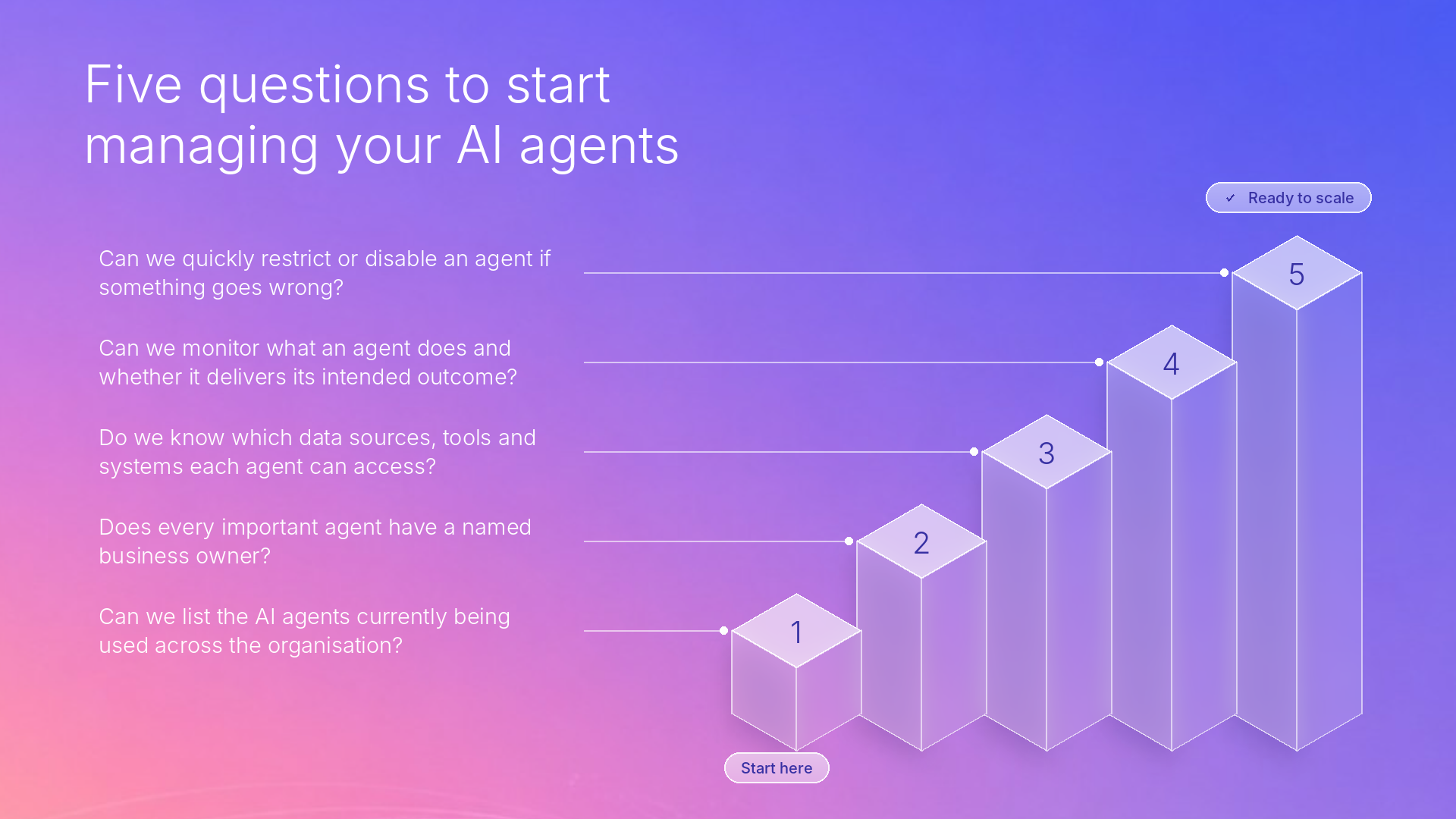
If the answer to any of those questions is "we don't know", you have found a useful place to start.
It is also worth distinguishing between experimentation and production.
A prototype summarising publicly available documents does not need exactly the same controls as an autonomous finance agent capable of updating records or triggering payments.
Governance should scale with capability and consequence.
For European organisations, that inventory also supports compliance. The EU AI Act places different obligations on AI systems depending on their role and risk profile, and its transparency obligations under Article 50 apply from 2 August 2026. Among other things, people must be told when they are interacting directly with an AI system. High-risk obligations, which include AI used in employment decisions, have been postponed to 2 December 2027 under the Digital Omnibus. The implication goes beyond compliance: organisations need visibility into where AI exists, what role it plays and who interacts with it.
You cannot govern what you cannot see.
The next phase of AI adoption will almost certainly produce impressive dashboards showing how many agents an organisation has created.
That may be the wrong metric.
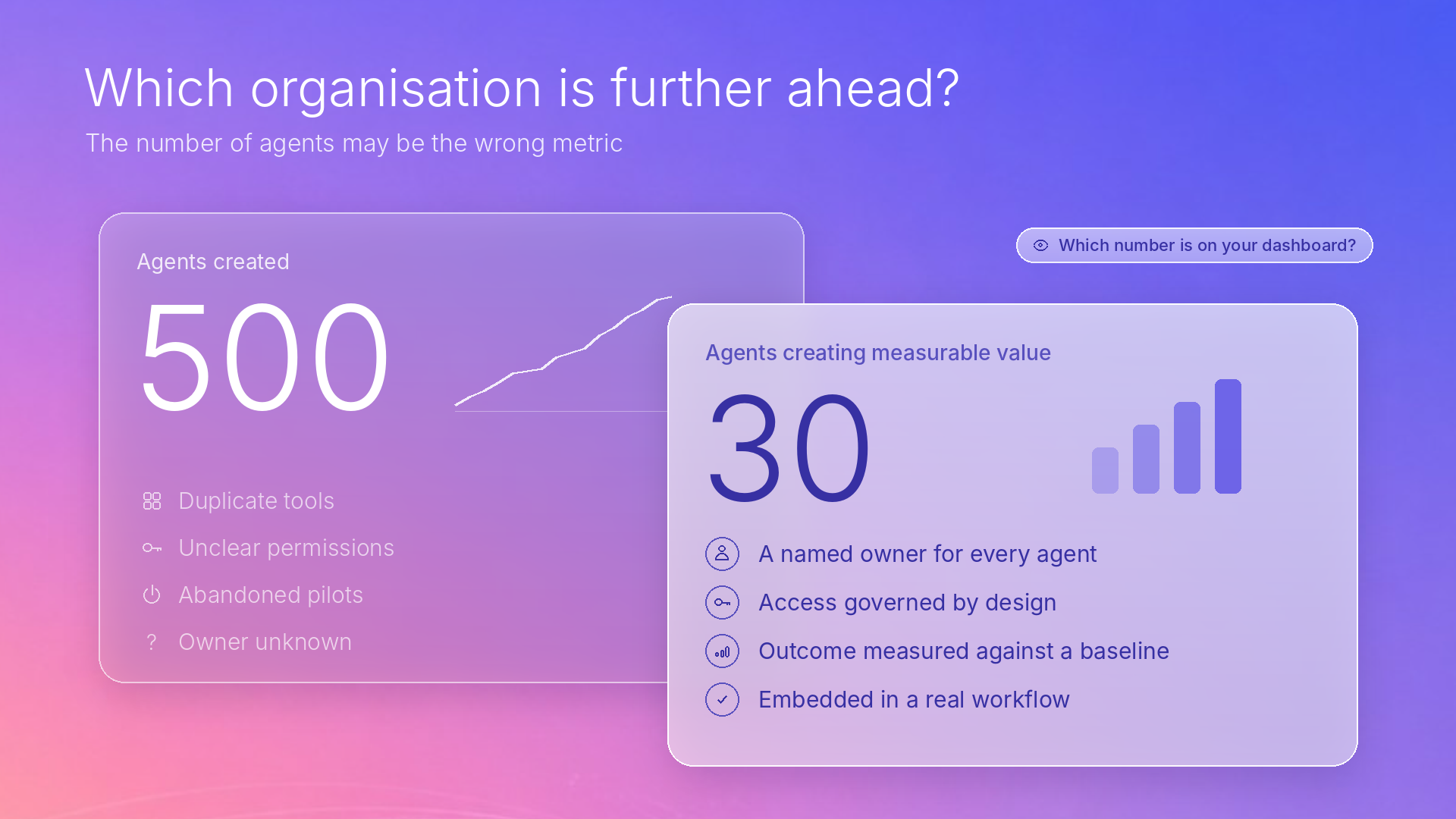
One organisation could deploy 500 agents and create a tangled ecosystem of duplicate tools, unclear permissions and abandoned experiments.
Another might deploy 30, each connected to a meaningful business outcome, governed appropriately and embedded into a workflow employees actually use.
Which organisation is further ahead?
As agentic AI matures, the competitive advantage may not come from creating agents fastest. It may come from knowing where autonomy creates value, where humans should remain in control and how the two should work together.
That requires technical architecture, certainly. But it also requires process design, security, governance, measurement, [skills and organisational change](/adopt-educate).
At [Digital Bricks](/about-us), that is increasingly where we help organisations: moving from "What could we build with AI?" to "How should AI actually operate inside our business?" Whether that starts with [building agents in Copilot Studio](/build-innovate/copilot-studio-development) or with [responsible AI governance](/responsibility), the operating model is what makes them last.
Because building an agent is quickly becoming the easy part.
Knowing which agents you need, what they should be trusted to do and how you manage them once they are working alongside your people?
That is where the real transformation begins.
Not sure how many agents are already running in your organisation? That question is usually the best place to start. Our [Agent Adoption Accelerator](/agent-adoption-accelerator) helps you map your agent landscape, assign ownership and build an operating model that lets AI scale safely. [Talk to our team](/contact-us) to find out where you stand.


Unlock exclusive insights and stay ahead in the digital world. No spam, only useful content.