Back to Blog
Thinking in the Age of AI: Why Cognitive Offloading Should Be on Every Leader's Agenda

August 18, 2026
•
AI Adoption


When calculators became mainstream, nobody worried we'd forget how to do maths.
When GPS became ubiquitous, nobody expected we'd lose our sense of direction.
Yet both changed the way our brains work. Now imagine a technology that doesn't just help you calculate or navigate. A technology that can write, analyse, summarise, recommend, brainstorm and reason alongside you. That's the promise of AI. It's also the challenge. Because as AI becomes increasingly capable of doing the thinking with us, leaders must confront an uncomfortable question: If AI is doing more of the thinking, are we still developing the skills that make human judgement valuable in the first place?
For years, organisations have focused on what AI can do. How much faster can we move? How many processes can we automate? How much productivity can we unlock? Those are important questions. But a new question is emerging. What happens when people stop doing the thinking themselves?
A recent article from McKinsey & Company explores the growing concept of cognitive offloading: the tendency for people to delegate mental effort to technology rather than actively engaging their own reasoning, memory and problem-solving capabilities. The article argues that while AI can dramatically enhance productivity, organisations must be careful not to create workplaces where employees become passive consumers of AI-generated outputs rather than active critical thinkers. This matters because the future of work is not simply about adopting AI. It is about ensuring that people continue to create value alongside it. The challenge isn't AI. It's how we use it.
History is filled with technologies that have helped humans reduce mental effort. Calculators removed the need for complex arithmetic. GPS systems replaced map reading. Search engines reduced the need to memorise information.
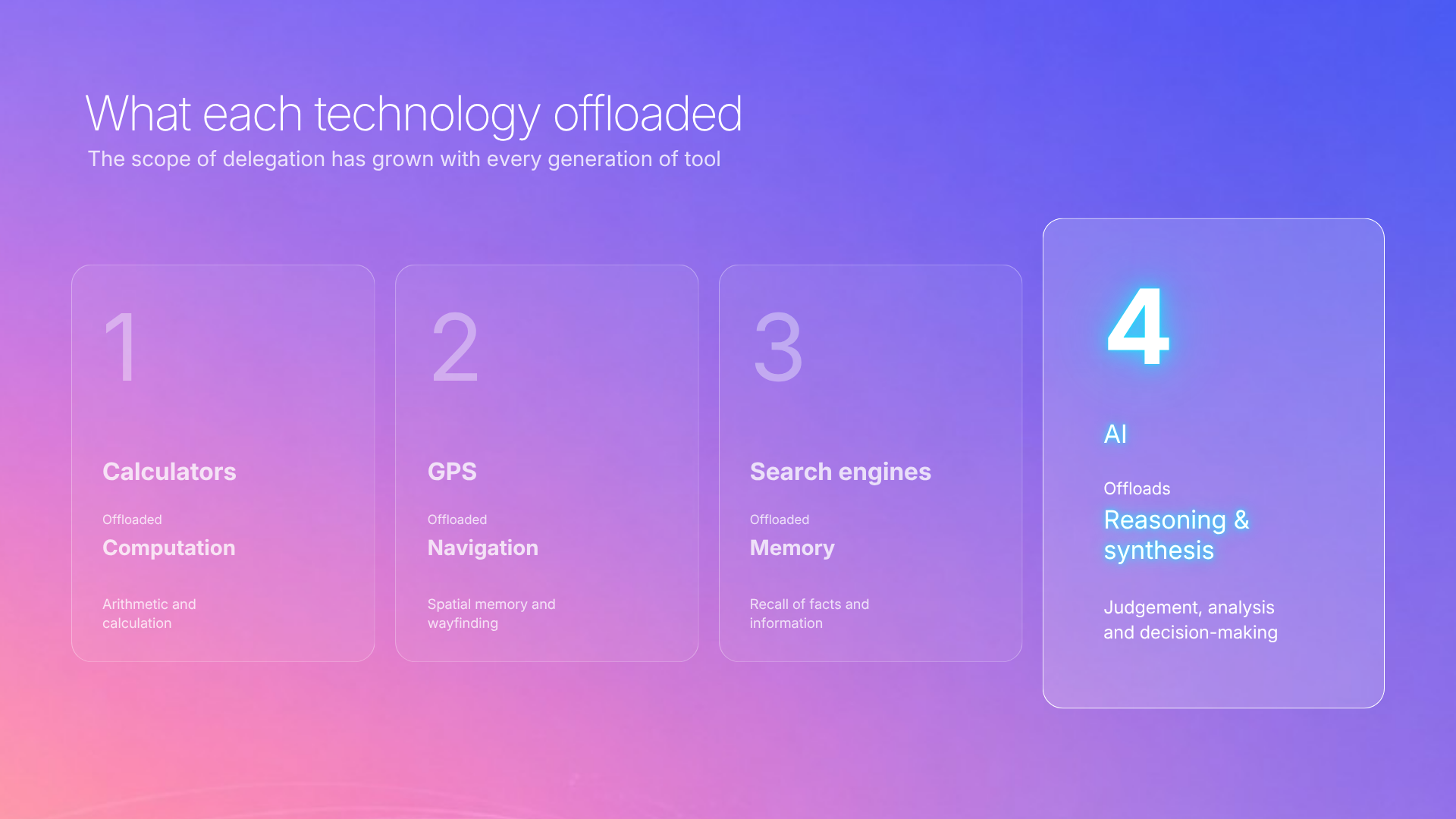
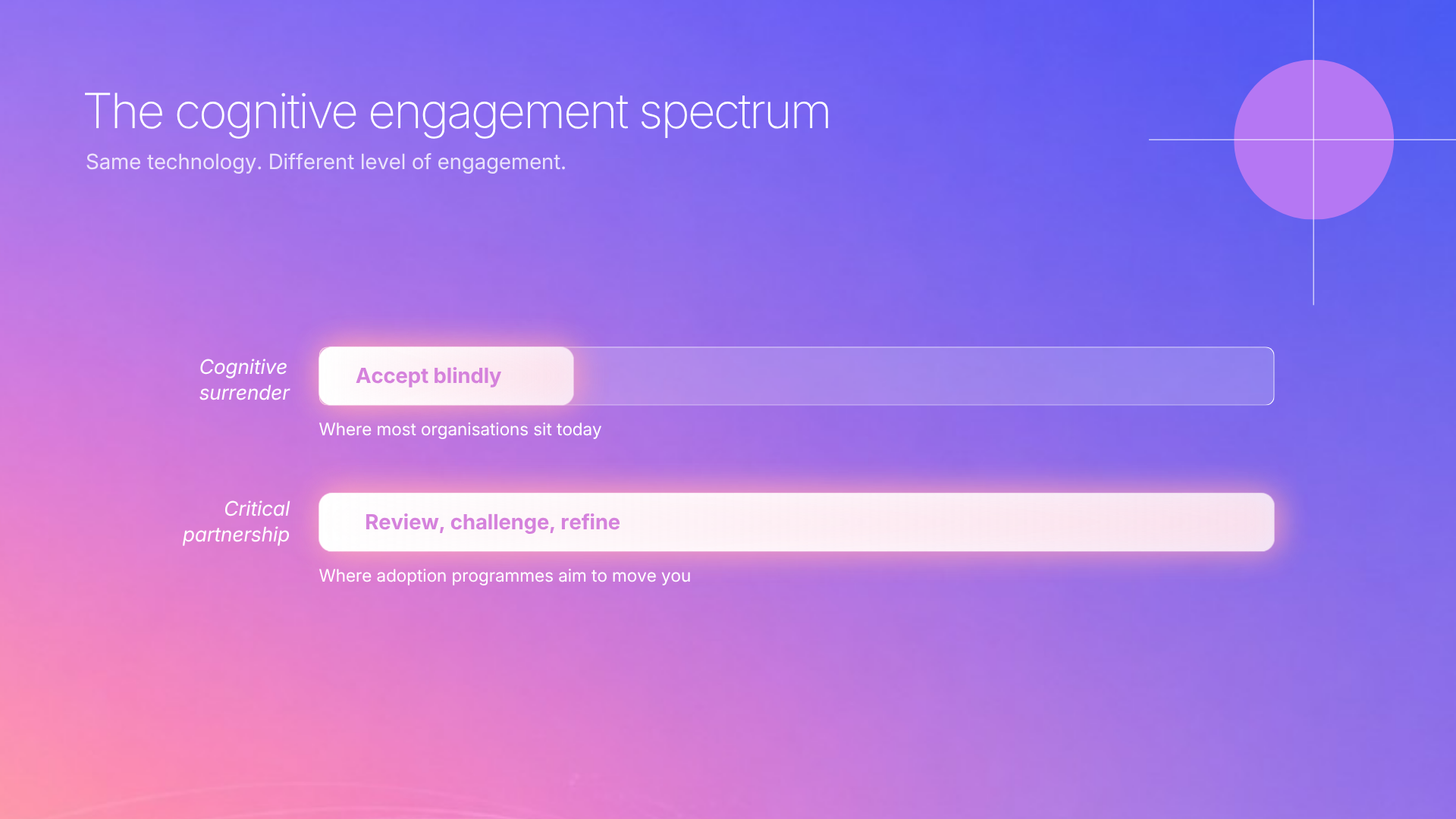
Generative AI takes this a step further. Instead of simply helping us complete tasks, AI can now draft reports, summarise meetings, analyse information, generate recommendations and answer complex questions. In many cases, it can produce outputs in seconds that previously required hours of effort. The productivity gains are undeniable. But there is a distinction between using AI as a tool and relying on AI as a substitute for thinking. If employees automatically accept AI-generated outputs without reviewing, challenging or refining them, organisations risk creating a workforce that becomes increasingly dependent on technology for judgement and decision-making. As highlighted by McKinsey & Company, emerging research suggests that excessive cognitive offloading may reduce independent analytical thinking and weaken the very skills organisations rely on to navigate complexity and uncertainty. The issue is not that AI makes people less capable. The issue is that capability only grows when it is exercised.
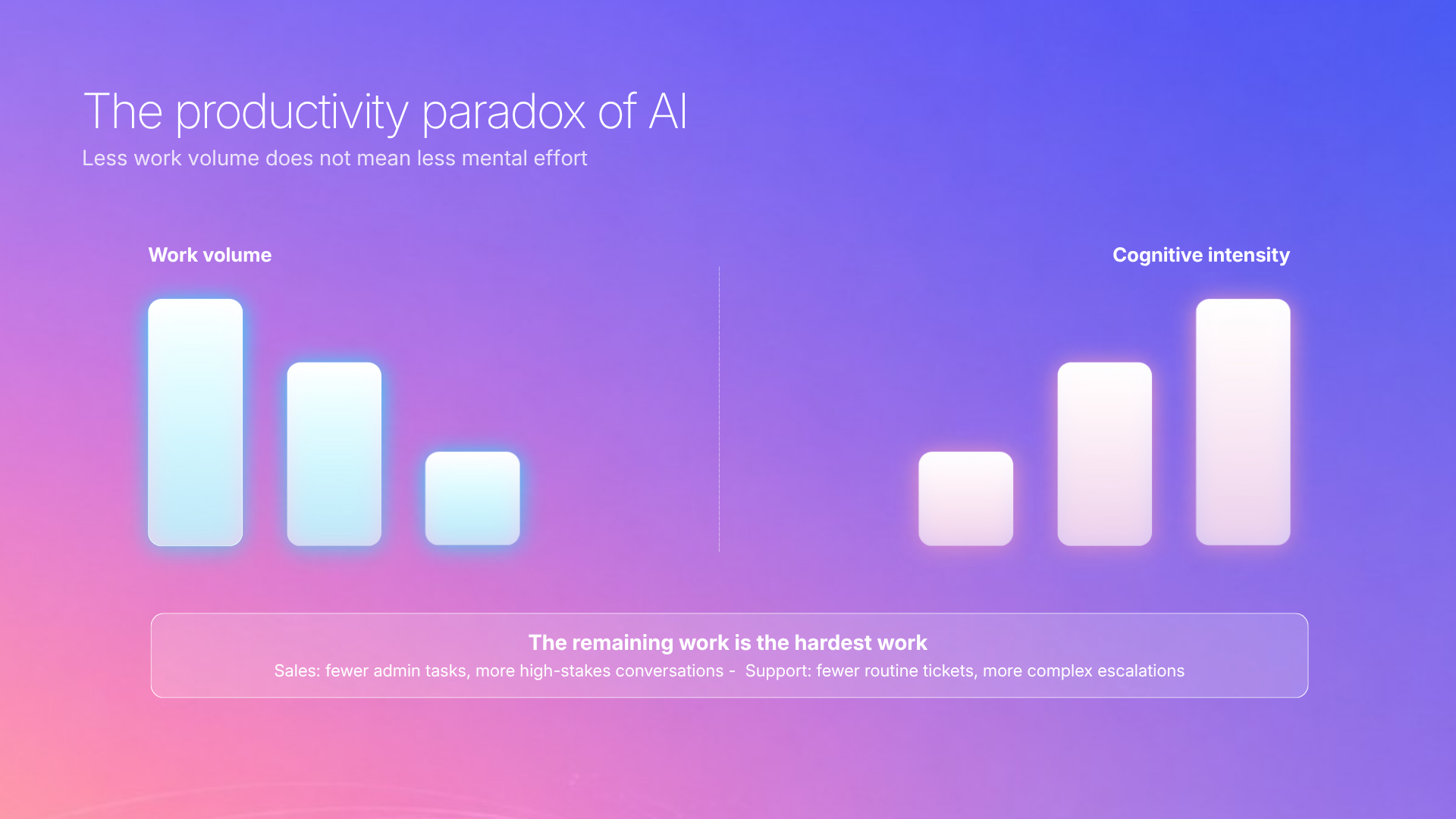
One of the most interesting observations from McKinsey & Company's article is that while AI often reduces the overall volume of work, it can simultaneously increase the cognitive intensity of work. Consider a sales professional whose routine administration has been automated. The administrative burden disappears, but the day may now consist almost entirely of high-stakes customer conversations. Consider a customer service employee whose straightforward enquiries are resolved automatically. The remaining work involves only complex escalations requiring judgement, empathy and problem-solving. Or consider a knowledge worker who can generate reports in minutes instead of hours. The challenge is no longer creating the report. The challenge is interpreting the information, identifying risks and making sound decisions.
In each example, AI removes the easier tasks and leaves behind the work that places greater demands on human judgement. This creates a paradox. Work becomes more efficient while simultaneously becoming more mentally demanding. Organisations that focus solely on efficiency gains may miss this shift entirely. The result can be teams that appear more productive on paper while becoming increasingly cognitively overloaded in practice.
At Digital Bricks, we believe the next phase of AI transformation will be shaped less by technological capability and more by human capability.
Most organisations have already begun exploring possibilities with AI. Many have established governance frameworks and responsible AI policies. Increasingly, leaders understand the importance of managing risk alongside innovation. Yet moving from experimentation to sustained business value remains difficult. This is because successful AI transformation is not simply a technology challenge. It is an adoption challenge.
Employees must know how to work effectively with AI. They need to understand where AI can accelerate outcomes, where human oversight remains essential and how to challenge outputs that may be incomplete, inaccurate or lacking context. The organisations creating the most value from AI are not replacing human expertise. They are amplifying it. This principle sits at the heart of the Digital Bricks approach: Possibility × Governance × Adoption. Possibility explores what AI can achieve. Governance ensures it is deployed responsibly. Adoption determines whether value is realised. Without adoption, even the most sophisticated AI strategy struggles to deliver meaningful outcomes.
The discussion about cognitive offloading provides an important reminder that technology transformation and human transformation must happen together.
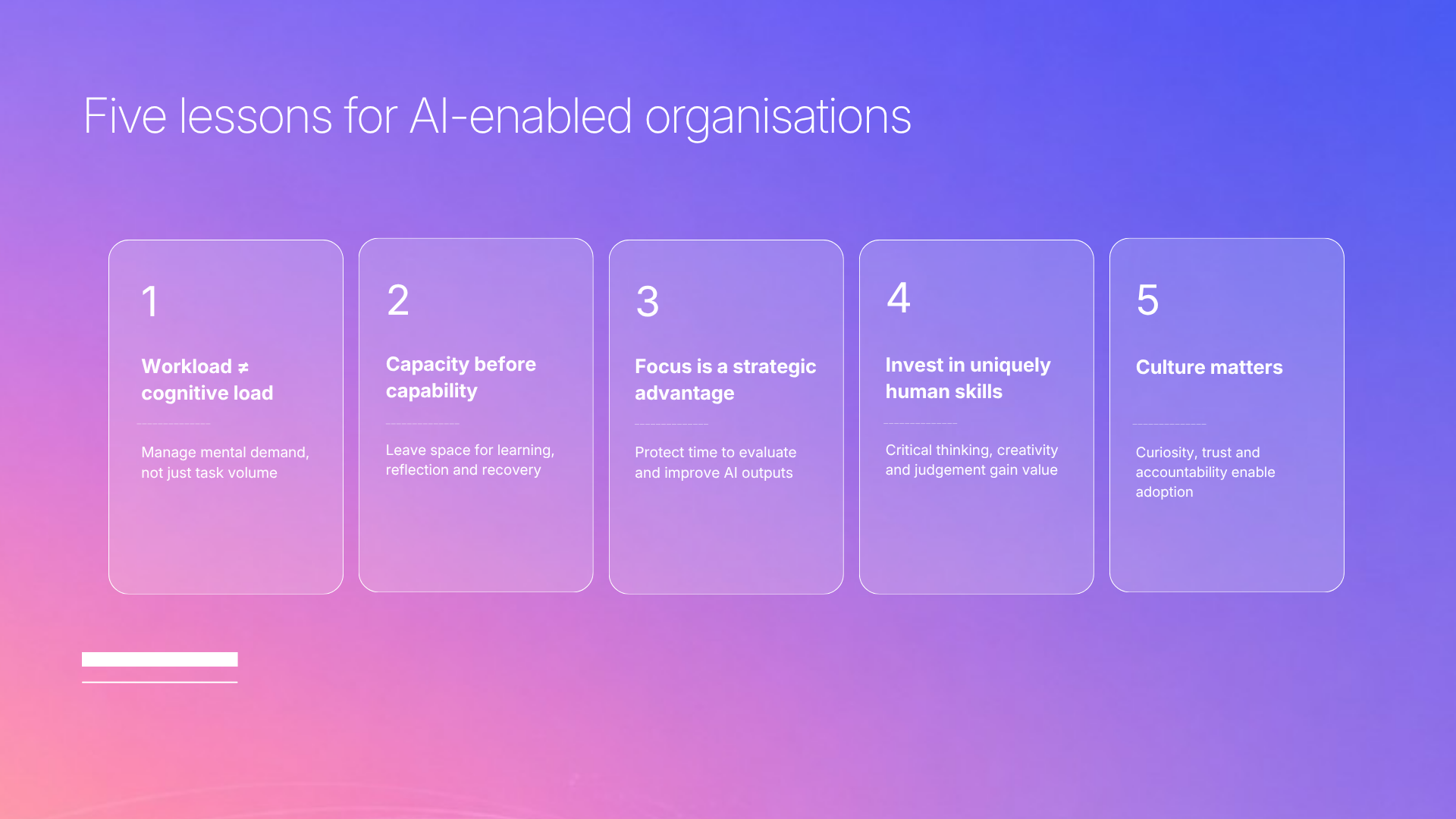
Firstly, organisations need to think differently about workload. The focus should not simply be on the quantity of work but on the cognitive demands placed on employees. AI should remove unnecessary effort while preserving opportunities for critical thinking, learning and decision-making.
Secondly, leaders need to recognise that capability depends on capacity. Asking employees to embrace new technology, adopt new processes and build new skills simultaneously can create significant cognitive pressure. Sustainable transformation requires space for learning, reflection and recovery.
Thirdly, focus has become a strategic advantage. Modern workplaces are full of interruptions, notifications and competing priorities. Yet AI delivers its greatest value when people have the time and attention needed to evaluate and improve the outputs it generates. Faster content creation means little if nobody has time to think about the content being created.
Fourthly, organisations must continue investing in the uniquely human skills that AI cannot replicate. Critical thinking, collaboration, communication, leadership, creativity and judgement become more valuable as AI takes over routine work. In many ways, AI raises the premium on human capability rather than reducing it.
Finally, culture matters. The organisations that thrive will be those that create environments where employees feel confident experimenting with AI, challenging outputs and learning new ways of working. Technology adoption succeeds when curiosity, trust and accountability are present.
The conversation around AI often begins with technology. The more important conversation is about work. How do organisations redesign their ways of working for an AI-enabled future? How do leaders ensure employees remain engaged, capable and confident as AI becomes embedded in daily processes? How can organisations accelerate productivity without compromising judgement, creativity or human oversight? These are the questions we help organisations answer.
At Digital Bricks, our focus extends beyond deploying technology. We help organisations build the conditions for successful adoption through AI transformation programmes, responsible governance frameworks, Microsoft Copilot enablement, leadership engagement and practical learning experiences that help employees develop effective AI habits. The concept of cognitive offloading reinforces something we have long believed: AI creates value when people actively engage with it, not when they simply defer to it. The goal is not to create a workforce that depends on AI. The goal is to create a workforce that uses AI to think better, move faster and make stronger decisions. That is where sustainable competitive advantage is created.
The first wave of AI adoption was about capability. The next wave will be about capacity. Organisations have invested heavily in platforms, copilots, assistants and automation technologies. The challenge now is ensuring people can work alongside those technologies in ways that strengthen, rather than weaken, human capability. AI is not replacing judgement. It is making judgement more important.
The organisations that succeed will not be those that automate the most. They will be those that create the strongest partnership between human intelligence and artificial intelligence. Technology may provide the engine. But people remain the driver. And as AI becomes a permanent colleague in the workplace, protecting our ability to think critically, make sound decisions and exercise good judgement may become one of the most important leadership responsibilities of the decade.


Unlock exclusive insights and stay ahead in the digital world. No spam, only useful content.