Back to Blog
New Advancements in AI Agents, Workflow Automation, and Real-Time Voice Experiences

June 3, 2026
•
AI Adoption


AI agents are evolving quickly. What started as productivity assistance inside chat interfaces is now becoming something far more operational. Organisations are beginning to build intelligent systems that can complete tasks, navigate applications, automate workflows, and communicate naturally with employees and customers in real time.
Recent updates across the Microsoft AI ecosystem highlight just how quickly enterprise AI development is accelerating. From improved computer-using agents to redesigned workflow experiences and real-time voice capabilities, the direction is becoming increasingly clear. AI is moving beyond assistance and into execution.
At Digital Bricks, we see this as a major turning point for organisations exploring AI consultancy, AI development, and intelligent automation strategies.
One of the most significant developments is the continued advancement of computer-using agents.
These agents are designed to interact with applications much more like a human user would. Rather than relying entirely on APIs, the predefined "menus" software uses to talk to other software, or rigid system integrations, they can understand interfaces, navigate platforms, select options, input information, and complete actions across systems.
This matters because many organisations still operate with fragmented software environments, legacy systems, and disconnected operational tools. Traditional automation often struggles in these environments because systems were never built to communicate seamlessly with one another. APIs only work when software has been deliberately set up to expose them, and many older or siloed tools simply weren't.
Computer-using agents help close that gap.
Instead of rebuilding entire technology ecosystems, organisations can begin introducing intelligent operational layers capable of interacting directly with existing software environments. This creates new opportunities for process automation, administrative support, operational coordination, and intelligent task execution.
For businesses investing in AI transformation, this represents a major shift from isolated automation towards truly adaptive AI operations.
At Digital Bricks, we believe these types of AI agents will play an increasingly important role in enterprise operations over the coming years, particularly within customer service, finance, internal operations, supply chain coordination, and knowledge work environments.
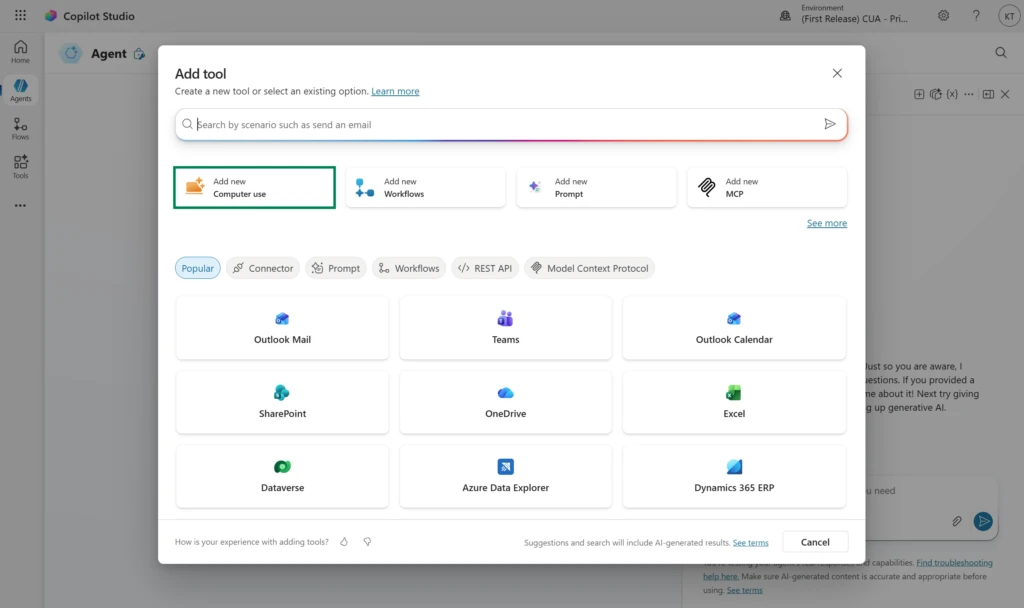
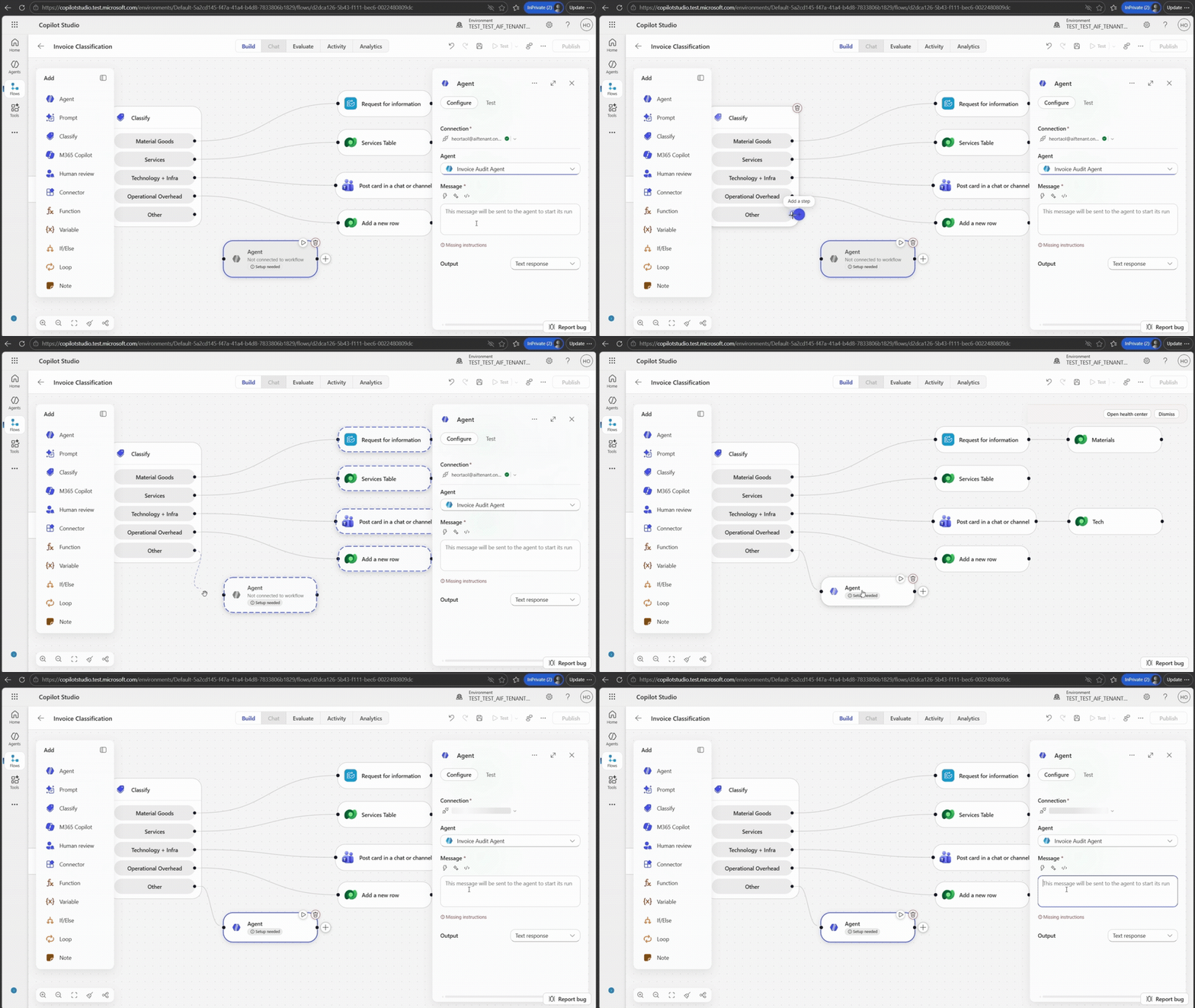
Another important update is the continued evolution of workflow experiences inside the Microsoft ecosystem. As organisations expand their AI initiatives, the challenge is no longer simply generating outputs. The real challenge becomes orchestration. How do multiple actions, systems, triggers, approvals, and intelligent decisions work together in one scalable operational flow?
The latest workflow improvements are focused on making automation more accessible, more intelligent, and easier to manage. Rather than relying on highly technical development environments, businesses are increasingly able to design workflows that combine AI reasoning, automation logic, business rules, and connected systems into a single experience.
Consider a simple example. An incoming customer email requesting a refund could trigger a workflow where AI reads the request, checks the order history in one system, validates it against refund policy, routes anything unusual to a human for approval, processes the refund in another system, and sends a confirmation back to the customer, all without a person manually stitching those systems together.
This changes how organisations approach AI development. Instead of building isolated AI tools, businesses can begin designing end-to-end operational journeys powered by intelligent agents and contextual automation. AI can now support workflows that involve understanding requests, retrieving information, triggering actions, escalating decisions, and communicating outcomes across multiple systems simultaneously.
The result is not simply automation. It is operational augmentation. This is where we see many organisations beginning to rethink the structure of work itself.
Voice experiences are also becoming significantly more advanced. Recent developments in real-time voice capabilities are helping AI systems respond faster, communicate more naturally, and create more fluid conversational interactions. Historically, voice systems often felt rigid or transactional. Delays in response time and limited contextual understanding created experiences that rarely felt intuitive. That is beginning to change.
Modern real-time voice AI can process conversations with far greater responsiveness, helping create interactions that feel considerably more human and conversational. This has major implications for customer engagement, internal support systems, frontline operations, training environments, and AI-powered assistance experiences. As these technologies mature, voice will increasingly become another operational interface for enterprise AI. Employees may interact with AI systems conversationally while completing workflows. Customers may engage with intelligent voice agents capable of understanding context and responding dynamically. Operational teams may use voice-enabled AI support during real-time tasks and decision-making processes.
What this points to is a broader shift. Whether the entry point is a screen, an API, or a voice conversation, the interface itself becomes less important. The intelligence behind it becomes the real differentiator.
Many organisations are still caught between experimentation and execution. They have explored AI pilots, tested copilots, or introduced isolated productivity tools, but few have fully translated AI into scalable organisational capability. That gap is becoming one of the defining challenges in enterprise transformation.
The latest Microsoft AI developments reflect a broader shift happening across the industry. Organisations are no longer simply asking what AI can generate. They are asking how AI can operate.
How can AI reduce operational friction?
How can AI support employees in real time?
How can AI systems coordinate across departments and workflows?
How can organisations build intelligent processes instead of disconnected tools?
These are fundamentally strategic questions, not just technical ones.
At Digital Bricks, our work in AI consultancy and AI development consistently shows that successful AI adoption requires much more than technology implementation alone. Organisations need governance, workforce readiness, process redesign, leadership alignment, and a clear operational strategy for how intelligence is embedded into the business. Without that structure, AI often remains trapped in isolated experiments.
The direction of enterprise AI is becoming increasingly clear. AI agents will become more capable. Workflows will become more intelligent. Voice interactions will become more natural. Operational systems will become increasingly augmented by AI-driven decision support and automation.
The organisations creating the most value from AI will not necessarily be the ones adopting the most tools. They will be the organisations that build the clearest operational strategy around intelligence itself.
At Digital Bricks, we help organisations move beyond experimentation by designing scalable AI systems that align technology, adoption, governance, and operational transformation into one connected direction. That includes:
The next phase of AI is not just about productivity. It is about building intelligent organisations.
The organisations that win with AI won't be the ones with the most tools, but the ones with the clearest strategy for embedding intelligence into how they operate. At Digital Bricks, we help you get there, from AI agent development and workflow automation to governance, adoption, and enterprise AI architecture.
Let's explore what intelligent operations could look like for your organisation. Get in touch with our team to start the conversation.


Unlock exclusive insights and stay ahead in the digital world. No spam, only useful content.