Back to Blog
What We Actually Mean By 'The Frontier'

June 23, 2026
•
AI Strategy


"AI doesn't fail organizations. It exposes them." — Darren Lonsdale, transformation lead at Prosci, writing in CIO, 2026
Here is a number that should stop a boardroom cold. In 2026, IDC found that 88 out of every 100 AI pilots never make it into production. Not because the technology failed. The models worked fine. They stalled on governance, on data nobody had readied, on the unglamorous question of whether anyone would actually use the thing. And the most expensive part is that almost none of those companies were short on capability. They had the same models everyone else had. What they lacked was somewhere for that capability to land.
It is worth being precise about the word, because almost everyone gets it wrong. The frontier of AI. Frontier models. Frontier firms. It carries the ring of progress without the weight of a definition, which is exactly why it spread so fast. So let us start by saying what the frontier is not.
The instinctive picture is technological: the latest model, the largest context window, the agent that can do something last year's could not. On this view, being at the frontier means owning the most advanced capability.
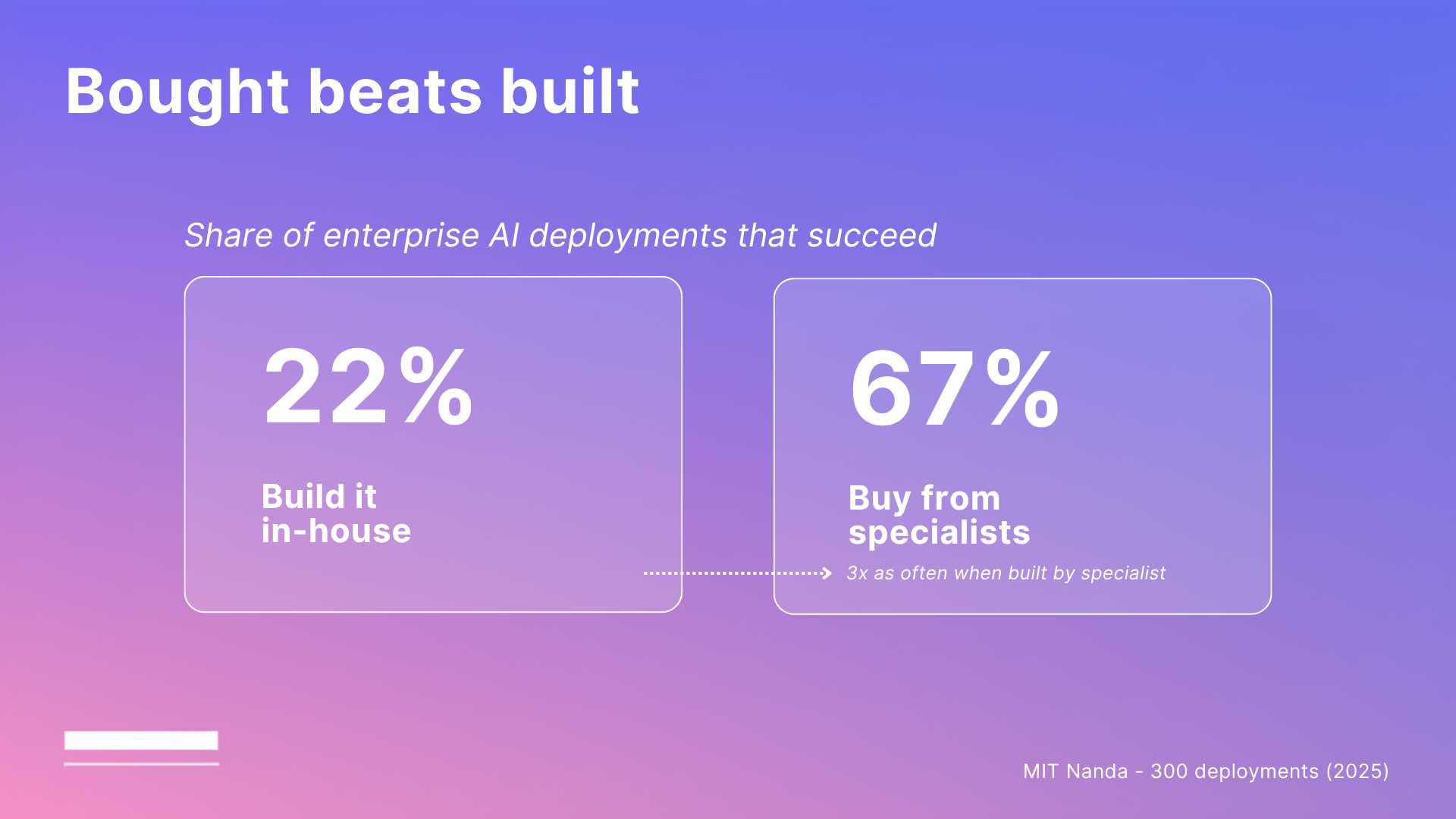
It is a tidy story and it is mostly wrong. The capability frontier moves so fast, and is so widely available, that being ahead on it buys you almost nothing durable. The model you are dazzled by this morning is a commodity by next quarter, sitting in your competitor's account on identical terms. Here is the uncomfortable proof: MIT's NANDA initiative studied 300 real deployments and found that buying AI from specialists succeeded about 67% of the time, while companies that built their own bespoke systems succeeded only a third as often. The ones chasing the bleeding edge in-house lost to the ones who simply bought the capability and put their energy into using it well. If the frontier were technological, it would be a line everyone crosses at once. Which is to say, no frontier at all.
The real line sits somewhere far less glamorous and far more decisive: between an organisation that can absorb a new capability and one that cannot.
Picture two companies buying the identical tool on the same Monday morning. One threads it into how work actually happens, builds the guardrails around it, and within a quarter has people reaching for it unprompted. The other runs a pilot, produces a flattering slide, and quietly lets it die because nothing underneath was ready to carry it. Same tool. Same morning. The tool was never the variable. Everything around it was.
And the data says hardly anyone is on the right side of that line yet. Gartner has pinned the blame squarely: roughly 85% of failed AI projects fail on poor data quality, not poor models. Writer's 2026 survey of 2,400 executives and employees found three-quarters of leaders admitting their AI strategy is "more for show" than real guidance. These are not technology problems. They are organisational ones, every single one. Which relocates the work entirely. The job is no longer procurement. It comes down to three things, and not one of them is a feature you can buy.
Most organisations badly misjudge what is achievable, and they get it wrong in both directions at once. They overestimate how exotic it has to be, picturing some moonshot that needs a research lab and a year of runway. And they underestimate how much is already sitting within reach, today, with tools they could switch on this quarter.
The genuinely useful examples are almost never the spectacular ones. They are the dull, invisible processes that quietly ate a thousand hours a year and now eat a hundred. The supplier invoices that used to crawl through three inboxes before anyone approved them. The customer query that once waited overnight for the one person who knew the answer and now gets resolved in the moment. The monthly report that took a team two days to assemble and now drafts itself before the meeting. None of it makes a keynote. All of it compounds.
There is a delicious irony buried in the research here. More than half of corporate AI budgets pour into sales and marketing, the glamorous, board-friendly use cases, yet MIT found the biggest returns hiding in the back office, in the unglamorous automation of operations nobody wanted to put on a slide. The flashy bets underperform the boring ones, reliably, because the boring ones attack work that is repetitive, high-volume, and measurable, which is exactly the work these systems are best at.
This is why possibility is more than a pep talk. Seeing what is real, in a company that actually looks like your own rather than a polished vendor demo, does something no amount of strategy deck can. It resets your sense of what counts as ordinary. The bar moves. Once you have watched a business like yours quietly close its books in hours instead of days, you stop asking whether it is possible and start asking why you are not doing it yet. That shift, from "could we?" to "why haven't we?", is the whole game. The frontier advances not when someone builds something astonishing, but when something astonishing becomes unremarkable enough that you simply assume you should have it too.
Here the line turns sharp. When a powerful new capability arrives, most organisations do one of two things, and both are mistakes. Some refuse it, which feels safe but is not: people start using it anyway, through the back door, with no rules at all. Someone pastes a confidential contract into a free chatbot to summarise it. A team builds a customer-facing agent that quietly quotes the wrong prices because nobody checked what it was allowed to say. Others rush in, which feels bold but is not: they hand an autonomous agent access to the inbox, the CRM, and the finance system on day one, and it sends the wrong invoice, books the wrong meeting, or deletes the wrong record faster than anyone can step in.
The fix is simple to state and harder to do: decide the boundaries before you switch anything on. What data can this agent see? What can it change on its own, and what needs a person to approve it first? Who is accountable when it gets something wrong? An agent that drafts replies but cannot send them without a click. A system that can read every customer record but only write to a sandbox until it has earned trust. Gartner expects more than 40% of agentic AI projects to be scrapped by 2027, and the reason is rarely the technology. It is cost, unclear value, and exactly these missing guardrails. Governance is not the brake on ambition. It is what lets you put your foot down without losing the wheel.
This is where most transformation efforts quietly go to die, and they die in a very specific place. Not at the strategy, which is usually sound. Not at the technology, which usually works. They die in the gap between a capability existing and a human being actually using it. The licence is paid for, the tool is live, and three months later the usage dashboard is flat, because everyone drifted back to the way they already knew.
The instinct is to call this resistance, or a skills gap, and to fix it with more training and a firmer mandate. That instinct is almost always wrong. The real problem is rarely the people; it is the environment they are working in. Is the new way actually easier than the old way, or just newer? When someone tries the tool and it fumbles the first attempt, are they supported or quietly judged? Does using it sit on the path of least resistance, or does it take a small act of personal heroism every morning? People are not refusing to change. They are responding, rationally, to the incentives in front of them.
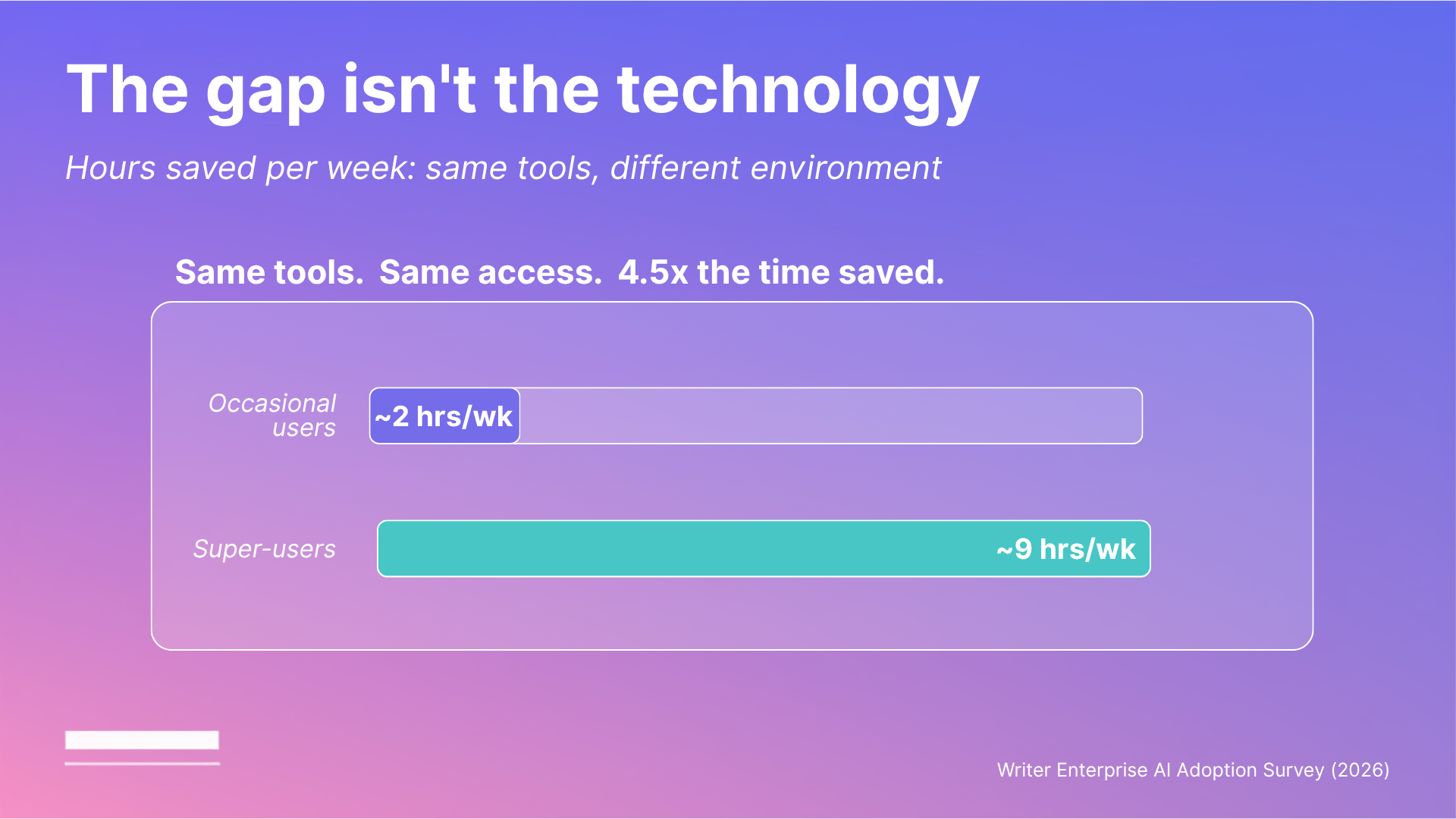
The split this produces is already stark. Writer found that AI super-users save around nine hours a week, roughly four and a half times what the laggards manage, and were three times more likely to land a raise or promotion. Here is the part worth sitting with: the capability was identical across both groups. Same tools, same access, same licences. The only thing that differed was the environment around them.
Which points straight at the fix. Adoption does not happen because you tell people to adopt; it happens when you make the new way the easiest way to work. That means redesigning the workflow so the tool is where the work already is, not a separate tab someone has to remember to open. It means a manager who visibly uses it themselves rather than just forwarding the launch email. And it means celebrating the early clumsy attempts instead of punishing them, because the first ten uses are always worse than the old way before they become dramatically better. Get the environment right and adoption stops being something you push. It becomes the thing people reach for, because it is simply the easier path.
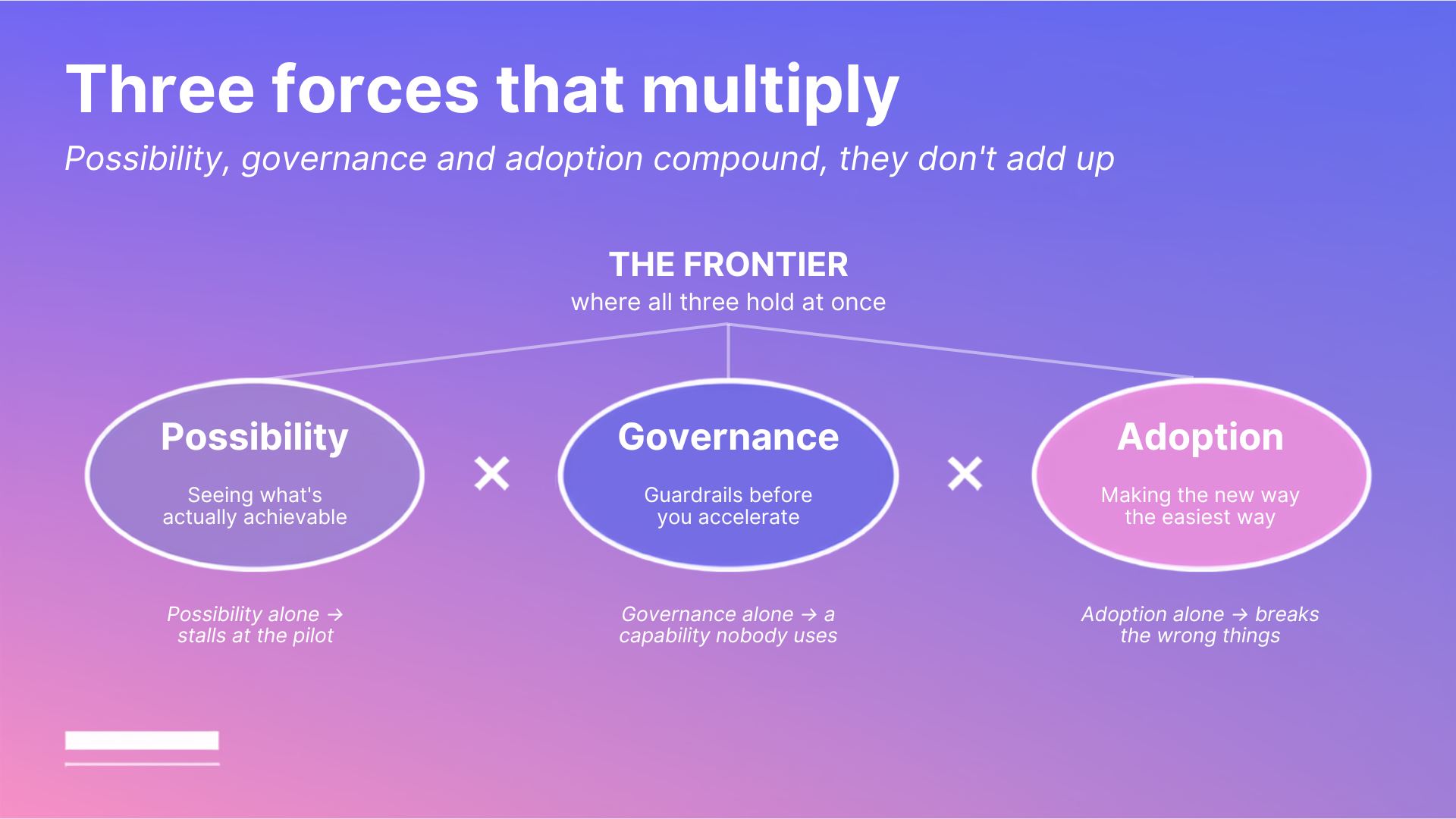
None of the three is about the technology, and all three compound. An organisation that sees what is possible but cannot govern it stalls at the pilot, one of the 88. One that governs beautifully but never drives adoption builds an immaculate capability nobody opens. One that drives adoption without governance moves fast and breaks precisely the wrong things. The frontier is the place where all three hold at the same time, which is why so few companies are standing on it, and why getting there is a discipline rather than a purchase order.
"See you on the frontier" is not a flourish. It is an invitation to an uncomfortable idea: that the work of the next few years is not keeping up with the technology, which mostly keeps up with itself, but building the kind of organisation that can take whatever the technology offers and do something with it. That is the frontier. Not the edge of what machines can do, but the edge of what your organisation can absorb. And unlike the technological frontier, this one does not move on its own. You have to walk to it.
Walking to the frontier is the work we do with organisations every day, across the same three fronts. On possibility, we find the use cases that actually matter, the unglamorous, high-value processes where AI pays back fastest, and we build them; as a Microsoft Solutions Partner, that runs from Copilot Studio agents and Power Platform to retrieval-augmented generation and multi-agent orchestration, grounded in a clean, connected data foundation. On governance, we put the structure in place before you accelerate, not after something breaks, so autonomous systems can act without creating risk you cannot see. On adoption, we make the new way the easy way, through our Copilot and Agent Adoption Accelerators, workshops, and e-learning, so the capability you build is the capability your people genuinely use.
If you want to talk about where your organisation sits today and what it would take to move, let's talk.
See you on the frontier.


Unlock exclusive insights and stay ahead in the digital world. No spam, only useful content.