Back to Blog
Microsoft 365 Copilot Is Starting to Look Less Like a Tool and More Like a Teammate

August 4, 2026
•
News


There was a time when AI sat firmly on the sidelines of work. You asked a question, it gave an answer. You requested a summary, it produced one. Useful, certainly. Transformational, not quite.
The latest updates to Microsoft 365 Copilot suggest we're entering a different phase altogether. Microsoft's July 2026 release introduces more advanced models, deeper reasoning capabilities and new ways for Copilot to work across applications and tasks. On the surface, these look like incremental feature updates. In reality, they point to a much bigger shift in how work gets done.
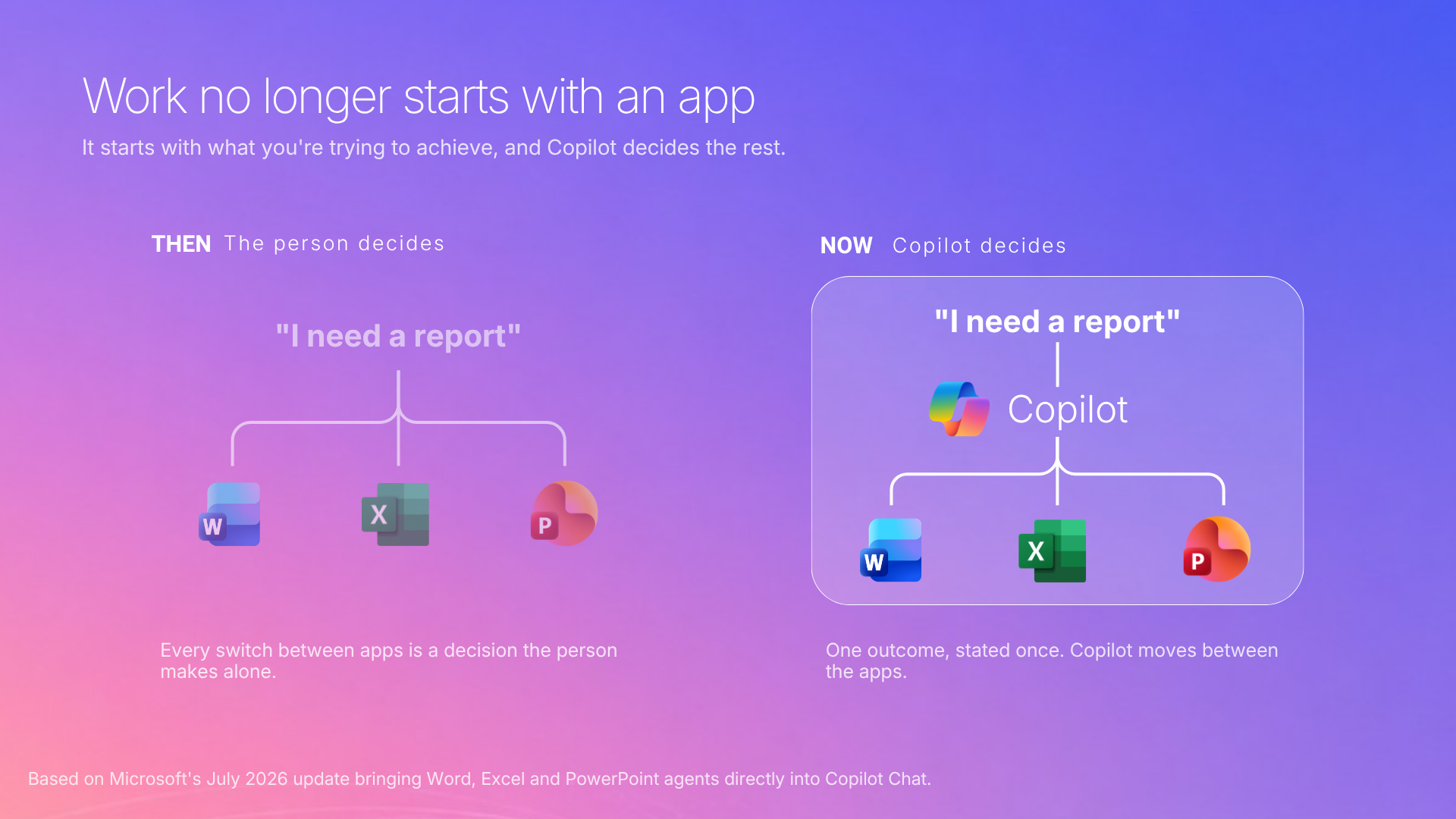
For decades, work has revolved around applications. Need a document? Open Word. Need analysis? Open Excel. Need a presentation? Open PowerPoint. Employees adapted their work to fit the software.
AI is beginning to reverse that relationship.
With the ability to bring Word, Excel and PowerPoint agents directly into Copilot Chat, Microsoft is moving towards a world where work starts with intent rather than an application. Instead of deciding which tool to use, people can focus on the outcome they're trying to achieve while AI orchestrates the process behind the scenes.
That may sound like a subtle change, but its implications are significant. The more work happens through conversation, the less important individual applications become. The future workplace starts to look less like a collection of disconnected tools and more like a connected environment where knowledge, context and action flow seamlessly together.
Interestingly, we've seen this movie before. Few people today think about the browser when they're shopping online, booking a flight or streaming a film. The technology became invisible and the outcome became the focus. AI appears to be heading in exactly the same direction.
The introduction of GPT-5.6 and Claude Sonnet 5 within Microsoft 365 Copilot reinforces that direction.
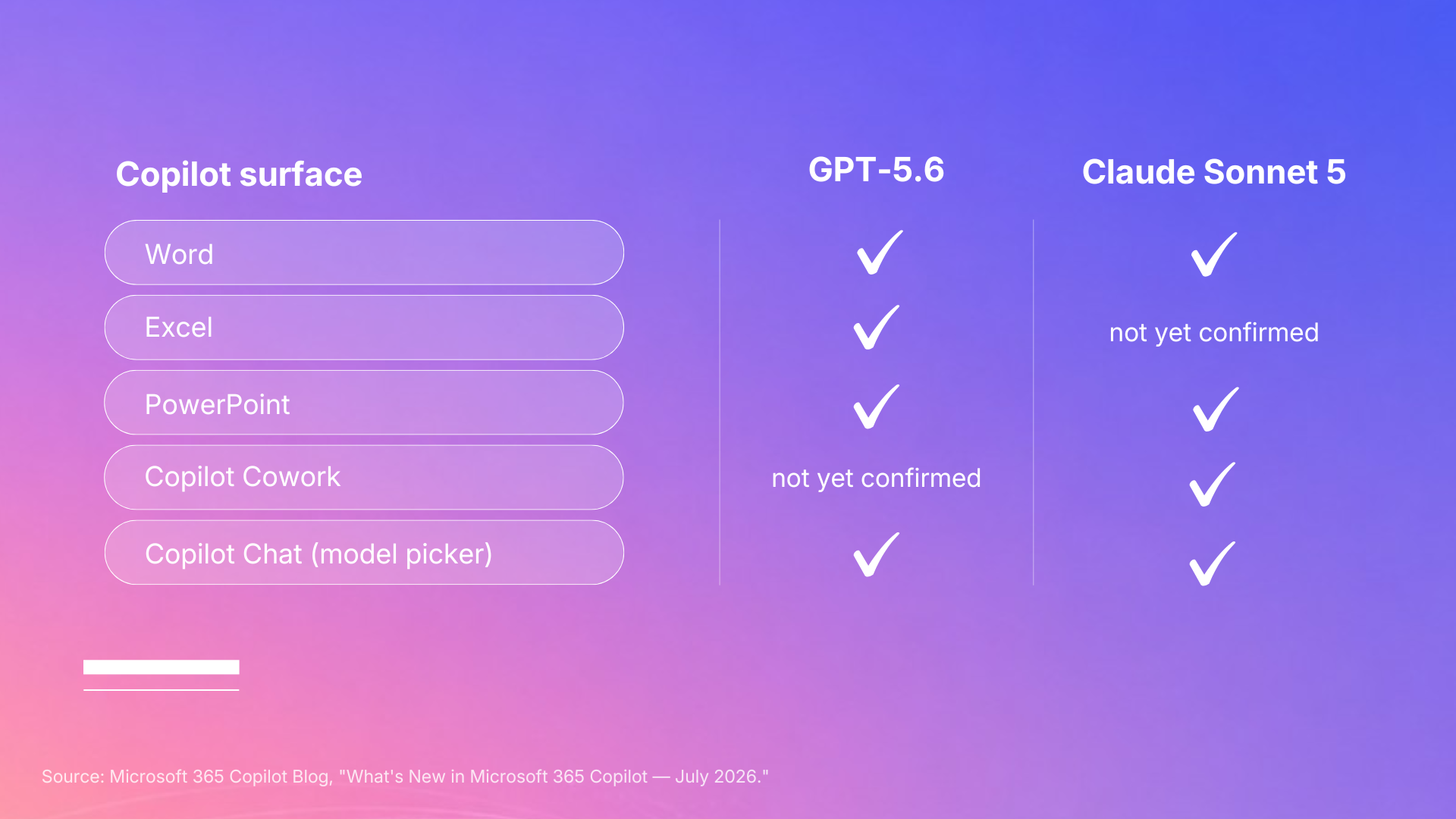
According to Microsoft, these models bring stronger reasoning capabilities and are designed to handle increasingly complex, multi-step work.
This matters because the conversation around AI is evolving. The first wave focused heavily on productivity. How quickly can we draft an email? How easily can we summarise a meeting? How much time can we save?
The next wave is about something very different.
It's about helping people navigate complexity.
It's about connecting information across teams, projects and systems.
It's about turning fragmented organisational knowledge into actionable insight.
Here's a surprising statistic: McKinsey Global Institute research has long suggested that knowledge workers spend around a fifth of their working week looking for information or expertise hidden somewhere within the organisation. Imagine if AI's greatest contribution isn't creating new content, but helping people rediscover what their organisation already knows.
And that brings us to what may be the most interesting part of Microsoft's announcement.
For all the attention AI models receive, the real value of enterprise AI has never been the model itself. The value comes from context.
Microsoft's continued investment in grounding Copilot in meetings, files, conversations and organisational data reflects a growing recognition that relevance matters more than intelligence alone. A brilliant AI working with poor information is still limited. A well-informed AI that understands the context of your organisation becomes something far more powerful.
Many organisations are now discovering that their greatest AI challenge isn't technical. It's organisational.
Can employees find the information they need?
Is knowledge structured in a way AI can access and understand?
Do people know when to trust AI, when to challenge it, and how to integrate it into their daily work?
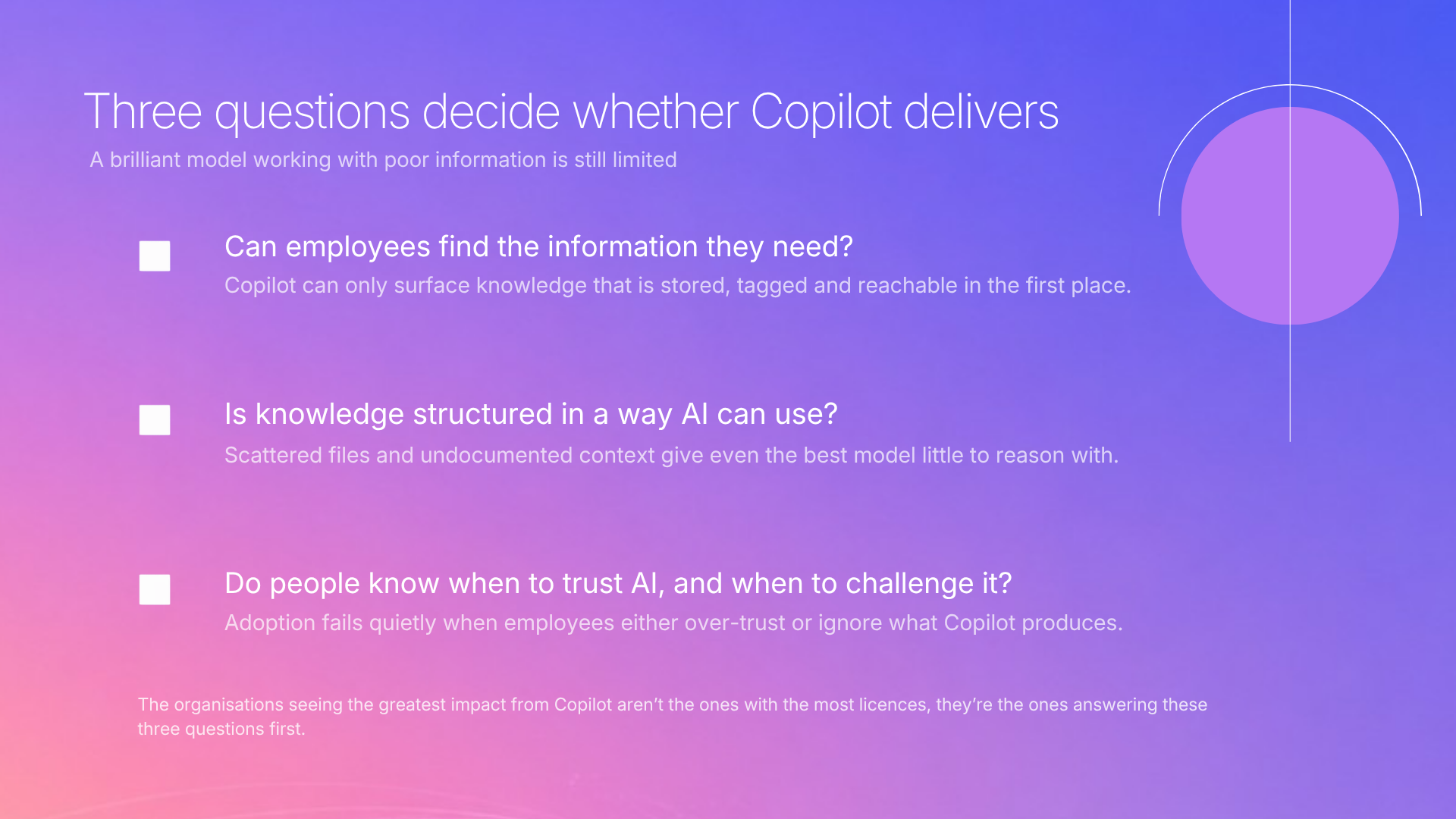
These questions sit at the heart of successful AI transformation. The organisations seeing the greatest impact from Copilot aren't necessarily those with the most licences. They're the organisations creating the conditions for adoption, putting the right governance in place and helping employees develop the confidence to work differently.
At Digital Bricks, we often describe this as the intersection of Possibility × Governance × Adoption. Microsoft's latest updates are expanding what's possible almost every month. The challenge for leaders is ensuring their organisation evolves alongside the technology.
What's striking is that many organisations still approach AI as a technology deployment, while the real challenge lies in AI adoption, AI governance and change management. The technology is moving quickly. The human side often isn't.
In many ways, AI today feels remarkably similar to the early days of email. When email first arrived, it was viewed as another productivity tool. Few could have predicted it would fundamentally change how organisations communicate, collaborate and make decisions. AI may be approaching a similar inflection point.
Because the real story behind Microsoft's July announcement isn't that Copilot has gained new features.
It's that AI is steadily becoming a more active participant in work.
Applications are fading into the background. Conversations are becoming workflows. Organisational knowledge is becoming more accessible. And employees are beginning to collaborate with AI in much the same way they collaborate with colleagues.
One final thought. The spreadsheet has been around for almost half a century. Today, it's so embedded in business that we barely notice it. There's a good chance we'll look back at AI in ten years the same way: not as a breakthrough technology, but as a normal part of getting work done.
Whether organisations realise that value, however, will depend on far more than technology. Success will rely on how effectively they unlock knowledge, create trust, establish governance and help employees build new habits. In other words, success will depend on whether they can turn AI capability into real organisational change.
The technology is moving quickly. The more interesting question is whether organisations are ready to take advantage of what it makes possible.
Microsoft is showing us where AI is heading. The more important question is where your organisation is on that journey. If you're exploring how to turn AI capability into meaningful business value, we'd love to talk.


Unlock exclusive insights and stay ahead in the digital world. No spam, only useful content.