Back to Blog
From Fear to Empowerment: Why AI Adoption Starts with Human Confidence

September 4, 2026
•
AI Adoption


For all the discussion about copilots, agents, automation and the future of work, the biggest obstacle to AI adoption isn't technical. It's emotional.
Most organisations don't struggle with AI because the tools aren't powerful enough. They struggle because people are uncertain about what AI means for their role, their expertise and their future. This is the uncomfortable truth sitting beneath many AI transformation initiatives. Leaders purchase licences, launch pilot programmes and announce ambitious AI strategies. Yet adoption often stalls because fear spreads faster than capability. When people express concerns about AI, they are rarely worried about large language models or machine learning architectures. They are worried about something far more personal: relevance.
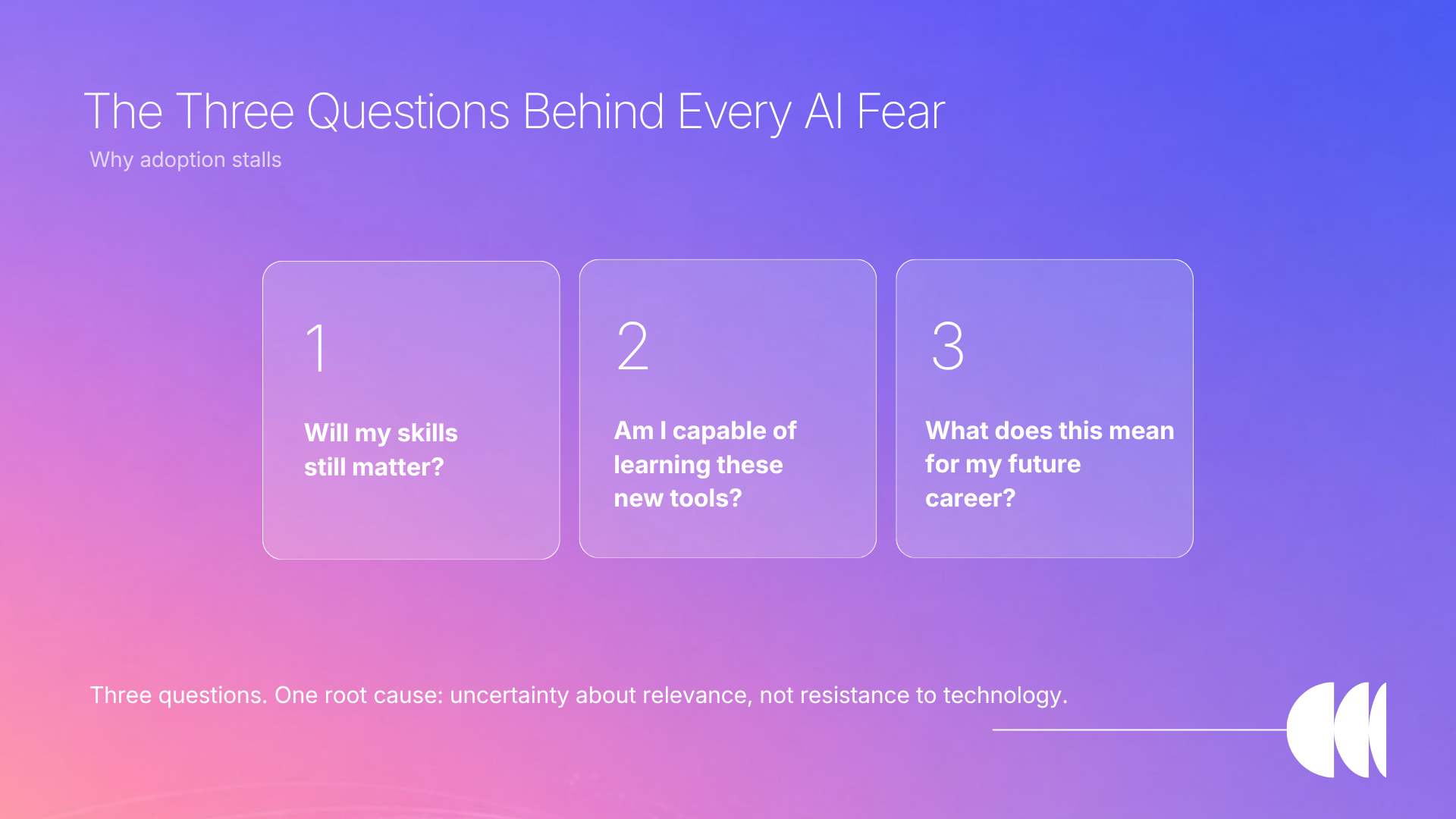
For decades, professional value has been linked to knowledge. The more expertise you accumulate, the more indispensable you become. Generative AI appears to challenge that assumption. A tool can produce a first draft, summarise a meeting, analyse a spreadsheet or generate code within seconds. The immediate question isn't whether the technology works. The immediate question is where that leaves the human being. Most AI anxiety can be traced back to three concerns: Will my skills still matter? Am I capable of learning these new tools? What does this mean for my future career?
These concerns are understandable. Every major technological shift has produced similar reactions. The difference is that AI has arrived at unprecedented speed and is impacting knowledge work directly. As a result, organisations are discovering that successful AI transformation depends less on technology deployment and more on helping people navigate uncertainty.
One of the most misunderstood aspects of AI adoption is resistance itself. When employees hesitate to engage with AI, leaders sometimes interpret it as reluctance to change or a lack of innovation mindset. In reality, resistance is often a rational response to uncertainty. People are being asked to adopt technology that is evolving weekly. The capabilities appear impressive, the headlines are often contradictory and the long-term implications remain unclear. For many employees, the challenge is not learning how to use AI. The challenge is understanding how they fit into an AI-enabled future. In periods of uncertainty, people seek stability. They look for signals that their experience still matters, that their contribution remains valued and that learning new skills will strengthen rather than diminish their position. When organisations fail to provide that reassurance, employees often default to caution. Adoption slows. Experimentation decreases. Valuable lessons remain hidden. The technology exists, but the confidence required to unlock its value does not. This is why communication has become a strategic capability in AI transformation. People do not simply need training on how AI works. They need a clear and believable narrative about why AI is being introduced, how success will be measured and what opportunities it creates for them personally.
Few narratives have dominated the AI conversation as much as the idea that AI will replace workers. It's an understandable fear, but it is increasingly misaligned with what leading organisations are actually seeing. The emerging reality is not one of wholesale job replacement. It is one of task redistribution.
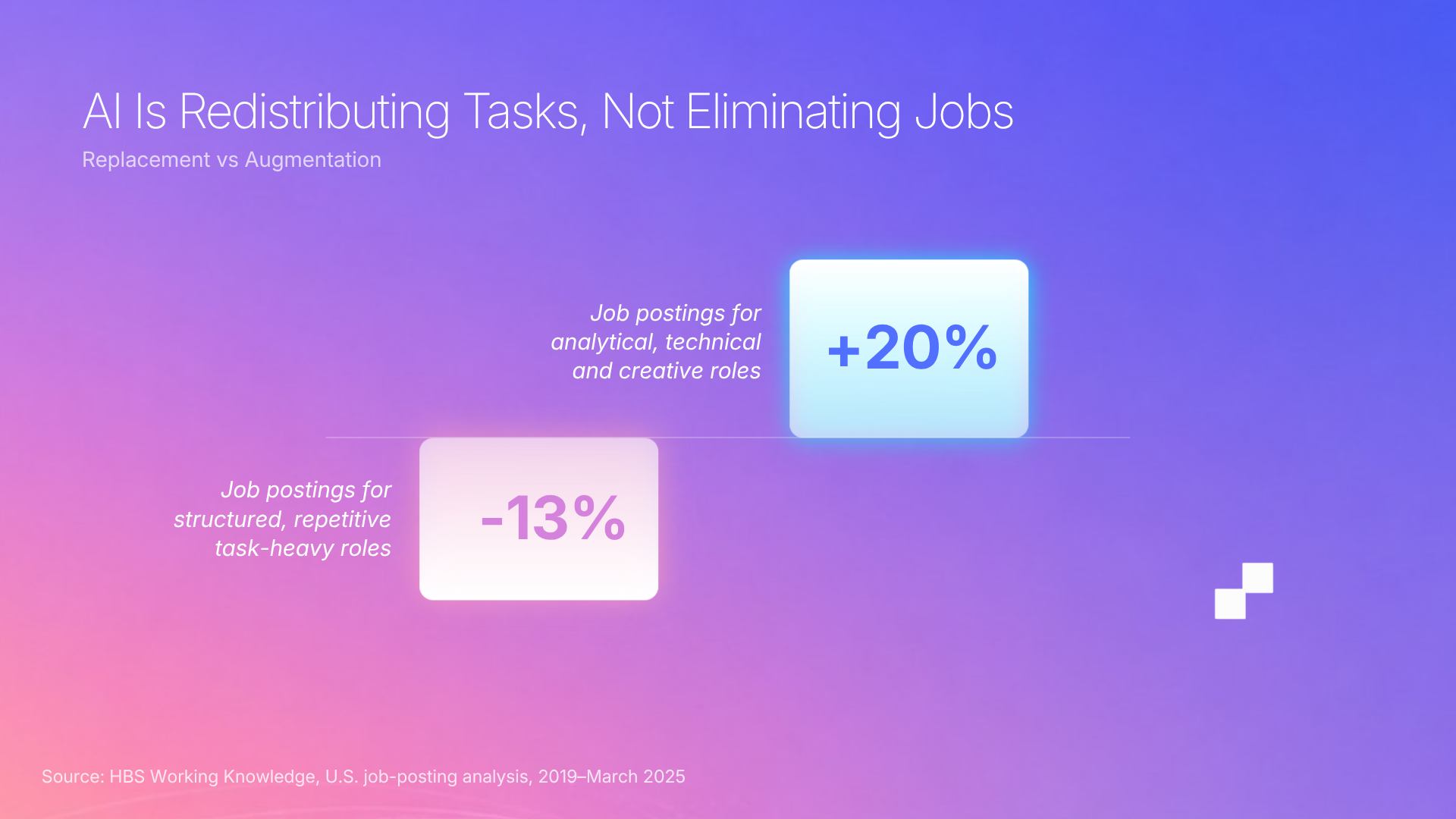
AI is exceptionally good at handling repetitive administrative activities, gathering information, generating first drafts and accelerating routine processes. What remains indispensable are the distinctly human capabilities that organisations depend on for competitive advantage: judgement, creativity, emotional intelligence, accountability, relationship building and contextual decision-making. This distinction matters because jobs are not simply collections of tasks. Most roles combine technical execution with interpersonal communication, strategic thinking and nuanced decision-making. Eliminating a task does not automatically eliminate a profession.
In fact, the organisations generating the greatest value from AI are adopting a fundamentally different mindset. Rather than asking how many employees AI can replace, they are asking how much more capable their employees can become when supported by AI. This is the principle behind augmentation. The most advanced organisations are building teams where humans and AI work together, each contributing their respective strengths. AI provides speed, scale and information processing. Humans provide direction, judgement and responsibility.
The result is not smaller organisations, the result is more capable organisations.
One of the clearest indicators of AI maturity is not the sophistication of the technology being used. It is the behaviour of the people using it. Employees who feel confident working with AI tend to approach the technology differently from those who remain sceptical or anxious. They experiment more frequently. They challenge outputs rather than accepting them blindly. They collaborate with colleagues to share prompts and techniques. They think creatively about where AI can remove friction from everyday tasks. Most importantly, they view AI as a partner rather than a threat.
This mindset shift has a compounding effect. People who use AI regularly become better at recognising opportunities. Better outcomes create greater trust. Greater trust leads to deeper engagement. Over time, confidence becomes capability. The opposite is also true. Employees who interact with AI reluctantly often use it infrequently, limiting their ability to develop practical skills. Because they see fewer benefits, they remain unconvinced of its value. Their uncertainty persists, reinforcing low adoption.
This is why sustained engagement matters far more than one-off training sessions. Confidence is built through repetition, curiosity and practical application.
This is where many leadership teams underestimate the challenge. They focus on governance. They focus on technology. They focus on use cases. What they often overlook is confidence.
Employees will not experiment with AI if they fear making mistakes. They will not share what they've learned if they worry about being judged. They will not challenge AI outputs if they assume the technology is always correct. Consequently, psychological safety has become one of the most important factors in successful AI adoption.
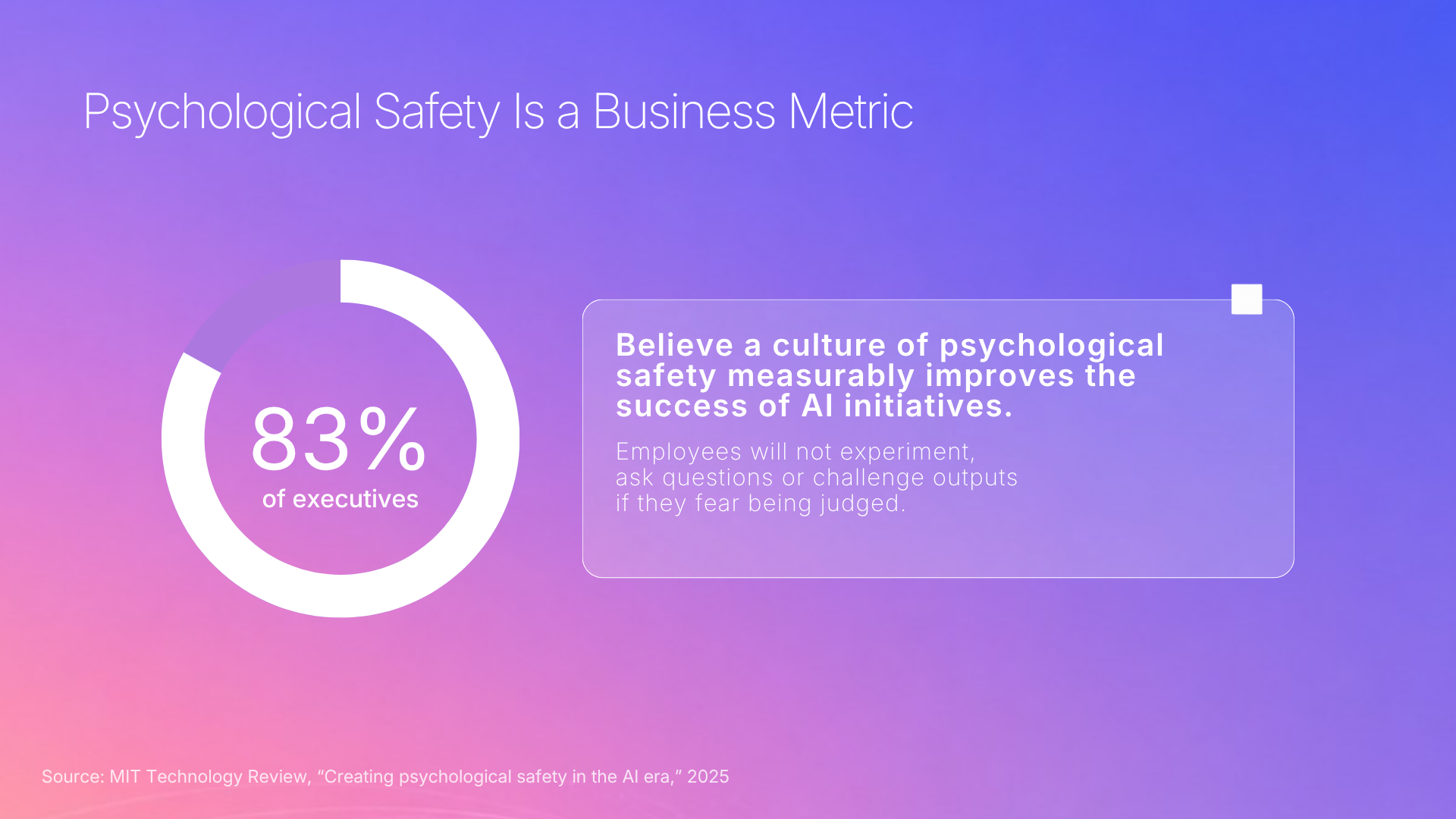
The highest-performing organisations are creating environments where employees can ask basic questions without embarrassment, experiment with new tools safely, share lessons learned and build practical experience without fear of failure. Because confidence is not built through executive presentations. Confidence is built through successful interactions. Every useful prompt, every better outcome and every time-saved task gradually transforms anxiety into familiarity. Familiarity creates understanding. Understanding creates trust.
This is also why AI literacy has become such a critical topic across Europe. The conversation has evolved beyond teaching people how to write prompts. AI literacy is about helping employees understand where AI creates value, where its limitations exist and when human oversight is essential. It provides the foundation that allows individuals to use AI confidently rather than cautiously. Increasingly, organisations are recognising that literacy is not a compliance activity. It is a capability-building activity. And capability is what ultimately drives adoption.
The organisations succeeding with AI are not necessarily those investing the most in technology. They are often the organisations investing the most in people. Leaders play an outsized role in shaping how employees perceive AI. When leadership communication focuses exclusively on efficiency, automation and cost reduction, employees naturally worry about their future. When communication focuses on empowerment, growth and capability-building, a different mindset begins to emerge. Employees pay close attention to the messages they're receiving. Are leaders talking about replacing work or improving work? Are they celebrating experimentation or only highlighting productivity metrics? Are they creating opportunities for learning or simply expecting adoption? The answers to these questions influence whether AI is viewed as a threat or an opportunity. The leadership challenge is therefore not just technological. It is cultural. Leaders must create an environment where curiosity is rewarded, learning is continuous and human expertise remains central to organisational success.
The next phase of AI transformation will not be defined by who has access to the most advanced model. The technology is rapidly becoming accessible to everyone. The real differentiator is whether organisations can create the conditions for people to embrace it.
Can leaders create trust? Can teams experiment safely? Can employees understand how AI enhances rather than diminishes their expertise? Can organisations equip their workforce with the confidence to work alongside intelligent systems? These questions are becoming far more important than questions about features and functionality.
At Digital Bricks, we believe sustainable AI transformation happens at the intersection of possibility, governance and adoption. Technology alone does not create transformation. People do. That is why our approach combines AI literacy, practical enablement, governance and change management into a single adoption journey. The objective is not simply to deploy AI tools. The objective is to help people understand them, trust them and use them with confidence. Because the organisations that will lead in the age of AI are not necessarily those with the most technology. They are those that empower their people to use it, and that journey always starts in the same place: Not with AI but with human confidence.


Unlock exclusive insights and stay ahead in the digital world. No spam, only useful content.