Back to Blog
AI Literacy Under the EU AI Act: Why It Matters More Than You Think

August 31, 2026
•
Responsible AI


Most organisations think AI literacy is about compliance. The smartest organisations know it's about capability. The arrival of the EU AI Act has sparked a wave of questions from business leaders across Europe.
"Does this apply to us?"
"Do we need AI training?"
"What exactly is AI literacy?"
And perhaps the most common question:
"How much do we actually need to do?"
These are understandable concerns. The EU AI Act introduces the world's first comprehensive framework for regulating artificial intelligence, and Article 4 places a clear responsibility on organisations to promote AI literacy among employees using AI systems. But before we talk about laws, obligations and governance, let's start with something much simpler. Let's talk about bicycles.
Imagine giving a nine-year-old a brand-new bicycle. The bicycle works perfectly. It is modern, fast and full of features. You hand it over and say: "Good luck."
What happens next? The child may figure it out eventually. But they'll probably wobble. They may crash. They might avoid riding altogether because they're nervous. Or they might become overconfident and take unnecessary risks. Now imagine a different approach. You spend some time teaching them:
The bicycle hasn't changed. The person's ability to use it has. That's AI literacy. AI systems are becoming the new bicycle of the workplace. The technology is increasingly available to everyone. What determines success is not access to the tool. It's whether people know how to use it properly.
Whenever AI risks are discussed, people often assume the technology itself is the problem. In reality, the biggest risks usually emerge when people don't understand the technology they're using. Let's use another simple example. Imagine a calculator. If a calculator tells you that 2 + 2 = 17, most adults immediately know something is wrong. Why? Because they already understand basic mathematics. They don't blindly trust the tool. They evaluate the answer.
Now imagine someone using a tool for something they know very little about. They may assume every answer is correct simply because a computer generated it. This is where organisations can get into trouble. Large language models such as Microsoft Copilot, ChatGPT and other generative AI systems can provide incredibly useful outputs. They can summarise information, generate content, analyse documents and assist decision-making.
However, they can also:
Someone who understands these limitations will use AI intelligently. Someone who doesn't may trust every answer without question. The technology hasn't changed. The user has.
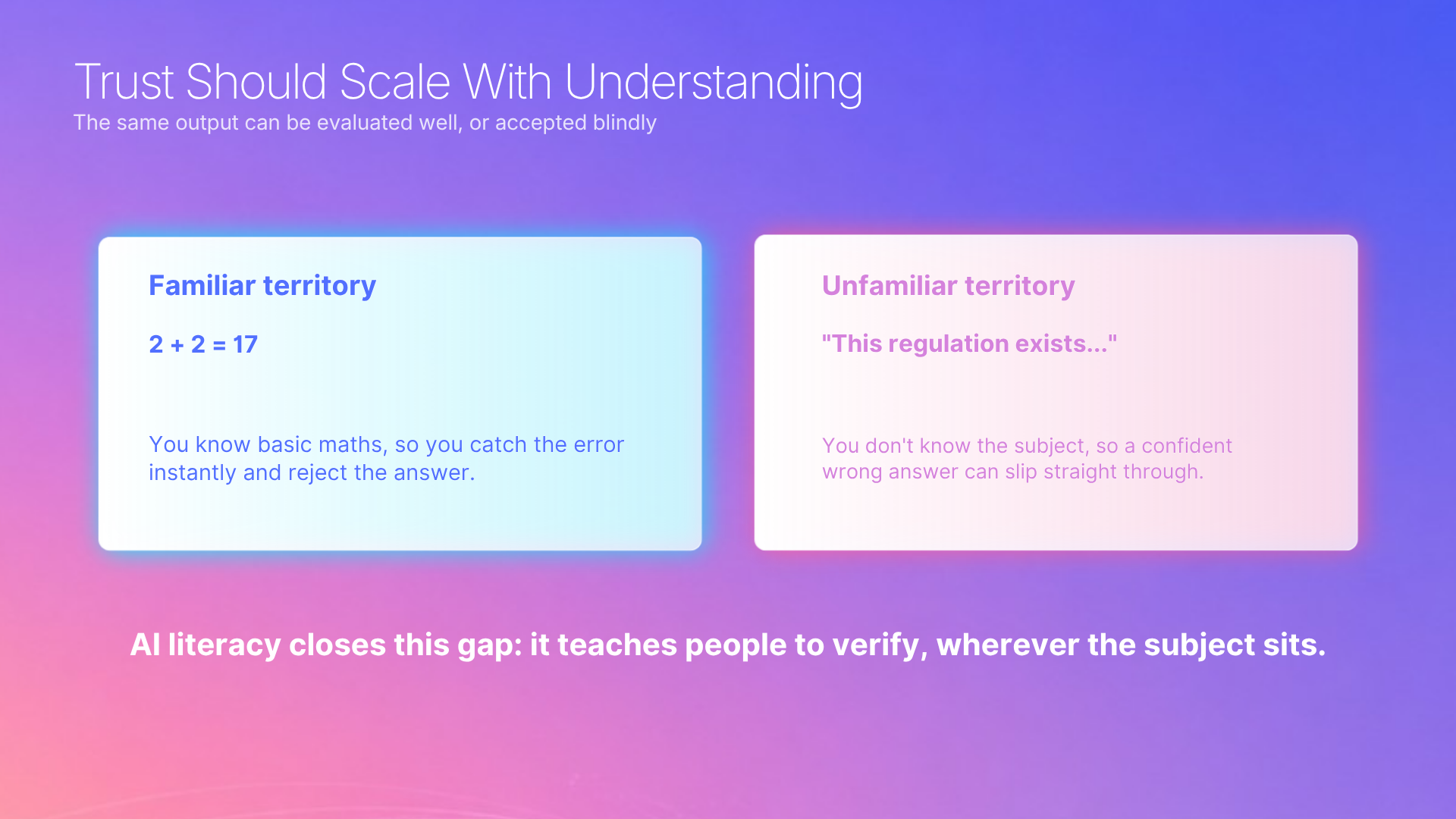
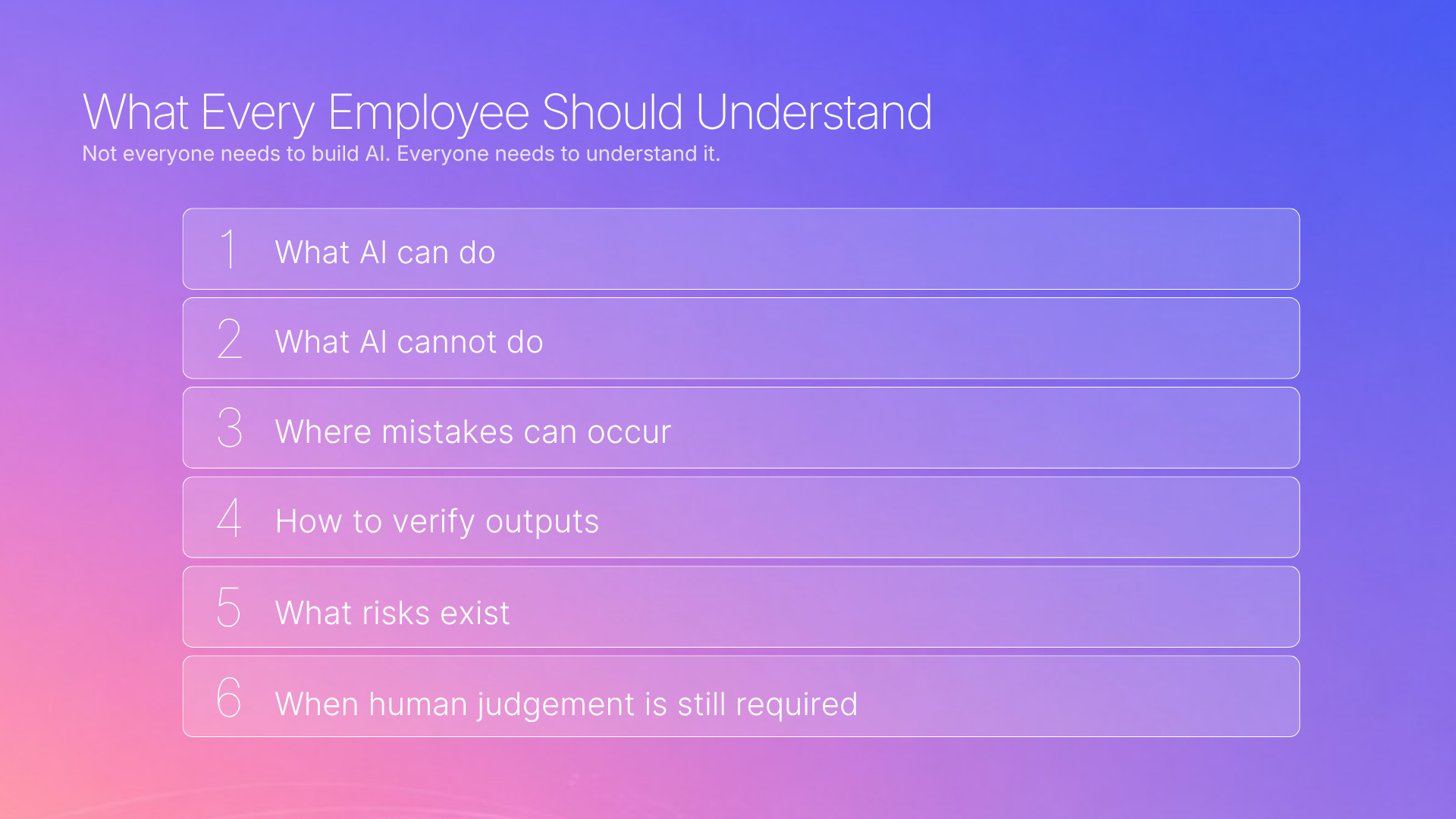
The term sounds complicated, but the concept is actually very straightforward. AI literacy means having enough knowledge and understanding to use AI responsibly and effectively. Not everyone needs the same level of literacy. Just as not everyone needs to be a mechanic to drive a car, not everyone needs to be an AI engineer to use AI. A finance manager doesn't need to build machine learning models. A HR professional doesn't need to understand neural network architecture. A marketing executive doesn't need to write Python code.
But all of them should understand:
That's AI literacy.
The European Union recognised something important. Most discussions about AI governance focus on technology. Organisations implement policies. They establish approval processes. They create risk controls. All of this matters. But none of it works if the people using AI don't understand what they're doing.
Imagine installing hundreds of traffic lights but never teaching anyone how traffic rules work. Road safety would still be a problem. Similarly, an organisation can have excellent AI policies and governance frameworks, but if employees don't understand concepts such as hallucinations, bias in source material, privacy risks or human oversight, those policies become much less effective. This is one of the reasons Article 4 requires organisations to take measures to promote AI literacy. The Act recognises that responsible AI begins with responsible people.
Let's look at some real-world examples.
Example 1: The Marketing Team
A marketing employee asks an AI assistant to write an article about industry regulations. The AI generates a professional-looking response. The employee publishes it immediately. Later, it turns out several of the regulations referenced don't actually exist. The employee assumed confidence meant accuracy. A more AI-literate employee would have verified the sources first.
Example 2: The HR Department
A recruiter uses AI to shortlist candidates. The system recommends certain applicants and rejects others. If the recruiter blindly follows those recommendations, they may overlook strong candidates or introduce unfair outcomes. An AI-literate recruiter understands that AI can support human decisions but should not replace human judgement.
Example 3: The Child And The Homework
Imagine a child asking AI: "Why is the sky blue?" The AI gives an answer. An AI-literate child doesn't simply copy it. They remain curious. They ask follow-up questions. They compare answers. They check other sources.
In many ways, AI literacy is simply teaching adults the same critical thinking skills we encourage in children.
Many organisations currently see AI literacy as a compliance requirement. That perspective misses the bigger opportunity. The most successful AI transformations don't happen because organisations buy better tools. They happen because people learn how to use those tools effectively.
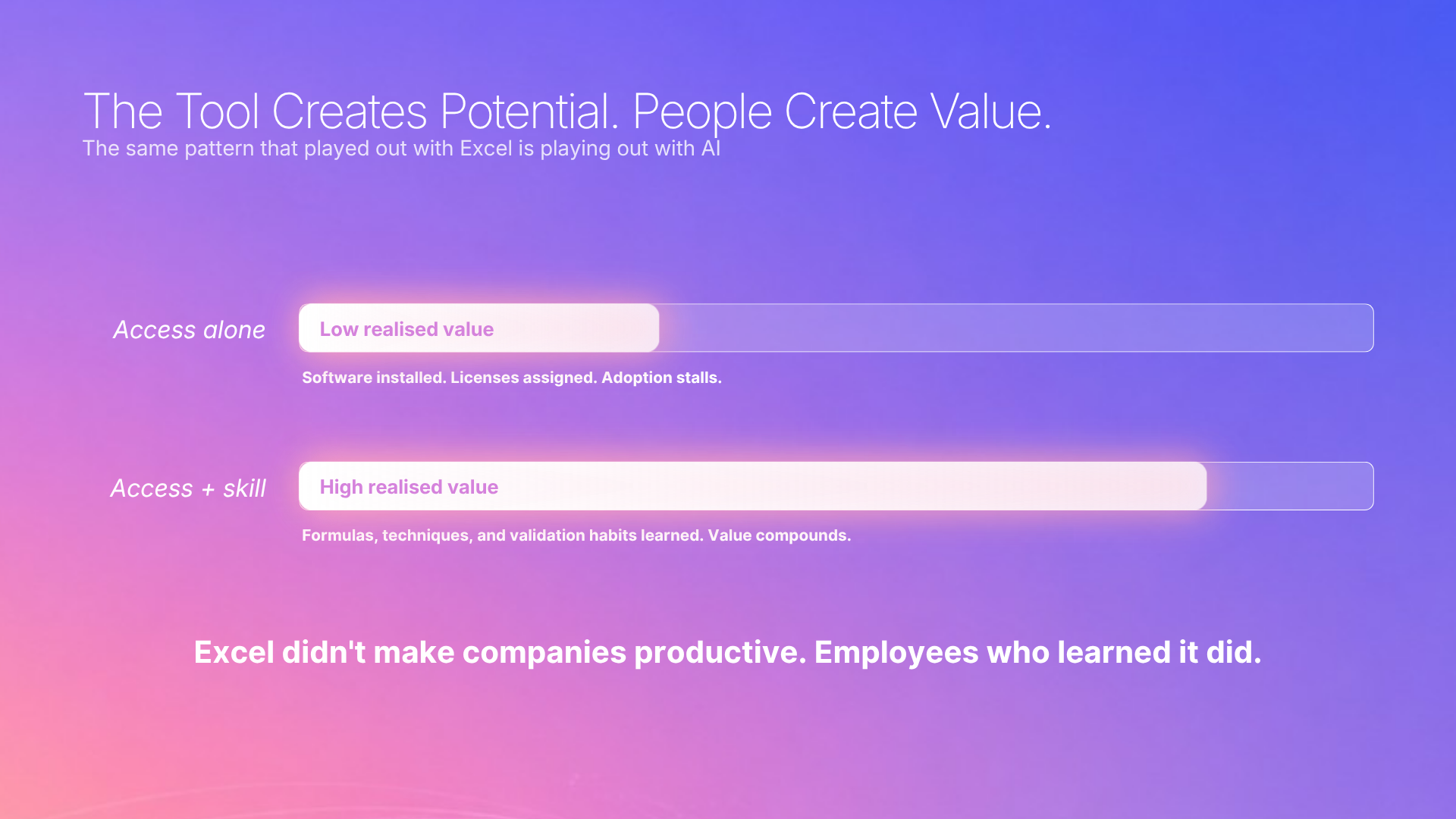
Think about Microsoft Excel. When Excel first appeared, simply having the software did not automatically make companies more productive. The value came from employees learning:
AI works the same way, a pattern confirmed by Microsoft's own Work Trend Index research into workplace AI adoption. The tool creates potential. People create value. An employee who understands prompting techniques, validation methods and responsible use principles will often achieve dramatically better outcomes than someone who simply has access to the same technology.
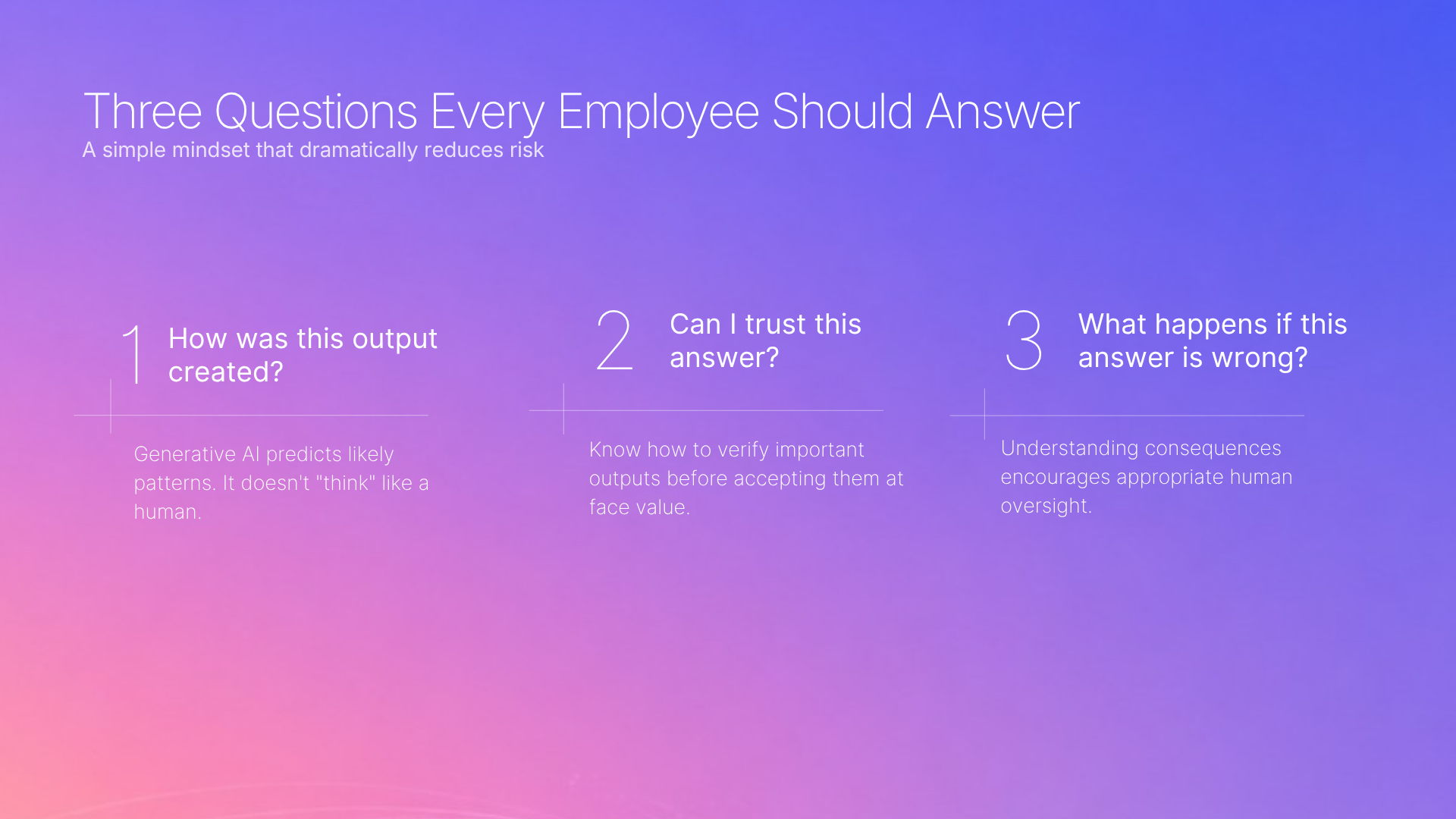
If your employees can answer these questions confidently, you are already making progress toward AI literacy.
1. How was this output created?
People should understand that generative AI predicts likely patterns rather than "thinking" like a human.
2. Can I trust this answer?
Employees should know how to verify important outputs rather than accepting them at face value.
3. What happens if this answer is wrong?
Understanding consequences encourages appropriate human oversight.
This simple mindset dramatically reduces risk while improving quality.
The organisations achieving the greatest success with AI are not necessarily the ones with the largest budgets. They are often the organisations whose employees feel confident using AI appropriately. Confident enough to experiment. Confident enough to challenge outputs. Confident enough to recognise limitations. And confident enough to combine human judgement with machine assistance.
That's what AI literacy really creates. Not compliance. Not certificates. Not training records. Capability.
Because in the end, AI will not transform organisations on its own. People will. And the organisations investing in AI literacy today will be the ones best positioned to realise the full value of AI tomorrow.
Article 4 is really just the compliance floor. The organisations getting real value from AI treat literacy as the foundation beneath everything else, the piece that has to be in place before governance frameworks or adoption programmes can actually work. That's the thinking behind how we approach AI transformation at Digital Bricks, built on people who genuinely understand the tools they're using.
If you're figuring out what that looks like for your own teams, whether it's a literacy baseline, a governance framework, or a broader adoption roadmap, we're happy to talk it through.


Unlock exclusive insights and stay ahead in the digital world. No spam, only useful content.