Back to Blog
AI Act Transparency Obligations: What the End of "Invisible AI" Means for Organisations

August 9, 2026
•
Responsible AI


For the last two years, the race in AI has been about making technology feel more human.
Chatbots have become conversational. Voice assistants sound natural. AI agents are increasingly capable of carrying out tasks on our behalf. The line between human and machine interaction is becoming harder to spot.
That evolution has created a new challenge: what happens when people can no longer tell whether they are interacting with a human or AI?
From 2 August 2026, the European Union's AI Act introduces a set of transparency obligations designed to answer precisely that question. While much of the conversation around AI regulation focuses on high-risk systems and governance requirements, Article 50 of the AI Act addresses something far more fundamental: ensuring people know when AI is involved.
For organisations deploying AI, this is not simply another compliance requirement. It is a sign of where the future of AI adoption is heading: towards greater transparency, accountability and trust.
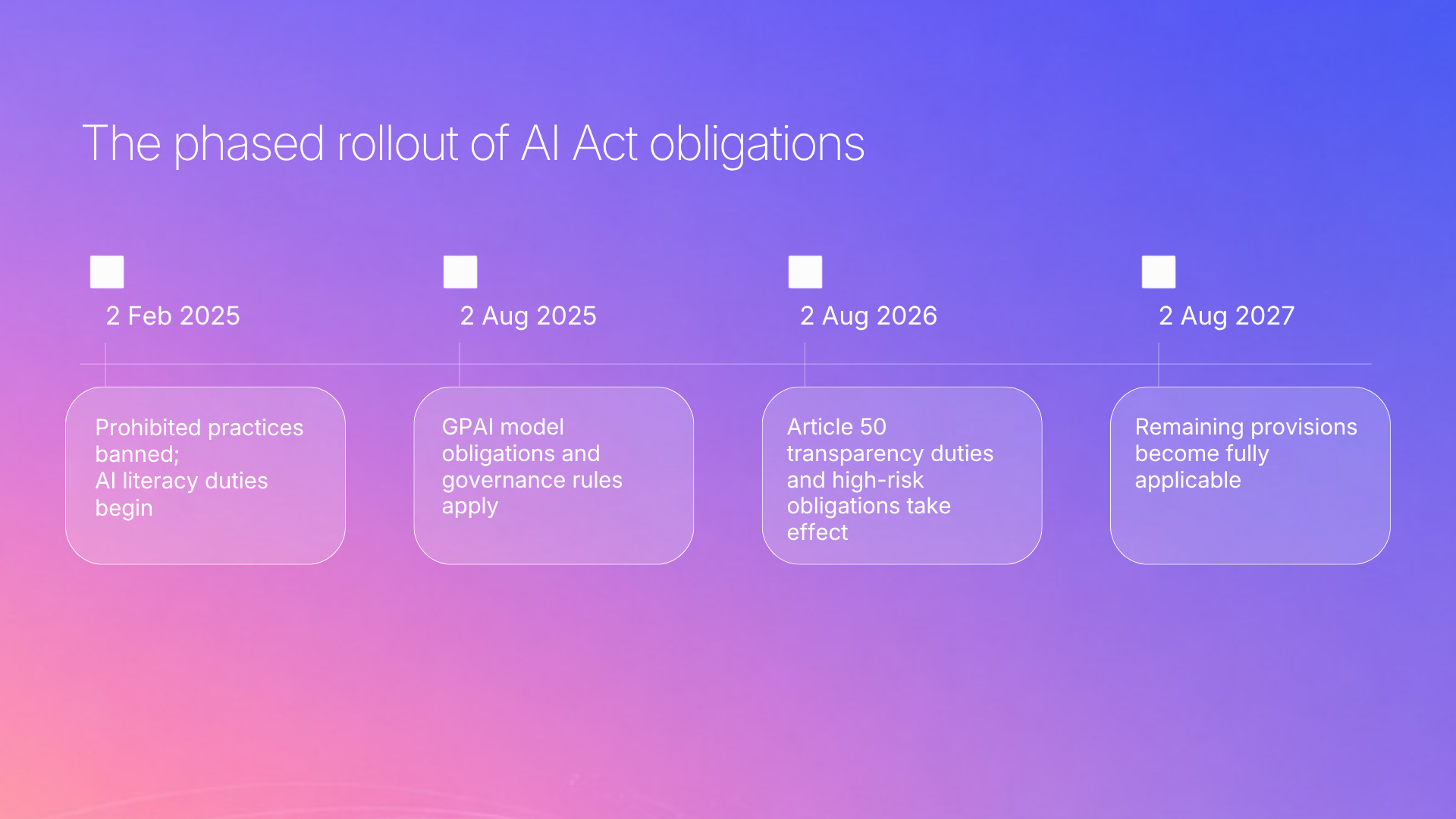
The AI Act establishes four categories of transparency obligations covering AI systems that:
Interact directly with people. Generate or manipulate synthetic content. Perform emotion recognition or biometric categorisation. Generate deepfakes or AI-generated content on matters of public interest.
These requirements come into force on 2 August 2026 and can apply to both AI providers and, in some cases, organisations deploying AI solutions within their own operations. Non-compliance may result in fines of up to €15 million or 3% of global annual turnover.
The objective is straightforward: people should be able to recognise when they are interacting with AI and when content has been generated or manipulated by AI systems. The broader goal is to reduce risks associated with deception, misinformation, impersonation and manipulation while preserving trust in digital interactions.
The transparency obligations arrive at a time when AI systems are becoming increasingly realistic.
In the early days of automation, identifying a machine was easy. Robotic responses stood out. Synthetic voices sounded artificial. AI-generated content often felt awkward or generic.
Today, that distinction is rapidly disappearing.
Modern AI systems can hold convincing conversations, generate photorealistic content and perform tasks that many users associate with human intelligence. While this creates significant opportunities for productivity and innovation, it also introduces new risks.
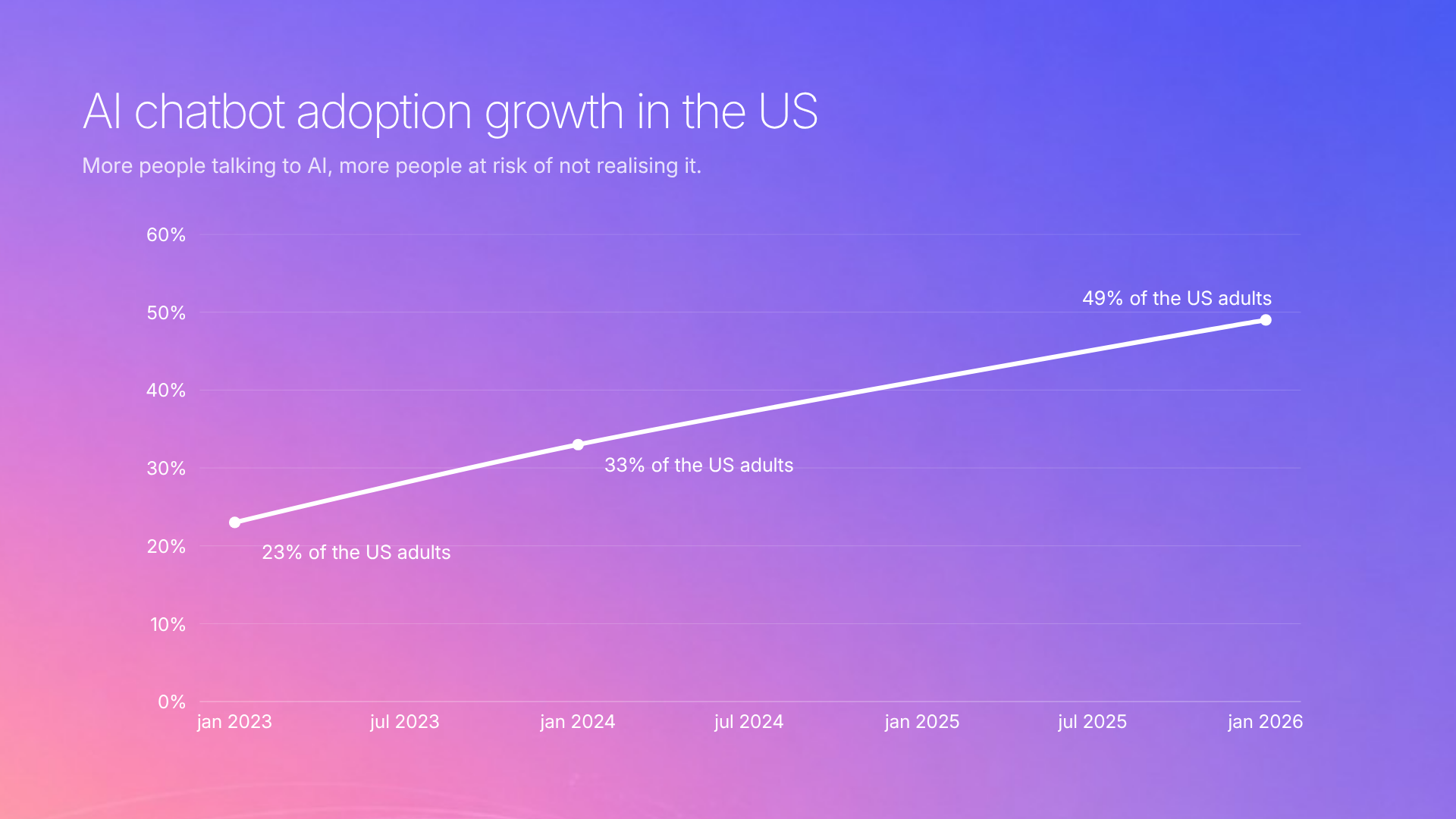
When people mistakenly believe they are interacting with another person, they may place greater trust in responses, share sensitive information or make decisions based on assumptions that are no longer accurate. According to the European Commission's interpretation of Article 50, transparency is intended to address precisely these concerns.
The result is a simple but powerful principle: if AI is part of the interaction, users should understand that.
One of the most discussed aspects of Article 50 concerns AI systems that directly interact with people.
This includes obvious examples such as customer service chatbots, virtual assistants and AI-powered hotlines. However, the scope is broader than many organisations initially assume. Social media bots, AI companions, voice interfaces and increasingly autonomous AI agents may also fall within scope.
The key consideration is whether a natural person is directly interacting with an AI system.
That sounds straightforward until organisations begin deploying AI across complex workflows. In many environments, human and AI contributions become intertwined. A customer query may begin with an AI assistant before being transferred to a human agent. An employee may use AI-generated suggestions while maintaining final control over communications.
These scenarios create an important distinction. The transparency obligation focuses on who is effectively participating in the interaction. Where AI is directly engaging with individuals, disclosure may be required. Where meaningful human involvement remains central to the exchange, the assessment becomes more nuanced.
For organisations embracing AI-powered services, understanding this distinction will become increasingly important.
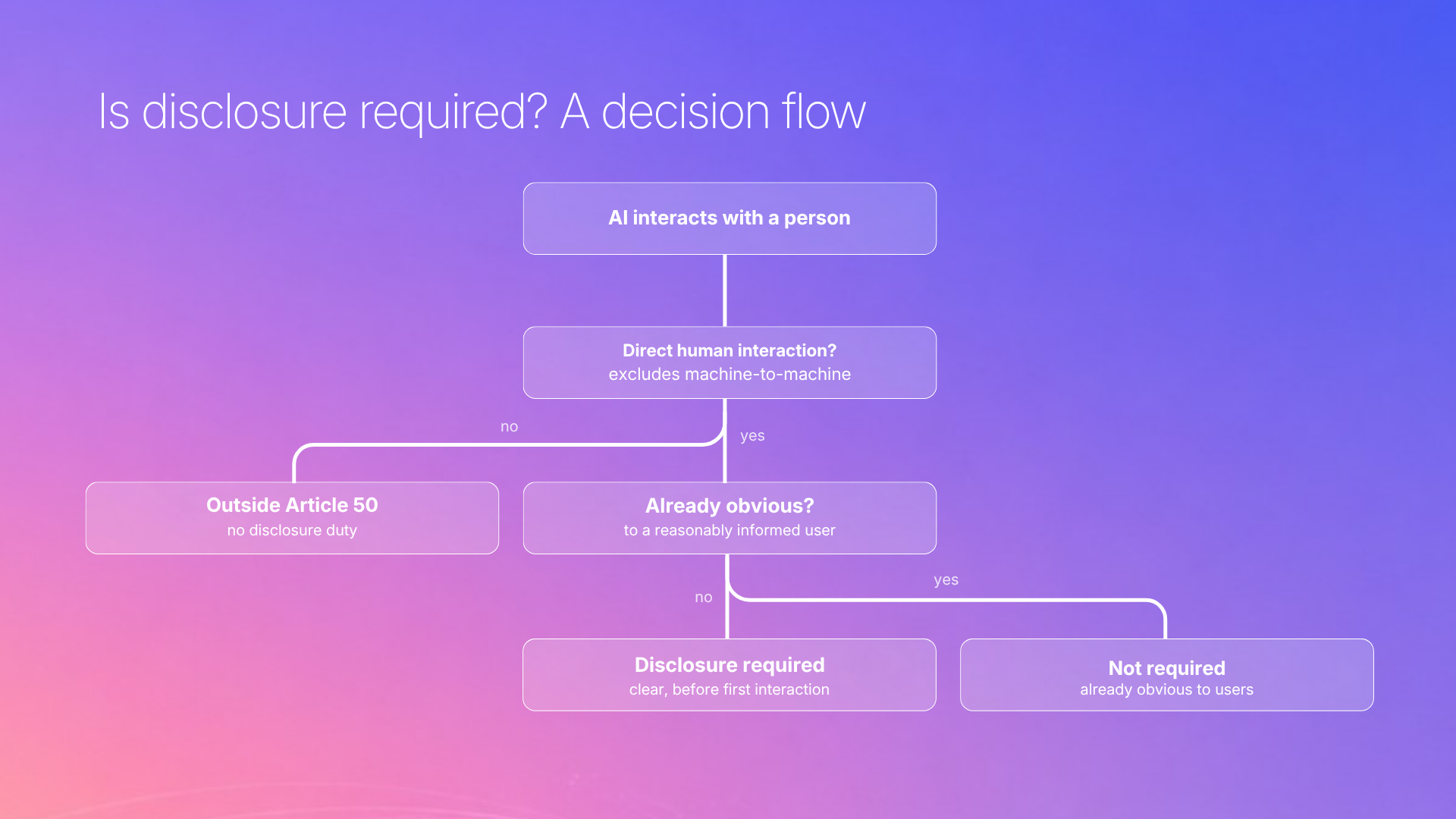
One of the most interesting elements of the AI Act is the exception for situations where it is already obvious that someone is interacting with AI.
If a reasonably informed person would clearly recognise that a system is AI-driven, disclosure may not be necessary.
The challenge, of course, is determining what "obvious" actually means.
The European Commission has indicated that this exception should be interpreted narrowly. Organisations must consider both their intended audience and anyone reasonably likely to encounter the system. Factors such as age, accessibility and digital literacy may all influence the assessment.
This creates a fascinating paradox.
The more realistic and human-like an AI system becomes, the less obvious its nature may be. As a result, the systems that organisations invest most heavily in making natural and intuitive may also require the most explicit forms of transparency.
In other words, success in AI design can increase the importance of disclosure rather than reduce it.
A common misconception is that transparency can be solved through legal notices or lengthy terms and conditions.
The AI Act takes a different view.
Providers are expected to design AI systems so that disclosure is built into the user experience itself. Information that a user is interacting with AI should be clear, distinguishable and available at the latest when the first interaction occurs. Simply hiding disclosures in documentation or technical metadata is unlikely to be sufficient.
This introduces an emerging principle that many organisations will need to embrace: transparency by design.
The question is no longer whether AI should be disclosed. The question is how organisations can make that disclosure meaningful, understandable and effective within the flow of the user experience.
For digital leaders, this shifts transparency from a legal issue to a design and adoption challenge.
Many organisations view AI transparency primarily through a compliance lens.
That is understandable, but it may be too narrow a perspective.
The organisations achieving the greatest value from AI are increasingly recognising that trust is becoming just as important as functionality. Employees need confidence in AI-assisted processes. Customers need confidence in AI-powered services. Leaders need confidence that innovation is taking place responsibly.
This is where transparency becomes more than a regulatory obligation.
It becomes an enabler of adoption.
At Digital Bricks, we often talk about successful AI transformation through three interconnected dimensions: Possibility × Governance × Adoption.
Transparency sits at the intersection of all three.
Without transparency, governance becomes difficult because people cannot clearly understand where AI is being used. Without transparency, adoption becomes challenging because uncertainty undermines trust. And without trust, even the most capable AI solutions struggle to deliver meaningful business value.
The AI Act's transparency requirements may be driven by regulation, but the underlying principle reaches much further. Organisations that develop a culture of openness around AI will likely be better positioned to scale adoption, accelerate innovation and build long-term confidence in the technology.
For years, organisations focused on making AI more capable.
Now they must also make it more visible.
The emergence of transparency obligations under the AI Act signals a broader shift in how AI will be governed, deployed and experienced. AI is moving from experimentation to everyday business reality, and with that comes greater responsibility to ensure people understand when, where and how it is being used.
The organisations that succeed in this next phase will not necessarily be those with the most AI.
They will be the ones that use it openly, responsibly and transparently.
Because in the age of AI, trust is no longer a by-product of innovation.
It is part of the product itself.
The organisations that navigate this new era most successfully won't necessarily be the ones with the most AI. They'll be the ones whose people understand it best.
That's why AI education has become such a critical part of every transformation journey. Through AI awareness sessions, adoption programmes and governance workshops, Digital Bricks helps organisations build the skills, confidence and understanding needed to use AI responsibly and effectively. Because transparency doesn't start with technology. It starts with people.


Unlock exclusive insights and stay ahead in the digital world. No spam, only useful content.