Back to Blog
The Transformation Paradox: Why AI Adoption Isn’t a People Problem

May 15, 2026
•
AI Adoption


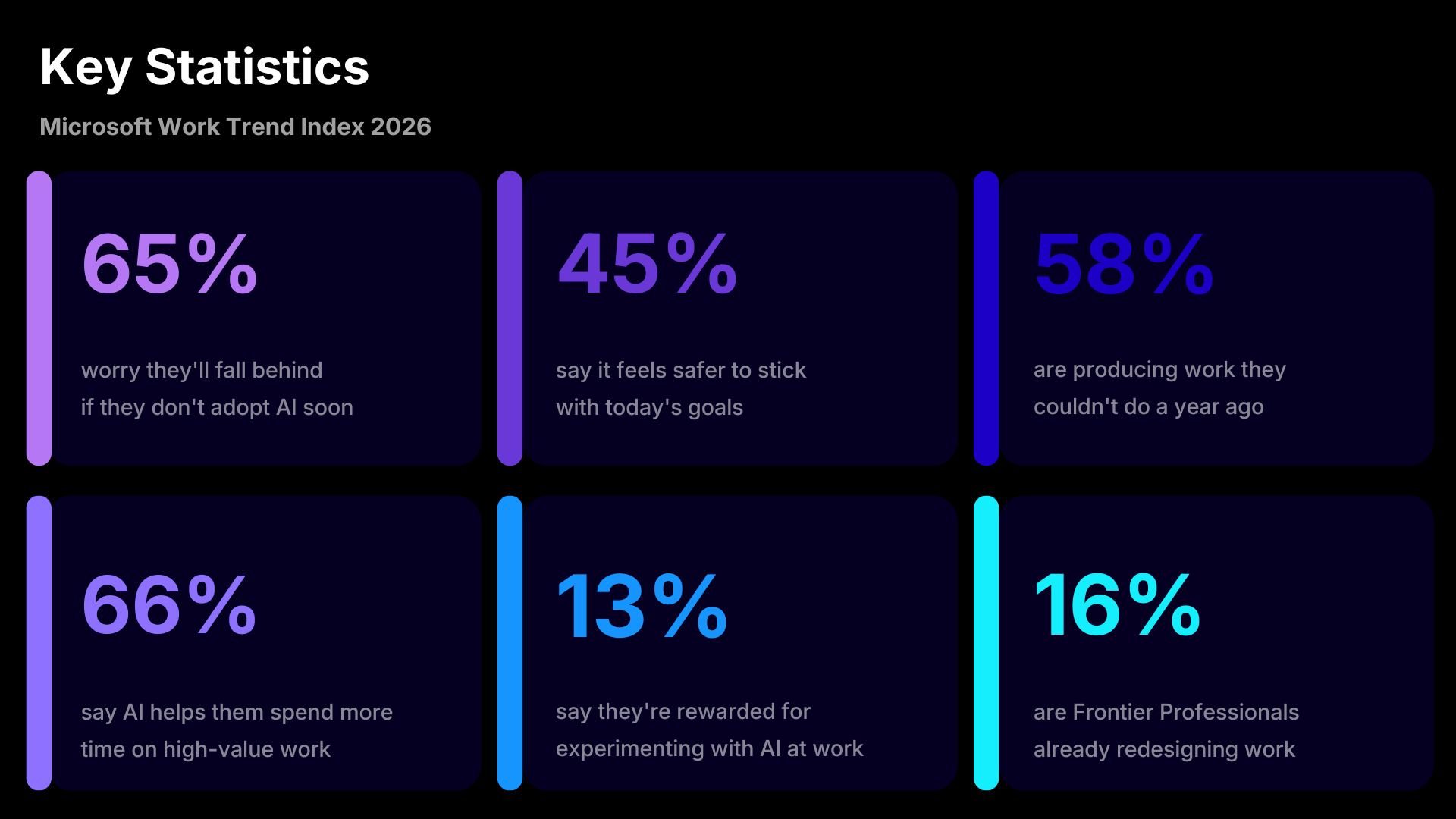
Organizations everywhere feel the tension. People can see that AI is changing how work gets done and quickly. Microsoft’s 2026 Work Trend Index found that 65% of AI users worry they’ll fall behind if they don’t adopt AI soon. Yet 45% say it feels safer to stick with today’s goals than to rethink their work with AI.
Microsoft calls this the Transformation Paradox:
People are ready to change, but their organizations aren’t set up to support it.
It’s easy to blame fear, resistance, or a lack of skills. But the data points somewhere else. The biggest obstacle to AI transformation usually isn’t the people. It’s the environment they work in.
The Work Trend Index draws on a global study of 20,000 AI users across 10 countries, plus trillions of anonymized Microsoft 365 productivity signals. One message comes through clearly:
The bottleneck isn’t the tech or the talent. It’s how work is designed and governed.
While employees want to adopt AI, the structures around them often discourage it:
The result is what researchers sometimes call “blocked agency”: people have the capability to do more, but the organization doesn’t give them the space or the permission to act on it.
AI expands what people can do, with faster analysis, sharper insight, and higher‑value output. In the same report, 58% of AI users say they’re producing work they couldn’t have done a year ago, and 66% say AI helps them spend more time on high‑value work.
But many organizations still measure success in ways that don’t match this new reality:
So people do what anyone would do: they optimize for what’s measured. Even if they believe AI matters, changing how work gets done can feel risky when deadlines, targets, and performance reviews still reward business as usual. That’s not resistance. It’s sensible risk management in a misaligned system.
The Transformation Paradox maps neatly to classic change management failure modes.
If you look at it through ADKAR (Awareness, Desire, Knowledge, Ability, Reinforcement), it becomes clear where many organizations get stuck:
In short: many organizations invest heavily in Awareness and Knowledge, but underinvest in Desire, building Ability at scale, and, most of all, Reinforcement.
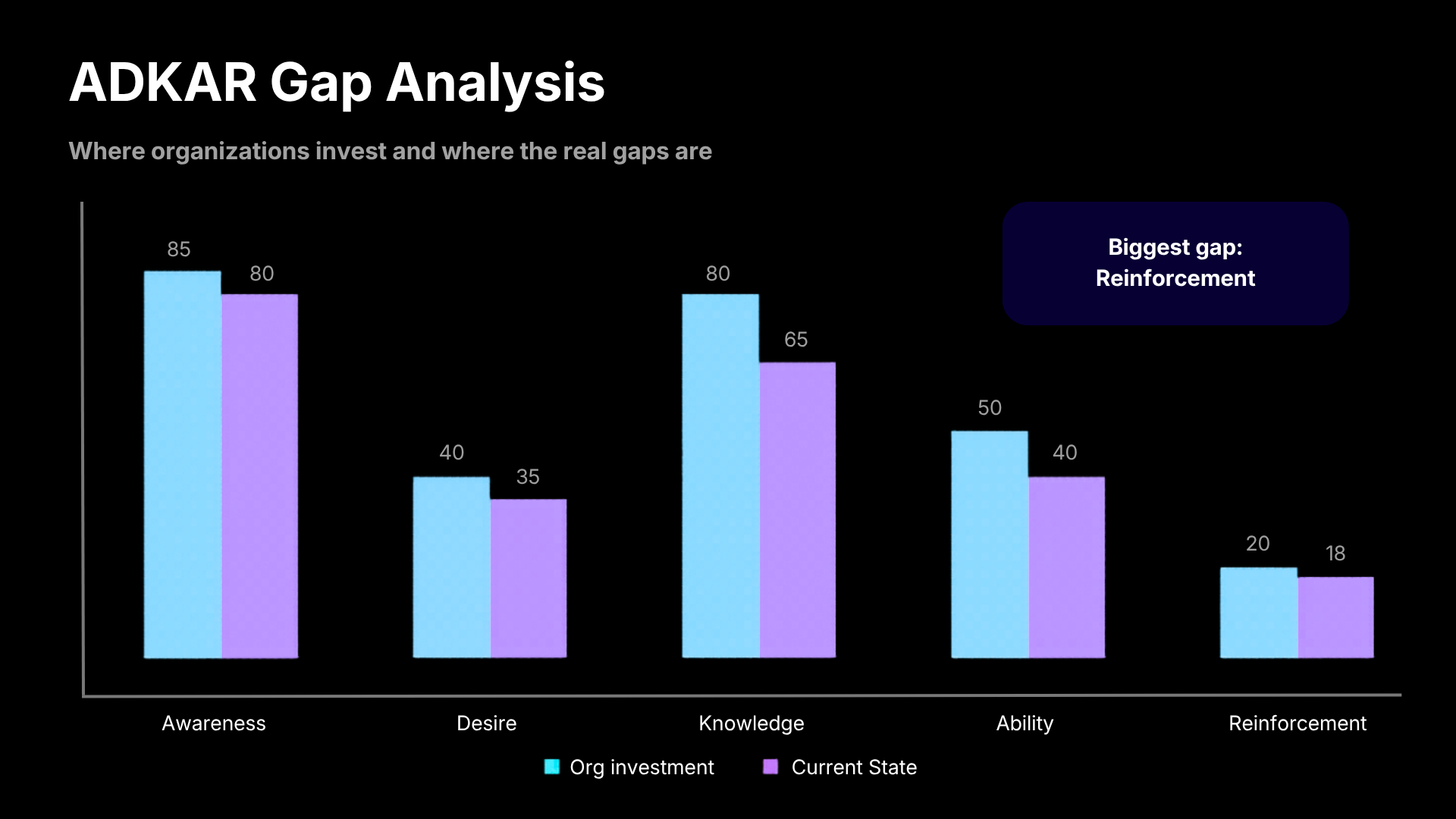
The Work Trend Index makes it clear: AI transformation doesn’t succeed just by adding tools. It succeeds when organizations re-architect work.
Here’s how change leaders can apply ADKAR at a system level:
1. Redesign Metrics Before You Redesign Roles
If performance goals reward efficiency over learning, people will avoid experimentation. Leaders must explicitly value:
2. Turn Frontier Professionals into Multipliers
Identify and amplify your most advanced AI users. Ask them to share what works, and bake those practices into how teams operate. That’s how you become a self‑reinforcing learning system. In parallel, put a talent practice in place that helps people build AI skills—and protects time and space for experimenting and practicing.
3. Shift From Task Execution to Outcome Ownership
As AI takes over execution, humans should gain agency: deciding, directing, and owning results. This requires updating decision rights, not just job titles.
4. Reinforce New Behaviours Relentlessly
What gets recognized gets repeated. Reinforcement can take many forms:
To conclude: build an AI‑ready environment where AI is treated as a strategic advantage, and where curiosity, creativity, and experimentation are expected.
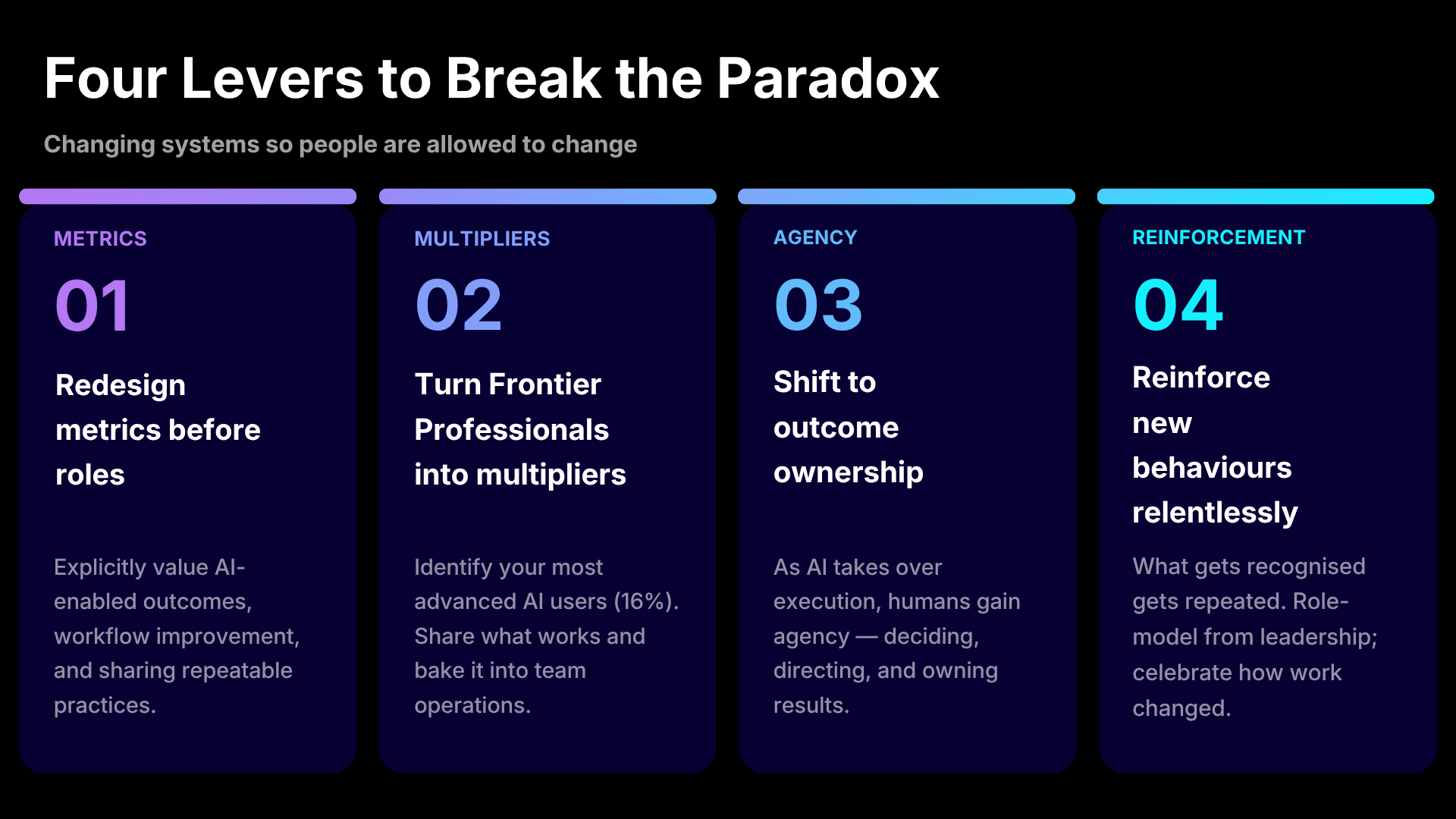
The Transformation Paradox is valuable because it gives leaders a clear diagnosis. Employees are not holding the organization back; most are waiting for clearer permission, better structure, and consistent reinforcement to move forward. Organizations that break through understand one simple truth: AI transformation is not about changing people faster, but about changing systems so people are allowed to change. This is where strong change management (grounded in ADKAR, aligned incentives, and redesigned work) ceases to be a support function and becomes a strategic advantage. In my role as AI Adoption Lead, this is exactly the work I do: closing the paradox by turning new ways of working into tangible, repeatable building blocks that teams can adopt, adapt, and scale. The call to action for leaders is clear: stop pushing adoption harder (or simply viewing it as a Knowledge and Desire problem) and start designing the systems that allow it to happen, consistently, responsibly, and at scale.
Written by: Odile de Jong


Unlock exclusive insights and stay ahead in the digital world. No spam, only useful content.