Back to Blog
AI Literacy is the Crucial First Step to Becoming a Frontier Firm

May 5, 2026
•
AI Adoption


In the 1980s, every office worker had to learn to type. In the 2000s, they had to learn to use a computer. The next decade's expectation? Knowing how to work alongside AI.
Most of us have been using AI tools for a couple of years now. They've become familiar parts of the working day. We use them to draft emails, summarise documents, brainstorm ideas. Individually, that part has largely happened.
But there's a significant difference between individuals using AI and an organisation that has truly adapted to it. The first is a habit. The second is a transformation and adoption.
Most businesses are still stuck in the first phase, a collection of people using AI tools in their own ways, for their own tasks, without any shared framework for how it fits into the way the company actually works. That's not nothing. But it's also not enough. And the gap between where most organisations are today and where the leading ones are heading is growing wider every quarter.
That destination has a name: the Frontier Firm, a next-generation organisation that blends human judgment with AI agents to scale faster, make smarter decisions, and deliver more value. And the bridge that gets you there starts with AI literacy.
AI literacy is one of those phrases that risks meaning everything and nothing. It's not the ability to build a neural network. It's not understanding transformer architecture. And it's definitely not just knowing how to type a prompt into ChatGPT.
True AI literacy is a layered capability, a ladder that begins with awareness and ascends all the way to genuine strategic fluency. Think of it like driving. You don't need to know how an engine works to be a good driver, but you do need to understand the rules of the road, how to read the conditions, and when to hand control to someone else.
The US Department of Labor published its AI Literacy Framework in February 2026, defining five foundational content areas that every worker needs to develop.
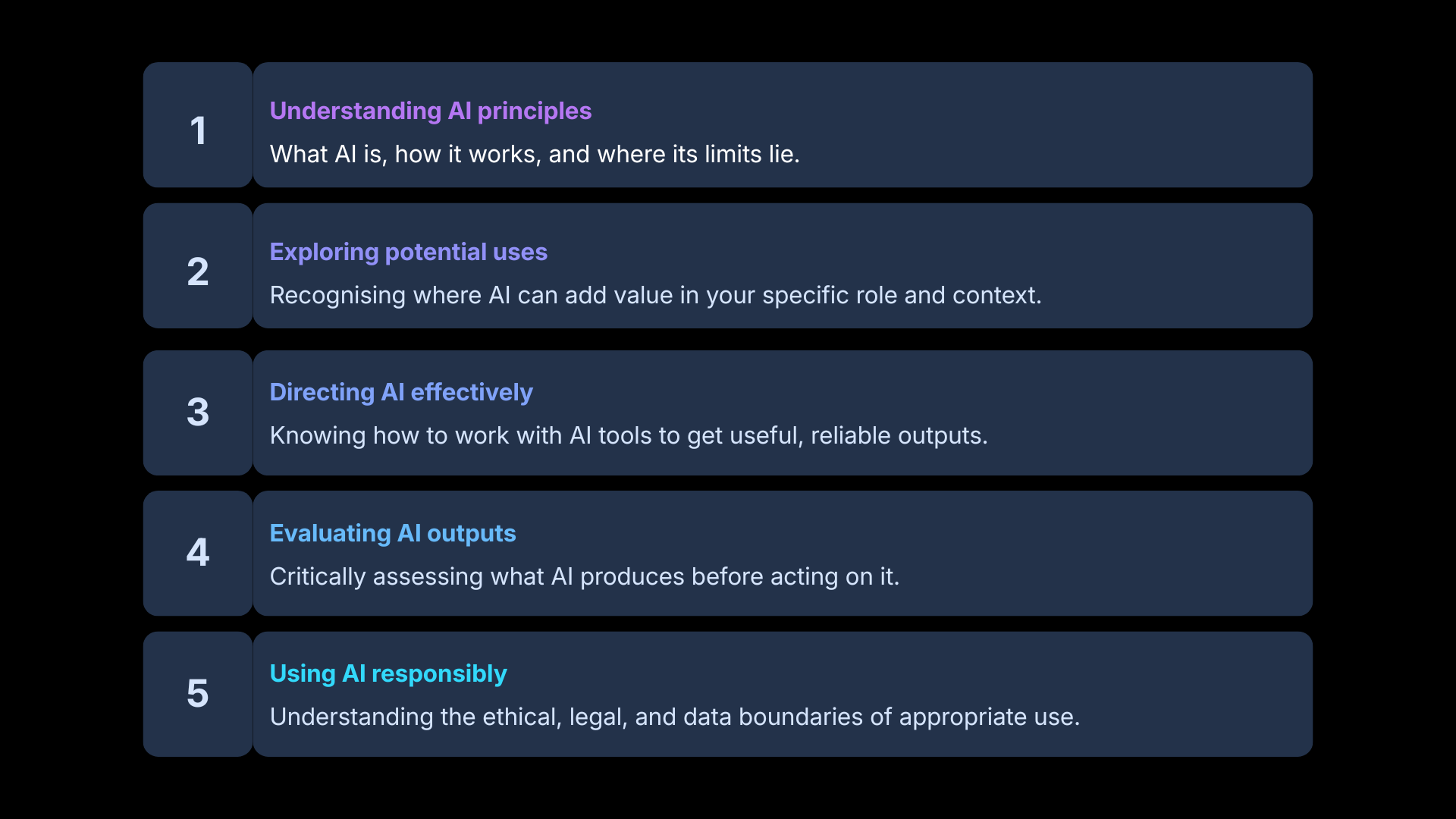
These aren't just nice-to-haves. Since February 2025, the EU AI Act has made a sufficient level of AI literacy a legal requirement for any organisation operating in Europe that uses AI systems, which, at this point, is nearly every organisation. The DOL framework provides the roadmap; the EU AI Act makes it mandatory.
Most organisations currently have pockets of the first two areas covered. The Frontier Firms Microsoft describes? They're building systematically across all five and beyond, into the kind of strategic fluency that lets entire workforces direct and oversee AI agents, not just use individual tools.
Microsoft's concept of the Frontier Firm introduced with real clarity at Ignite 2025, is perhaps the most useful frame yet for what AI-mature organisations actually look like in practice
A Frontier Firm isn't simply a company that uses a lot of AI tools. It's an organisation where the relationship between humans and AI agents has been fundamentally rethought. The defining phrase from Microsoft's Chief Partner Officer Nicole Dezen says it plainly: Frontier Firms are "human-led and agent-operated."
In practice AI is embedded across an average of seven business functions, not confined to a single team or pilot. Entire workflows are redesigned around human and AI working in tandem. Every employee is augmented with an AI assistant. And agents handle the repetitive, data-heavy cognitive work that previously consumed enormous amounts of human time and energy.
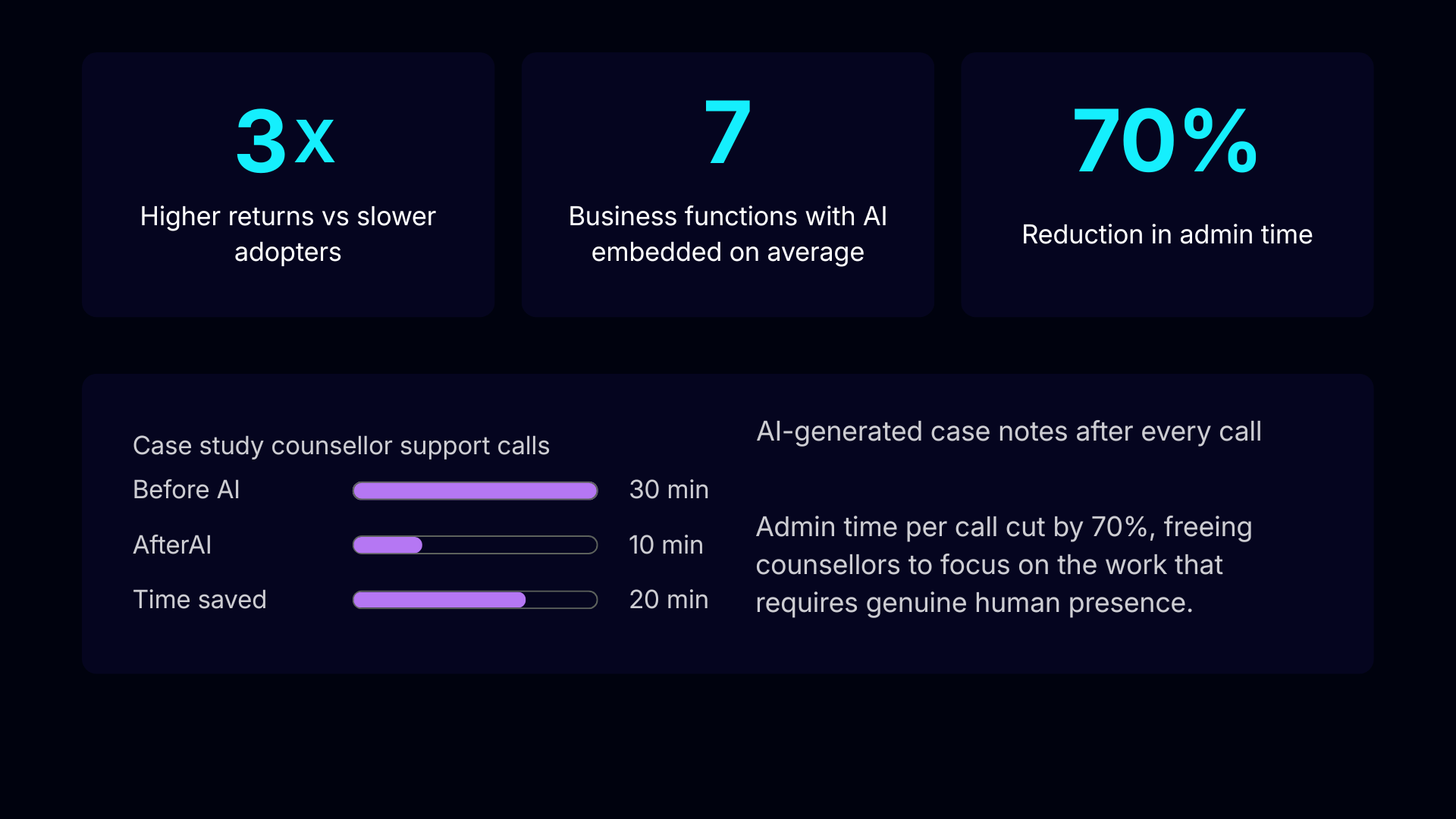
What's striking about the Frontier Firm model is that it makes the human dimension central, not peripheral. The competitive advantage isn't just having better agents, it's having people who know how to work with those agents. The technology is increasingly commoditised. The literacy is not.
Most organisations have individuals who use AI well. Very few have built an organisation that uses AI well. That's the gap worth closing.
That's not a criticism, it's just where most businesses are right now. The individual adoption phase happened fast and organically. People found tools that helped them and started using them. What hasn't happened yet, in most organisations, is the deliberate work of turning that individual behaviour into something structural: shared frameworks, redesigned workflows, clear governance, and the kind of collective AI literacy that lets an organisation move as one rather than as a hundred people doing their own thing.
The US Department of Labor's 2026 AI Literacy Framework captured it well: AI literacy cannot be a one-time event. It has to be a sustained, evolving capability, built through hands-on experience, not abstract training
Think about what agentic AI actually requires from the humans working alongside it. An agent isn't a search engine, you don't just ask it a question and evaluate an answer. An agent has goals, takes actions, and makes decisions across extended sequences of work. Directing one well requires a specific and learnable set of human capabilities.
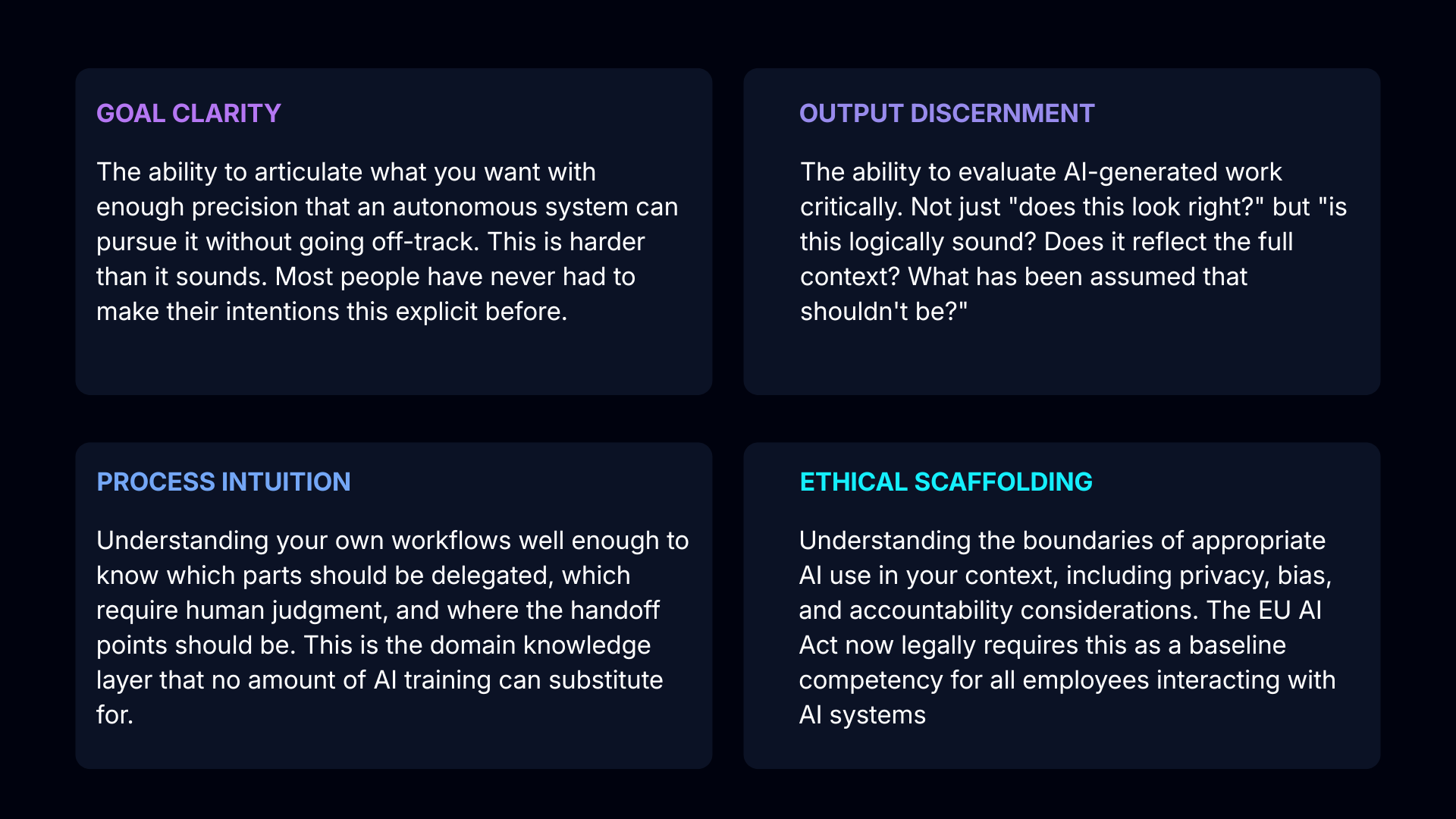
These aren't abstract qualities. They're trainable, measurable, and critically, they're what separates an organisation that uses agents effectively from one that deploys them well.
The good news is that AI literacy is learnable.
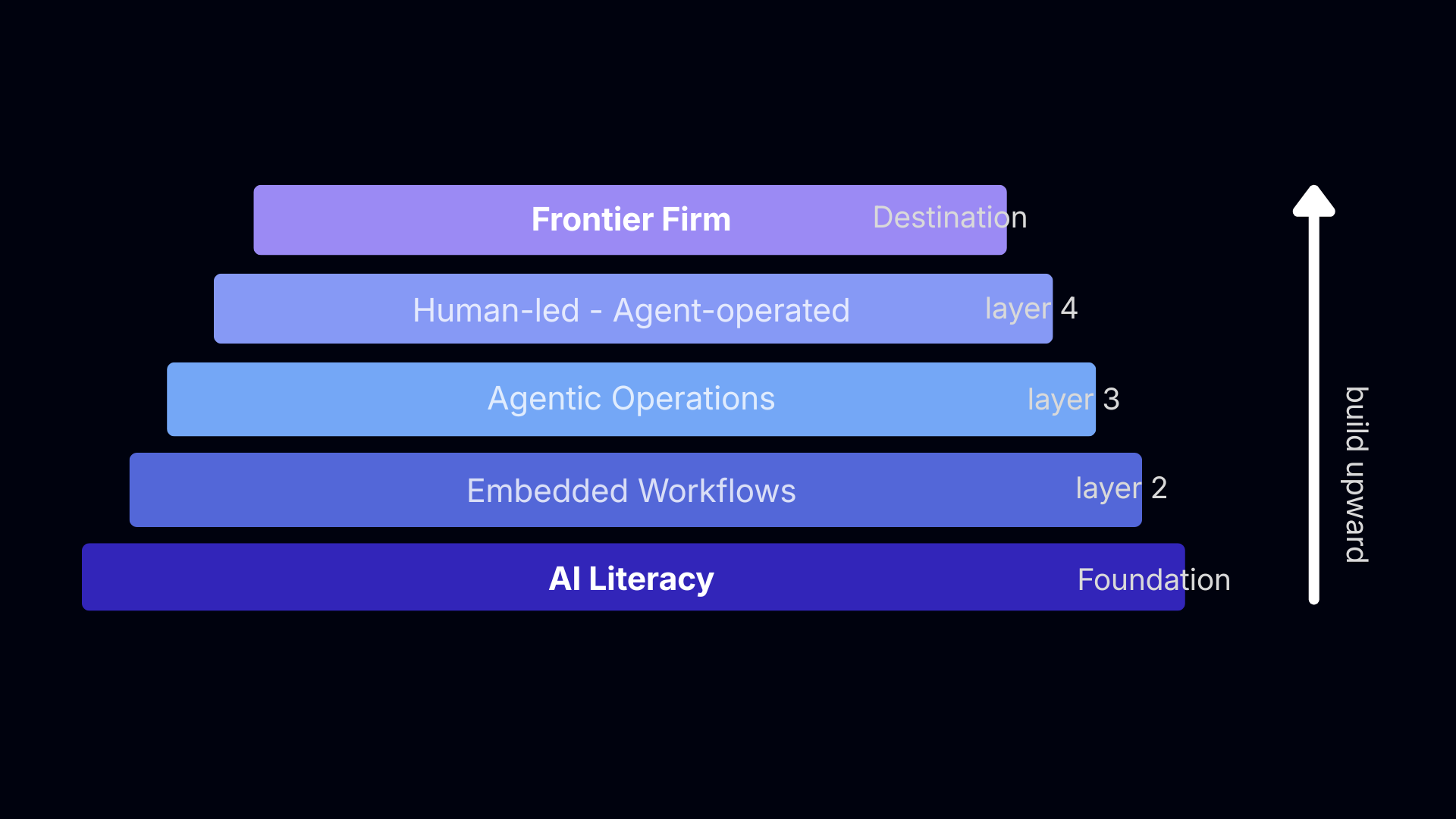
Think of it like a building. AI literacy is the foundation layer. You can stack technology, agents, and automation on top, but if the foundation isn't solid, everything above it becomes unstable. Organisations that skip this step and jump straight to deploying AI tools are building on sand. The capability looks impressive until the cracks appear. Outputs that go unchecked, workflows that break down, people who don't trust the technology they're supposed to rely on.
Get the foundation right, and everything else becomes possible. AI literacy is what allows your organisation to move from individual tool use to embedded workflows, from embedded workflows to autonomous agents, and from autonomous agents to the kind of human-led, agent-operated business that defines a Frontier Firm. Each layer depends on the one beneath it. And the bottom layer is always people who genuinely understand what they're working with.
At Digital Bricks, our AI literacy training programmes are designed to build that first layer properly so it can carry the weight of everything that comes after.
This is the foundation. Without it, the rest collapses.
The individual adoption phase is done. Most people in your organisation have already found their own way into AI tools, there's familiarity, curiosity, and genuine appetite. That's actually a strong foundation to build on.
What comes next is the organisational layer. Turning individual habits into collective capability. Building the shared frameworks, the redesigned workflows, and the AI literacy infrastructure that lets your organisation move as one, not just as a group of individuals who happen to use AI.
That shift doesn't require starting from scratch. It requires intention, structure, and a clear-eyed view of where your organisation sits on the literacy spectrum today and where it needs to go. Becoming a Frontier Firm isn't about technology procurement.


Unlock exclusive insights and stay ahead in the digital world. No spam, only useful content.