Back to Blog
What Really Is AI Literacy?

December 9, 2025
•
Learning
.png)

It is unlikely you havent heard the term “AI literacy” in the last 12 months. But very often it’s misunderstood. Some imagine it’s simply a jargon-heavy tech course. They may think it means everyone learned to write the perfect ChatGPT prompt or knows a few AI acronyms. In reality, AI literacy is far more than trendy terminology or a one-off workshop. It is a deep understanding of what artificial intelligence truly is, what it can (and cannot) do, and how to use it wisely in everyday work.
Many see AI as almost magical – as if their laptop’s new chat tool is a smart genie granting wishes. But no genie, no matter how powerful, can replace human judgment. A core misconception is that AI works like human intelligence. In truth, the “A” in AI is for “artificial.” These systems don’t think or reason the way we do; they use statistics and pattern recognition. Understanding that difference is the first step in becoming AI-literate. Only by stripping away the mystique can organisations start treating AI as the powerful tool it is, rather than some mysterious wizardry they only half-trust.
Too many companies make the mistake of equating AI literacy with the latest buzz. They send staff to flashy seminars, let them play with chatbots for an hour, and assume the job is done. Others treat AI literacy like basic digital literacy – something only tech teams need, not the marketing manager or HR director. Yet another myth is that AI literacy is optional or a passing fad that doesn’t affect day-to-day business.
.png)
In fact, not understanding AI can become a serious liability. Employees who think of AI as always reliable often accept its outputs at face value, which can lead to embarrassing errors or misjudgments. On the other hand, those who fear AI might ignore tools that could streamline their work. The truth is that AI literacy means empowering people across the organisation. It means equipping everyone – from interns to CEOs – with a clear idea of what AI is and isn’t, how it behaves, and where it fits into their roles.
For example, consider the simple question: What is a “model”? In AI-speak, a model is just a set of mathematical patterns trained on data. Explaining this – that a chatbot or image classifier is powered by a model, not a mini genius – helps demystify the technology. Or take “LLM,” short for large language model, which drives many modern text tools: it’s just an AI model trained on huge amounts of text. Teaching these basics dispels myths that AI is consciously creative or infallible. In short, true AI literacy starts by clearing the fog and showing that AI, at its core, is artificial, meaning man-made, rule-based, and driven by data.
Beyond myths and hype, there is now a legal side to AI literacy, at least in Europe. The EU’s new Artificial Intelligence Act – a landmark regulation coming into effect on 2 February 2025 – explicitly requires organisations to take “suitable measures” to ensure their people have sufficient AI literacy. Article 4 of the Act applies to anyone providing or deploying AI systems. In plain language, it means if your company uses any AI tools or systems (from chatbots to predictive models), you must train your staff to use them responsibly.
.png)
The Act itself defines AI literacy as the knowledge and understanding needed to deploy AI systems in an informed way. It’s not just about knowing how to click buttons; it’s also about being aware of AI’s opportunities and risks. Recital 20 of the law even suggests that AI literacy should cover everyone affected by AI – which could mean communicating clearly with customers or partners about how AI is used. While the regulation does not slap a specific fine on companies for lacking AI literacy, regulators will consider it when enforcing other rules. In other words, failing to educate your team on AI could be seen as negligence if something goes wrong.
For organisations in Europe, and those who do business with European partners, this is a wake-up call. But even outside the EU, smart companies will take notice. This isn’t just bureaucratic red tape; it’s a recognition that AI touches everything. Whether or not a law forces your hand, building AI literacy is quickly becoming an international best practice.
Actually, whether you’re inside Europe or not, AI literacy is a strategic necessity. Leaders who ignore it risk falling behind. We are seeing companies around the world rush to adopt AI tools – from customer-service bots to automated analytics – hoping for efficiency gains. Yet many are finding that technology alone isn’t enough. Without well-informed teams, AI initiatives can falter. Research and real-world experience show that “shadow AI” often emerges: employees start using AI tools unofficially because official channels are too slow or non-existent. This can create security and compliance nightmares if no one is checking what data is fed to these tools.
On the flip side, organisations with a strong foundation in AI literacy flourish. When people understand AI’s strengths, they start spotting valuable use cases in their daily work. For instance, a finance analyst who knows how generative AI works might use it to quickly draft reports, then polish them with their expertise – saving hours. A product manager aware of AI’s limitations can smartly combine human creativity with AI automation, rather than expecting the tool to do all the innovation. This kind of bottom-up innovation only happens when a broad range of employees know enough about AI to experiment with it.
.png)
Microsoft’s research on the Frontier Firm illustrates this well. These frontier organisations deploy AI widely and even use AI agents (more on that below) as part of normal business. They report much higher productivity and more optimistic staff attitudes than others. Crucially, staff at these firms don’t fear AI taking their jobs; they see AI as empowering their work. This confidence comes from having been educated about AI early on. In short, companies that treat AI literacy as a priority become industry leaders, while those that don’t risk having their AI investments wasted or even causing harm.
So what does being “AI literate” actually look like in practice? We at Digital Bricks think of it in four intertwined dimensions: Engage, Create, Understand, and Manage. Together, these build a solid grasp of AI at every level of an organisation.
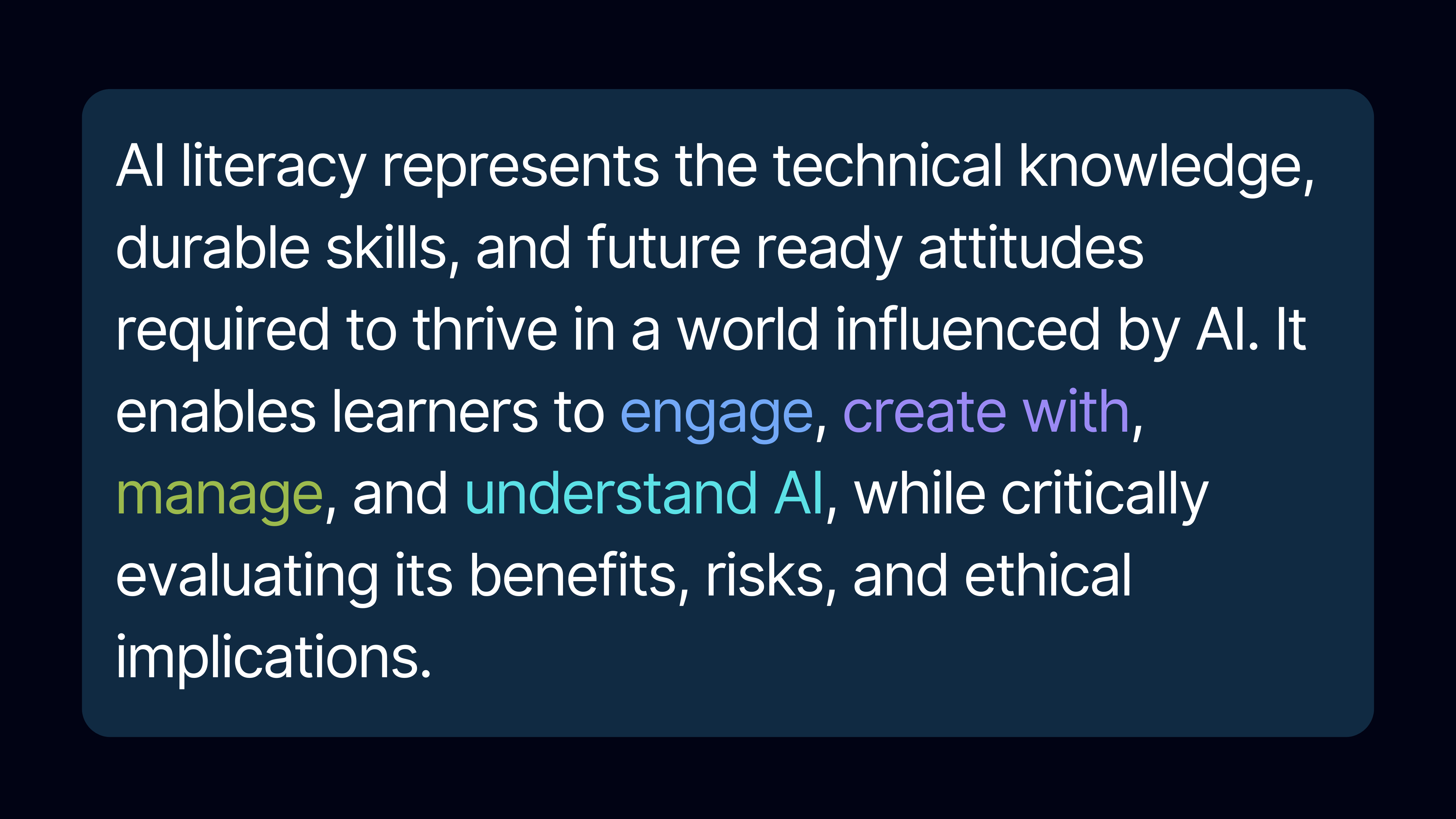
AI literacy starts with engagement. Everyone should become comfortable with basic concepts and vocabulary, not just IT specialists. Staff need to know what AI is – and equally important, what it is not. This means understanding that AI stands for artificial intelligence: systems created by humans and data, not living minds. For example, explaining that ChatGPT is powered by an “LLM” (large language model) – essentially a statistical engine trained on text – helps dissolve the idea that AI “thinks” like a person. People should know that AI excels at pattern recognition. It can spot trends in data or predict likely word sequences, but it doesn’t have awareness or intentions.
This foundational step also involves learning the common terms. What is a model? (It’s essentially the formula or algorithm behind AI.) What is a prompt? (Instructions or questions that guide an AI’s response.) Gaining familiarity with these words empowers staff to discuss AI intelligently. It means they can ask good questions, like “Is this answer based on facts or guesswork?” Engagement is about replacing mystery with clarity – showing that AI is powerful but fully within the realm of technology, not magic.
Once people understand the basics, the next step is learning to create with AI. In today’s workplace, that often means using generative AI tools to produce content, ideas, or solutions. Here, prompt engineering becomes a key skill. That doesn’t mean writing complex code, but rather learning how to ask the AI in clear, effective ways. A well-crafted prompt can mean the difference between a useless AI answer and a helpful one. For example, telling an AI assistant, “Summarise this report for a busy executive in bullet points” yields a very different result from a vague request like “Summarise this.” Teaching staff how to iterate on prompts – try different phrasings, give examples, refine questions – unlocks much of AI’s value.
But creating with AI is only half the story. Crucially, employees must also critically evaluate the outputs. AI hallucinations – confident, fluent-sounding but incorrect or misleading answers – are a real problem. An AI might invent dates, misinterpret data, or produce biased suggestions if it is not carefully guided. AI-literate staff know to treat AI outputs as first drafts, not final products. They learn to fact-check, to ask “Does this look right?” and to use human judgement to correct and improve the AI’s work. In practice, that might mean having a person proofread AI-generated text, reviewing AI-suggested code for errors, or running generated answers by a subject matter expert. Additionally, AI literacy covers awareness of responsible use in content creation. For instance, using AI for marketing copy might raise questions about originality or compliance. Well-informed teams consider copyright issues, bias in training data, and the ethical tone of what the AI produces. In short, creating with AI is a dance of partnership: staff should learn to guide AI tools and then oversee them, ensuring the end result meets human standards of quality and ethics.
For deeper confidence, organisations should help staff understand what happens under the hood. This does not require technical mastery of algorithms, but rather an intuitive sense of AI mechanics. People should appreciate that AI outputs come from data. If the input data is flawed, the results will be too. For example, if an AI is trained mainly on English data, it might struggle with other languages. If the training data has biases (say, under-representing women or minorities), the AI’s suggestions can reflect those biases. Understanding this link encourages staff to think carefully about data sources and questions of fairness or accuracy.
Another part of understanding is grasping the limits of AI. For instance, large language models like those behind chatbots often have knowledge up to a certain date and may confidently make things up about events beyond their training. Knowing that helps users avoid embarrassing mistakes like citing a fake CEO quote or a bogus statistic. Moreover, as AI often relies on large computation, small tweaks (like asking an AI to explain its reasoning) might not always work – knowing these quirks prevents frustration.
Ultimately, understanding AI means demystifying it further: people learn that AI systems use layers of mathematics to find patterns and generate answers, and that those answers are only as reliable as the system’s design and data allow. This knowledge helps them set realistic expectations. It also highlights why ongoing learning matters: AI technology evolves rapidly, and a truly literate workforce keeps up with how models improve and what new capabilities emerge.
Finally, AI literacy includes managing AI within the organisation. This is about strategy and responsibility: deciding where and how AI tools should be used. AI-literate teams learn not to offload every task to AI. They determine which tasks suit AI automation (such as sorting documents, processing routine inquiries, or analyzing large datasets) and which require human skills (like creative strategy, nuanced negotiation, or complex ethical judgements). Management of AI also means maintaining human oversight at the critical points. In practice, this could involve setting up processes like “always have a human review any AI-assisted financial decision” or “document every prompt and answer used for official content.” It also means guarding against over-reliance: ensuring employees don’t become complacent and trust AI blindly. Instead, AI literacy reinforces that the human team is always ultimately in charge.
Moreover, this pillar covers governance practices. Literate organisations will establish guidelines: who can use which AI tools, for what purposes, and how to protect sensitive data. They might keep audit logs of AI usage to review later. Everyone learns the value of retaining critical thinking and domain knowledge: for instance, a doctor knows that an AI might help with patient research, but the final diagnosis must come from human expertise.
In short, managing AI is about balance. It recognizes that AI is a powerful assistant, but it stays clear that AI is not sentient or infallible. Staff with good AI literacy understand their role as supervisors of these tools. They know that even as AI takes on more tasks, people’s creativity, judgement, and values drive the business forward.
Taken together, these components – engaging, creating, understanding, managing – define what we at Digital Bricks call AI literacy. They might sound basic, but mastering them transforms AI from a mystery into a set of capabilities every employee can wield.
Once the groundwork of AI literacy is laid, innovation naturally follows. With these skills in place, employees start noticing opportunities all around them. When teams know what AI can do, they generate ideas from the bottom up: a customer support specialist might propose using an AI bot to answer common queries, an operations analyst might automate inventory checks with machine learning, a designer might co-create visuals with generative models. These use cases emerge organically because people think in AI terms, rather than being told to find ways to use a new tool.
This bottom-up approach avoids one of the classic pitfalls: waiting for some grand AI strategy to come from on high. Instead, individual departments test and iterate on AI applications relevant to their work. Management can then guide the best ideas to scale, knowing they were born from practical need. The result is faster adoption and real productivity gains, rather than the poor adoption rates and wasted pilots that happen when people lack the skills to use AI properly.
Looking further ahead, the concept of AI literacy extends to emerging trends like agentic AI. Microsoft and others talk about a future of “Frontier Firms” where AI agents – specialized autonomous programs – do much of the routine work. In such a world, employees become “directors” of teams of digital workers. For example, imagine a project manager who hands off a research task to one AI agent, asks another to compile data, and uses a third to draft a presentation, all under their coordination. This vision can only become real if people first understand the fundamentals of AI. After all, to manage a fleet of AI agents effectively, you need to know what those agents are capable of, what limits they have, and when they need a human’s guidance. In short, AI literacy today is the stepping stone to the agent-driven workplaces of tomorrow.
.png)
Building this level of AI literacy might sound daunting, but there is help available. Practical, tailored training is key, and it’s not enough to just buy a standard “AI course” and hope everyone absorbs it. That’s where focused education comes in. At Digital Bricks, we offer structured AI literacy programmes designed for all kinds of roles. We run on-site workshops where employees learn by doing – for example, practising prompt engineering exercises relevant to their field – and we also provide e-learning modules for self-paced study.
These programs cover everything from the basics (what is AI, how do I start a conversation with a chatbot?) to advanced topics (how to spot and correct an AI hallucination, how to assess the quality of AI data). Importantly, we align the training with each organisation’s context: the tools they use, the industry they’re in, and the challenges they face. By the end, staff don’t just have textbook knowledge; they have hands-on confidence to engage with AI in their daily work.
Whether your business is just starting its AI journey or looking to deepen its capabilities, embedding AI literacy through training is a smart strategy. It ensures you meet regulatory expectations like the EU’s Article 4, certainly, but more importantly it means your people gain the skills to turn AI into a genuine asset. When employees feel confident about AI, they not only adopt it faster – they also do so responsibly, in line with company values and governance.
In the age of artificial intelligence, literacy isn’t a luxury – it’s a foundation. For leaders, investing in AI literacy means preparing the workforce for change, protecting the organisation from avoidable mistakes, and unlocking new avenues of innovation. It means recognising that behind every AI tool are human users and decision-makers, and those humans must be equipped for the task. AI literacy training – whether through in-person workshops or engaging e-learning – builds this foundation. It turns curiosity into competence and uncertainty into clarity. Ultimately, a literate organization is one where technology augments human talent, rather than mystifies it. As AI continues to reshape industries, teams that understand and manage it wisely will have the winning edge. In other words, AI literacy is not just about keeping up; it’s about leading the way into the future.


Unlock exclusive insights and stay ahead in the digital world. No spam, only useful content.